|
Related
Species:
Mapighia punicifolia has been renamed M. emarginata by recent authorities.
Distant affinity:
Ciruela del Monte (Bunchosia argentea), Ciruela Verde (Bunchosia armeniaca), Nance (Byrsonima crassifolia)
Adaptation:
The acerola is typically found in dry, thorn-woodlands
as a deciduous tree. It grows in San Diego County, coastal Southern
California and in more extreme areas with protection. There are
trees in Riverside, Calif. and San Bernardino County. In general,
acerola has poor cold tolerance, with young plants typically killed
at temperatures below 30° F. Trees can survive brief exposure to
28° F with loss of leaves. Trees are sensitive to wind (shallow
root systems). The acerola is drought tolerant, and will adopt a
deciduous habit; irrigation results in leaf and flower flush. Plants
can easily adapt to pot culture in
well-draining, limed soil.
DESCRIPTION
Growth Habit:Large, relatively
fast growing bushy shrub or small tree (to 15 feet). Can be pruned
to any desired shape, but grows best as a managed shrub. Multiple
or single trunks which can be trained. Occasionally, bushes appear
to be composed of canes. Branches are brittle, and easily broken.
Leaves may be irritating to some people. The root system is shallow,
and trees can be toppled by wind, but they can be uprighted and
recover over time.
Foliage: Acerola leaves are dark
to light green, glossy when mature, obviate to lanceolate, with
minute hairs which can be irritating. Foliage will drop during water
stress, but recovers well with flush and flowering.
Flowers: The flowers are sessile
or on short-peduncled cymes, with small pink to white flowers with
five petals. Up to 90% of flowers fall from tree, but "Blossom Set"
can be used to counter this effect. Flowering can occur throughout
the year, but is typically in cycles associated with rain. Irrigation
can be used to induce flowering. Flowering occurs primarily on old
growth. Pollination rarely observed, but thought to be by the solitary
bee, Centris. Honeybees do not appear effective (contested). Cross-pollination
may or may not be required depending on variety or strain (contested).
In available cultivars, fruit does set without obvious pollinators
or need for cross-pollination.
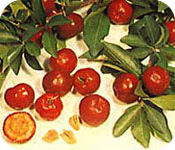
Fruit:Fruits are round to oblate,
cherry-like but with 3 lobes. They are bright red (rarely yellow-orange)
with thin skin, easily bruised. The pulp is juicy, acid to sub-acid
occasionally nearly sweet, with a delicate flavor and apple notes.
The fruit is very high in Vitamin C, up to 4,000 mg per 100 g fresh
weight, but typically around 1,500 mg C. Green fruits have twice
the Vitamin C level of mature fruits. Fruits develop to maturity
in less than 25 days. Seeds typically three with fluted wings, forming
a triangle. Many aspects of seed viability have not been studied.
CULTURE
Location: The plant prefers full
sun for fruit development, giving rise to the problem of winter
protection in harsher climates. Shaded trees fruit, but at reduced
fruit densities, and the plants themselves become somewhat spindly.
Due to its shallow and smaller root system, acerola can be interplanted
with other crops more closely than many trees.
Soil: Acerolas grows in marl, limestone,
clay and other heavy soils as long as it drains well; waterlogging
of roots will cause plant death. Soil pH should be 6.5-7.5 as acid
soils do not promote vigorous growth. Liming of trees and working
into the soil is a common practice and necessary for high productivity.
Irrigation: The acerola does best
with 1000-2000 mm of water. However, as mentioned, acerola is drought-tolerant.
Irrigation can be used to cause flowering and can regulate flower
cycles. Under good constant irrigation, acerola will flower all
year, with between 1 and 3 flowering peaks. Acerola does well with
both overhead and drip irrigation.
Fertilization: Acerolas requires
a good, balanced fertilization schedule, and regular (once a year)
liming of soil. Foliar sprays are very effective, and are used commercially.
Mineral nutrition is very important, with good levels of boron and
iron required.
Pruning: The plant will tolerate
heavy pruning, but requires time for recovery. In more tropical
areas, plants do not seem overly affected by pruning. Plants are
pruned commercially with citrus pruners. Can be kept as a small
bush (e.g. 5 ft) and will produce well.
Frost Protection:As with most
frost-sensitive plants, the acerola will need some protection when
grown in areas were frost can occur. Growing with overhead protection
or growing next to a wall or building may be sufficient, but the
plant may also be covered with heavy cloth or plastic sheeting draped
over a frame for added protection. Container grown plants can be
moved too a frost secure area.
Propagation:
Acerolas can be propagated by seed, cutting, grafting, and other
standard methods. The plant does not appear stringent in its requirements.
Seed viability can be very low; in some groves, seedlings are never
observed. Cuttings are considered the simplest method of propagation
and, with the use standard IBA hormone, give near 100% success rates.
Grafting onto rootstocks has not been systematically studied, although
grafts onto Byrsonima crassifolia rootstock have been successful.
Pests and Disease: The Acerola
is susceptible to root-knot nematode (Meloidogyne spp.) which causes
serious problems with young trees and slower losses of productivity
in older trees. It is also attacked by a variety of common insects,
such as aphids, whitefly and scale. In other areas of the world
(Mexico, Caribbean) weevils (Anthonomus spp.) are serious pests,
and can limit fruit production. In tropical areas, Cercospora fungi
can be a major cause disease.
Harvest: The fruit deteriorates
rapidly once removed from tree; sensory differences can be noted
within 4 hours. The fruit undergoes rapid fermentation, and is typically
unusable by 3-5 days. Unrefrigerated fruit develops mold quickly
The best uses are direct eating, jams and jellies, and syrups. Juices,
which are popular in Brazil, do not hold their sensory characteristics
for extended periods. The fruit has also been used for baby food,
as a supplement source for Vitamin C, as an ice cream and pop-sickle
ingredient, and in many home recipes. Frozen fruit falls apart when
thawed. In the tropics, there are typically 3 harvest periods per
year. In more temperate areas, one and possibly 2 harvests occur.
With regular irrigation, some fruit production may occur through
much of the year. Eight year old trees can yield from 30 to 60 pounds
of fruit. From seed, plant can fruit in the 2nd or 3rd year; cuttings
may fruit in the first year. Productivity increases over a 15 to
20 year period, and then levels or declines. Forty year old productive
trees are known in southern Florida.
Commercial Potential: Plantings
of acerola are increasing worldwide, with Brazil leading the way.
The increased plantings are a direct result of increased use of
acerola for a natural source of Vitamin C for nutritional supplements.
CULTIVARS
B-17 A common variety. High in vitamin C and subacid to acid.
Dwarf A low-growing cultivar, to
about 2 ft. tall. Grows well in a hanging basket. Can take colder
weather than others, to 22° F.
Florida Sweet A common California
variety. Fruit large, 1-1/4 inches in diameter. Skin thick. Flesh
very juicy, flavor applelike, semisweet. Vitamin C content about
1,500 to 2,000 mg. per 100 g. Tree erect, with open-type growth
and outstanding yields. Originated in Homestead, FL by the Florida
Sub-Tropical Engineering Station.
Manoa Sweet Orange-red fruit of
the sweet type. Tree upright, spreading, very productive. Originated
in Honolulu, HA by Henry Y. Nakasone, University of Hawaii. Introduced
in 1963.
Other named varieties include: Beaumont, Haley, Hawaiian Queen,
Maunawili, Red Jumbo, Rehnborg and Tropical Ruby. Varieties other
than B-17 and Florida Sweet are not often encountered in Southern
California, although several are now available from Pacific Tree
Farms, Chula Vista, CA.
|
|
|
AVAILABLE FROM:
Alan's Tropical Fruit Trees
Largo, FL
California Tropical Fruit Tree Nursery
Vista, CA
Exotica Nursery Inc.
Vista, CA
Green Mart
Orange, CA
Jene's Tropicals
St. Petersburg, FL
Ong Nursery
San Diego, CA
Pacific Tree Farms
Chula Vista, CA
Papaya Tree Nursery
Grenada Hills, CA
Ben Poirier
Fallbrook, CA
Tropical Oasis Farms
Cucamonga, CA
Montoso Gardens
Maricao, Puerto Rico
|
|