|
Related
Species:
Bilimbi ( Averrhoa bilimbi L.).
Adaptation:
The carambola is classified as subtropical
because mature trees can tolerate temperatures as low as 27° F for
short periods of time with little damage. Like many other subtropicals,
however, young plants are more susceptible to frost and can be killed
at 32° F. Carambolas can be severely damaged by flooding or prevailing
hot, dry winds. The small trees make good container plants.
DESCRIPTION
Growth Habit: The carambola is
a slow-growing, short-trunked evergreen tree with a much-branched,
bushy canopy that is broad and rounded. Mature trees seldom exceed
25-30 feet in height and 20-25 feet in spread. Trees are very unlikely
to reach this size in California. In a spot to its liking carambolas
make handsome ornamentals. Container grown plants are equally attractive
and have the additional advantage of being movable.
Foliage: The spirally arranged,
alternate leaves are 6 - 10 inches long, with 5 - 11 nearly opposite,
ovate-oblong leaflets that are 1-1/2 to 3-1/2 inches in length.
They are soft, medium-green, and smooth on the upper surface, faintly
hairy and whitish on the underside. The leaflets are sensitive to
light and more or less inclined to to fold together at night or
when the tree is shaken or abruptly shocked.
Flowers: The fragrant, pink to
lavender flowers are 3/8 inch in diameter, perfect, and borne in
clusters in axils of leaves on young branches, or on older branches
without leaves. There are several flushes of bloom throughout the
year.
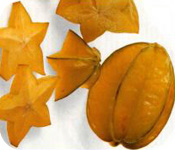
Fruit: Carambola fruits are ovate
to ellipsoid, 2-1/2 to 5 inches (6 to 13 cm) in length, with 5 (rarely
4 or 6) prominent longitudinal ribs. Slices cut in cross-section
are star shaped. The skin is thin, light to dark yellow and smooth
with a waxy cuticle. The flesh is light yellow to yellow, translucent,
crisp and very juicy, without fiber. The fruit has a more or less
oxalic acid odor and the flavor ranges from very sour to mildly
sweet. The so-called sweet types rarely have more than 4% sugar.
There may be up to 12 flat, thin brown seeds 1/4 - 1/2 inch long
or none at all. Seeds lose viability in a few days after removal
from fruit.
CULTURE
Location: Carambolas do best in a frost-free location.
They are tolerant of wind except for those that are hot and dry.
The tree needs full sun. Soils: The carambola is not too particular
as to soil, but will grow faster and bear more heavily in rich loam.
It prefers a moderately acid soil (pH 5.5 - 6.5) and is sensitive
to waterlogging. The plant often becomes chlorotic in alkaline soils.
Irrigation: The carambola need moisture for best performance. This
means regular watering during the summer months and must be watered
even in winter during dry spells.
Fertilization: In soils of low
fertility young trees should receive light applications every 60
to 90 days until well established. Thereafter, they should receive
one or two applications a year in deep soils or three or more applications
in shallow soils where nutrients are lost by leaching. Application
at the rate of 2 lbs per year for every inch of trunk diameter is
suggested. Fertilizer mixtures containing 6-8% nitrogen, 2-4% available
phosphoric acid, 6-8% potash and 3-4% magnesium are satisfactory.
In the more fertile soils of California, this program can be reduced.
The tree is prone to chlorosis in many western soils but responds
to soil and foliar application of chelated iron and other micronutrients.
Frost Protection: Since it is a small tree, winter protection can
be fairly easily given prior to any anticipated cold spell. Carpeting,
sheets and such can be spread over a frame, with light bulbs for
added warmth.
Pruning: Carambolas seldom need pruning. Pests and
Diseases: No serious diseases are known to be of sufficient importance
to require control measures. The fruit is subject to fruit fly,
fruit moths and fruit spotting bugs in those areas having these
infestations.
Propagation: The carambola is widely grown from seed
though viability lasts only a few days. Only plump, fully developed
seed should be planted. Veneer grafting during the time of most
active growth gives the best results. Healthy, year-old seedlings
of 3/8 - 3/4 inch diameter are best for rootstocks. Graft-wood should
be taken from mature twigs on which leaves are still present and,
if possible, the buds are just beginning to grow. Cleft-grafting
of green budwood is also successful. Top-working of older trees
has been done by bark grafting. Air-layering is less successful
than grafting. The roots develop slowly, and percentage of success
often is low. Trees are small and rather weak when propagated by
this method.
Harvest: Fruit best when ripened on the tree, but will
ripen slowly if picked before fully ripe. Green or ripe fruits are
easily damaged and must be handled with great care. Ripe carambolas
are eaten out-of-hand, sliced and served in salads or used as a
garnish. They are also cooked in puddings, tarts, stews and curries.
CULTIVARS Several carambola varieties
are sold in California nurseries, but sufficient data on these has
not been gathered, nor has adequate testing been done in California
to recommend any particular cultivar for planting. There are a number
of excellent carambola varieties available in Florida, including
the following:
Arkin Uniform fruit, 4 - 5 inches
long. Bright yellow to yellow-orange skin and flesh. Very sweet,
juicy, firm flesh with few seeds. Keeps and ships well. Tree partially
self-fertile. Bears December to March in California. The leading
commercial cultivar.
Fwang Tung Fruit 5 - 8 inches long.
Pale yellow skin and flesh. Very sweet and juicy, firm flesh with
few seeds. Beautiful star shape when cut in slices.
Golden Star Originated in Homestead
FL. Introduced in 1965. Large, deeply winged fruit. Skin bright
golden yellow. very waxy. Flesh juicy. crisp, mildly subacid to
sweet in flavor, containing no fibers. High in carbohydrates and
vitamins A and C. Tree bears well and regularly without cross pollination.
Hoku Selected by the University
of Hawaii. Fruit 5 - 6 inches long. Bright yellow skin and flesh.
Juicy, firm flesh with a sweet rich flavor, few seeds. Attractive
star shape when cut in slices.
Kaiang Fruit 4 - 5 inches long.
Bright yellow skin and flesh. Sweet, juicy, firm flesh with few
seeds. Beautiful star shape when cut in slices.
Maha Originated in Hawaii. Roundish
fruit with light yellowish-white skin. Sweet, crunchy, white flesh
with low acid content.
Sri Kembanqan (Kembangan) Originated
in Thailand. Elongated pointed fruit, 5 - 6 inches long. Bright
yellow-orange skin and flesh. Juicy, firm flesh with few seeds.
Flavor rich and sweet; excellent dessert quality.
Wheeler Medium to large, elongated
fruit. Orange skin and flesh. Mildly sweet flavor. Tree a heavy
bearer.
Thayer and Newcombe Two of the
better known tart varieties. |
|
|
AVAILABLE FROM:
Alan’s Tropical Fruit Trees
Largo, FL
J.D. Andersen Nursery
Fallbrook, CA
Atkins Nursery, Inc.
Fallbrook, CA
California Tropical Fruit Tree Nursery
Vista, CA
Exotica Nursery Inc.
Vista, CA
Green Mart
Orange, CA
Jene’s Tropicals
St Petersburg, FL
Laguna Hills Nursery
El Toro, CA
Roger & Shirley Meyer
Fountain Valley, CA
Ong Nursery
San Diego, CA
Oregon Exotics
Grants Pass, OR
Pacific Tree Farms
Chula Vista, CA
Papaya Tree Nursery
Granada Hills, CA
Ben Poirier
Fallbrook, CA
Tropical Oasis Farms
Cucamonga, CA
Pacific Tropical Gardens
Keau’au, Hawaii
Montoso Gardens
Maricao, Puerto Rico
|
|