|
|
|
|
|
Related
Species:
Thread Palm, Mexican Fan Palm (Washingtonia
robusta).
Adaptation:
The palms are extensively grown in many parts
of California and are common along the Gulf Coast and in Florida,
as well as in other parts of the world, particularly those with
Mediterranean-type climates. They are hardy to 18° F (USDA Zones 8-11).
DESCRIPTION
Growth Habits: The robust palms
grow at a moderate rate to about 50 feet with a large canopy of
several dozen leaves. The cylindrical, closely ringed and fissured
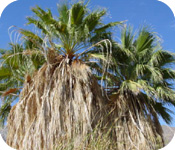
trunks are swollen at the base and covered with a "petticoat" of
dead, pendant leaf stalks, extending almost to the ground. The trees
are especially valuable as avenue plants, and are widely used as
such in southern California and Arizona. The also make handsome
specimens They are not a particularly good choice for container
culture because of their relatively fast rate of growth.
Foliage: The immense, fan-shaped,
costapalmate, grayish-green leaves are 3-4 feet long and 6-7 feet
wide, dividing about halfway into 50-70 pointed segments that bend
and split at the tips with threads in between. The leaves are edged
with prickles and stand well apart in an open crown.
Flowers:Numerous white to apricot,
bisexual flowers are borne on 9-15 foot arching, branched inflorescences
that hang down from among the leaves. Pollination is by wind and
various insects.
Fruit: The berry-like, small fruits
are brownish-black and have a thin, sweet pulp that tastes somewhat
like dates or butterscotch. Each fruit contains a single seed.
CULTURE
Location: California fan palms
are wind-tolerant and do best in a sunny location.
Soil:
The trees are widely adaptable to most soil conditions.
Irrigation: The palms are drought-tolerant
but appreciate some moisture. In native stands they always grow
near springs or other moist spots.
Fertilizing: The trees respond
to an occasional light fertilizing, particularly when young. Older
trees seem to do well without regular fertilizing.
Pruning:Cultivated trees usually
have the shag of dead leaves removed, since this can be a fire hazard
as well as a home to rats and mice. Older, untidy leaves are also
sometimes removed.
Propagation: Propagation is from
seed, which germinate in six weeks to two months.
Pests and Diseases: Major diseases
include phytophthora bud rot, pestalotiopsis and diamond scale fungus.
Harvest: The small fruits are harvested
when ripe and eaten fresh or dried, or made into jellies and drinks.
The seeds are also edible and were widely used by Native Americans
who ground them into meal for making bread or porridge. |
|
|
AVAILABLE FROM:
This fruit is not carried by any of our member nurseries.
|
|
|
|