|
Related
Species:
Clammy Ground Cherry (Physalis heterophylla), Tomatillo (P. ixocarpa), Purple Ground Cherry (P. philadelphica), Strawberry Tomato (P. pruinosa), Ground Cherry, Husk Tomato (P. pubescens), Sticky Ground Cherry (P. viscosa). There is considerable confusion in the literature concerning the various species. Hybrids between them are also known.
Distant affinity:
Tomato (Lycopersicon lycopsersicum), Wonderberry (Solanum X burbankii), Naranjilla (S. quitoense), Garden Huckleberry (S. scabrum) and others.
Adaptation:
The cape gooseberry is an annual in at temperate
regions and a perennial in the tropics. In the Andean regions of
South America it grows wild between 2,500 and 10,000 ft. The wild
range in Hawaii is 1,000 to 8,000 ft. The plants are frost tender
and are killed at temperatures of about 30° F. In much of California
the cape gooseberry is best grown as an annual, but will persist
for several years in frost-free areas of southern California. Some
California growers have grown seedling materials under glass during
the fall and winter and set out in early spring to gain the advantage
of the longest possible growing season.The plants are easily grown
in pots and adapt well to greenhouse culture.
DESCRIPTION
Growth Habit: The cape gooseberries
is a soft-wooded, perennial, somewhat vining plant usually reaching
2 to 3 ft. in height. Under good conditions it can reach 6 ft. but
will need support. The purplish, spreading branches are ribbed and
covered with fine hairs.
Foliage:The heart-shaped, nearly
opposite leaves are 2-1/2 to 6 inches long. They are slightly velvety
when compared with the narrower and smoother leaves of the tomatillo.
Flowers:Bell-shaped, nodding flowers
form in the leaf axils. They are yellow in color with dark purple-brown
spots in the throat, and cupped by a purplish-green, hairy calyx.
Fruit buds are produced after 12 to 13 stem internodes are formed.
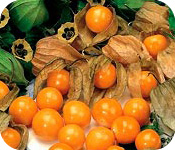
Fruit:After the flower falls, the
calyx expands, forming a straw-colored husk much larger than the fruit
enclosed, which take 70 to 80 days to mature. The fruit is a berry
with smooth, waxy, orange-yellow skin and juicy pulp containing numerous
very small yellowish seeds. As the fruits ripen, they begin to drop
to the ground, but will continue to mature and change from green to
the golden-yellow of the mature fruit. The unripe fruit is said to
be poisonous to some people. Cape gooseberries are self-pollinated
but pollination is enhanced by a gentle shaking of the flowering stems
or giving the plants a light spraying with water.
CULTURE
Location:
The plant likes a sunny, frost-free location, sheltered from strong
winds. It does well planted next to a south-facing wall or in a
patio.
Soil: The cape gooseberry will
grow in any well drained soil but does best on sandy to gravelly
loam. Very good crops are obtained on rather poor sandy ground.
Irrigation: The plant needs consistent
watering to set a good fruit crop, but can't take "wet feet". Where
drainage is a problem, the plantings should be on a gentle slope
or the rows should be mounded. Irrigation can be cut back when the
fruits are maturing. The plants become dormant during drought.
Fertilization: The cape gooseberry
seems to thrive on neglect. Even moderate fertilizer tends to encourage
excessive vegetative growth and to depress flowering. High yields
are attained with little or no fertilizer.
Pruning: Very little pruning is
needed unless the plant is being trained to a trellis. Pinching
back of the growing shoots will induce more compact and shorter
plants.
Frost Protection: In areas where
frost may be a problem, providing the plant with some overhead protection
or planting them next to a wall or a building may be sufficient
protection. Individual plants are small enough to be fairly easily
covered during cold snaps by placing plastic sheeting, etc. over
a frame around them. Plastic row covers will also provide some frost
protection for larger plantings. Potted specimens can be moved to
a frost-secure area.
Propagation: The plant is widely
grown from seed. There are 5,000 to 8,000 seeds per ounce, which
are sometimes mixed with pulverized soil or ashes for uniform sowing.
High humidity is required for good germination. The plants can also
be propagated from 1 year old stem cuttings treated with a rooting
hormone. Plants grown this way flower early and yield well but are
less vigorous than seedlings.
Pest and Diseases: Cape gooseberries
are bothered by several diseases, including Alternaria spp. and
powdery mildew. The plants are also prone to root rots and viruses
when grown on poorly drained soil. A host of insect pests also attack
the plants, namely cut worm, stem borer (Heliotis suflixa), leaf
borer (Epiatrix spp.), fruit moth (Phthorimaea), Colorado potato
beetle, flea beetle and striped cucumber beetle (Acalymma vittata).
Greenhouse grown plants are attacked by white fly and aphids. The
stored fruit can be adversely affected by Penicillium and Botrytis
molds.
Harvest: The fruit is harvested
when it falls to the ground, but not all fallen fruits may be in
the same stage of maturity and must be held until they ripen. It
may take some experience to tell when the calyx-enclosed fruits
are fully ripe. Properly matured and prepared fruits will keep for
several months.
The ripe fruit can be eaten out of hand or used in a number of other
ways. The unique flavor of the fresh fruit makes it an interesting
ingredient in salads and cooked dishes. Cape gooseberries cooked
with apples or ginger make a very distinctive dessert. The fruits
are also an attractive sweet when dipped in chocolate or other glazes
or pricked and rolled in sugar. The high pectin content makes cape
gooseberry a good preserve and jam product that can be used as a
dessert topping. The fruit also dries into tasty "raisins".
Commercial Potential: The cape
gooseberry is a useful small crop for the home garden, but tends
to be labor-intensive in commercial plantings. The fruit is much
less well known in this country than it is in Europe and other countries.
The cape gooseberry has been grown occasionally in California but
generally only on a small scale. Frost, prolonged cool weather and
attacks of pests and root-rot organisms have discouraged extensive
or repeated plantings on any large scale. California markets have
been supplied by local growers from time to time, but importations
from Mexico and elsewhere have proved to be more economical sources
of supply.
CULTIVARS
Giallo Grosso The large golden
fruit is eaten raw or preserved after ripening. In areas with mild
winters the plant will last for several years.
Giant Large, golden-orange fruit,
approximately 1 inch in diameter with a delicious flavor. Vigorous,
spreading plants grow 3 to 5 feet tall. Requires a long growing
season.
Giant Poha Berry Fruit is approximately
1 inch. The leaves are fuzzy, green-grey and different from other
Physalis. Plant grows from 1 to 2-1/2 feet tall.
Golden Berry Fruits average 1 inch
in diameter, with some reaching 2 inches. Pulp is very flavorful
and sweet. Deseeded fruit juice similar in color and intensity of
taste to orange juice. Dried fruits are used in fruit cakes in place
of raisins. Said to be resistant to light frosts which have caused
tomatoes and other Physalis species and cultivars to die. In cooler
climates, it takes 1-1/2 years from seed to bear well.
Golden Berry, Long Aston Original
Long Ashton selection of Golden Berry. Rich golden fruit, said to
be superior to other types. Other cultivars mentioned in various
sources include Dixon, Garrison's Pineapple Flavor, New Zealand,
Peace and Yellow Improved. |
|
|
AVAILABLE FROM:
Exotica Nursery Inc.
Vista, CA
Pacific Tree Farms
Chula Vista, CA
Papaya Tree Nursery
Granada Hills, CA
Ben Poirier
Fallbrook, CA
|
|