|
Distant
affinity:
Breadfruit (Artocarpus altilis), Jackfruit
(A. heterophyllus), Fig (Ficus spp.), Mulberry (Morus spp.), African
Breadfruit (Treculis africana).
Adaptation:
The che requires minimal care and has a tolerance
of drought and poor soils similar to that of the related mulberry.
It can be grown in most parts of California and other parts of the
country, withstanding temperatures of -20° F.
DESCRIPTION
Growth Habit: The deciduous trees
can eventually grow to about 25 ft. in height, but often remains
a broad, spreading bush or small tree if not otherwise trained when
they are young. Immature wood is thorny but loses its thorns as
it matures. Female trees are larger and more robust than male trees.
Foliage: The alternate leaves
resemble those of the mulberry, but are smaller and thinner and
pale yellowish-green in color. The typical form is distinctly trilobate,
with the central lobe sometimes twice as long as the lateral ones,
but frequently unlobed leaves of varied outlines are also found
on the same plant. As the plant grows, the tendency seems towards
larger and entire leaves, with at the most indistinct or irregular
lobing. The general form of the leaves comprise many variations
between oblong and lanceolate. The che leafs and blooms late in
spring--after apples.
Flowers: The che is dioecious,
with male and female flowers on different plants. Appearing in June,
both types of flowers are green and pea-sized. The male flowers
turn yellow as the pollen ripens and is released, while the wind-pollinated
female flowers develop many small stigmas over the surface of the
immature fruit. Male plants occasionally have a few female flowers
which will set fruit.
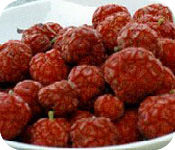
Fruit: Like the related mulberry,
the che fruit is not a berry but a collective fruit, in appearance
somewhat like a round mulberry crossed with a lychee, 1 to 2 inches
in diameter. The ripe fruits are an attractive red or maroon-red
color with a juicy, rich red flesh inside and 3 to 6 small brown
seeds per fruit. The flavor is quite unlike the vinous quality of
better mulberries. While still firm they are almost tasteless, but
when fully soft ripe they develop a watermelon-like flavor that
can be quite delicious. The sugar content is similar to that of
a ripe fig. In colder areas with early leaf drop the bright red
fruit are an attractive sight dangling from smooth, leafless branches.
CULTURE
Location: Ches need a warm, sunny location. They should
not be planted near sidewalks since the fallen fruit will stain.
Like the mulberry, the trees are quite wind-resistant. One method
of planting is to put a male and a female plant in a single site,
about 1 ft. apart, and prune to a combined volume of approximately
25% male and 75% female.
Soil: The trees are relatively undemanding,
but perform best in a warm, well-drained soil, ideally a deep loam.
Irrigation: Although somewhat drought-resistant, ches need to be
watered in dry seasons. In summer dry California a deep watering
about every two weeks is recommended. If the roots become too dry
during drought, the plant may began to defoliate and the unripe
fruit is likely to drop.
Fertilization: An annual application of
a balanced fertilizer such as 10:10:10 NPK in late spring will maintain
satisfactory growth. Nitrogen is the only element likely to be needed
in California.
Pruning: The trees need regular pruning to control
their shape. The branches formed the previous season should be pruned
to half their length. The branchlets on the remaining part of the
branches should also be trimmed about 50%. A summer pruning of the
male plant is also necessary when planted in a single site with
the female. To grow as a tree, in addition to pruning the lateral
branches, the leading branch may also need to be staked to point
it in a vertical direction. Trees grafted onto Osage orange (Maclura
pomifera) rootstock tend to be more robust and grow in a more upright
fashion.
Propagation: The che is readily grown from seed, although
the plants can take up to 10 years to bear. Seeds should be sown
as soon as extracted from the fruit. The plants are often propagated
from softwood cuttings taken in midsummer and treated with rooting
hormone. The che is also easily grafted to Osage orange rootstock
using either a cleft or whip-and-tongue graft. Pests and Diseases:
No pests or diseases have been noted. The ripe fruit is attractive
to birds, and deer will browse on both the fruit and foliage.
Harvest:
Ches begin to bear at an early age and mature trees can produce
as much as 400 pounds of fruit. The fruits ripen around November
in California. Unlike mulberries, the ripe fruits do not separate
easily from the tree and must be individually picked. It is important
that the fruits be thoroughly ripe to be at their best. A darker
shade of red with some blackening of the skin is a good indication
of full ripeness. The fruit will keep for several days in a refrigerator
in a covered dish. The fruits can be eaten out of hand or cooked
in various ways. Cooking with other fruits that can contribute some
tartness improves the taste. Mixing the ripe fruit in a blender
and straining out the seeds yields a beautiful and delicious che
"nectar".
Commercial Potential: In China
and other parts of East Asia the fruit is sometimes found in local
markets, but is relatively unknown commercially elsewhere. The attractive
color and reasonable shelf life of the che seem to indicate that
with a little effort, there could be a niche for it in farmer's
markets and specialty stores. There also appears to be some demand
for the fruit in Asian markets. Better selection should further
increase the marketing potential of the che. A seedless fruit or
one with with a bit of tartness would be a great improvement, as
would earlier ripening cultivars that separate readily from the
branches.
CULTIVARS
In China various selections
of the che are grown, but in this country there are no known cultivars
as such. |
|
|
AVAILABLE FROM:
Exotica Nursery Inc.
Vista, CA
Hidden Springs Nursery
Cookeville, Tenn.
Louisiana Nursery
Opelousas, LA
Northwoods Wholesale Nursery
Mollala, OR
Oregon Exotics
Grants Pass, OR
Papaya Tree Nursery
Granada Hills, CA
|
|