|
Related
Species:
Ilama (Annona diversifolia), Pond Apple (A.
glabra), Manrito (A. jahnii). Mountain Soursop (A. montana), Soursop
(A. muricata), Soncoya (A. purpurea), Bullock's Heart (A. reticulata),
Sugar Apple (Annona squamosa), Atemoya (A. cherimola X A. squamosa).
Distant affinity:
Pawpaw (Asimina triloba), Biriba (Rollinia
deliciosa), Wild Sweetsop (R. mucosa), Keppel Apple (Stelechocarpus
burakol).
Adaptation:
The cherimoya is subtropical or mild-temperate
and will tolerate light frosts. Young growing tips are killed at
29° F and and mature trees are killed or severely injured at 25° F.
If cherimoyas do not receive enough chilling, the trees will go
dormant slowly and then experience delayed foliation. The amount
of chilling needed is estimated to be between 50 and 100 hours.
The tree grows well in the coastal and foothill areas of southern
California, doing best at a slight elevation, 3 to 15 miles from
ocean. It is worth attempting in sunny, south-facing, nearly frost-free
locations from San Francisco Bay Area to Lompoc, and may survive
to fruit in a very few protected Central Valley foothill locations
from Chico to Arvin. Resentful of the excessive dry heat of the
interior, it is not for the desert. Cherimoyas are not recommended
for container culture .
DESCRIPTION
Growth Habit: The cherimoya is
a fairly fairly dense, fast-growing, evergreen tree, briefly deciduous
in California from February through April. The tree can reach 30 feet
or more, but is fairly easily restrained. Young trees "harp," forming
opposite branches as a natural espalier. These can be trained against
a surface, or pruned off to form a regular free-standing trunk.
Growth is in one long flush, beginning in April. The roots commence
as taproot, but the slow-growing root system is rather weak, superficial,
and ungreedy. Young plants need staking.
Foliage:The attractive
leaves are single and alternate, 2 to 8 inches long and up to 4 inches
wide. They are dark green on top and velvety green on the bottom,
with prominent veins. New growth is recurved, like a fiddle-neck.
Axillary buds are hidden beneath fleshy leaf petioles.
Flowers: The fragrant flowers are
borne solitary or in groups of 2 or 3 on short, hairy stalks along
the branches. They appear with new growth flushes, continuing as
new growth proceeds and on old wood until midsummer. The flowers
are made up of three fleshy, greenish-brown, oblong, downy outer
petals and three smaller, pinkish inner petals. They are perfect
but dichogamous, lasting approximately two days, and opening in
two stages, first as female flowers for approximately 36 hours.
and later as male flowers. The flower has a declining receptivity
to pollen during the female stage and is unlikely to be pollinated
by its own pollen in the male stage.
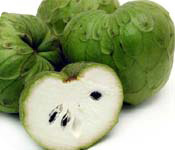
Fruits: The compound fruit is conical
or somewhat heart-shaped, 4 to 8 inches long and up to 4 inches
in width, weighing on the average 5-1/2 to 18 ounces, but the largest
fruits may reach 5 pounds in weight. The skin, thin or thick, may
be smooth with fingerprint-like markings or covered with conical
or rounded protuberances. The sweet, juicy, white flesh is melting,
subacid and very fragrant. The fruit is of a primitive form with
spirally arranged carpels, resembling a raspberry. Each segment
of flesh surrounds a single hard black bean-like seed. The fruit
size is generally proportional to the number of seeds within. They
ripen October to May.
CULTURE
Location: Cherimoyas prefer a sunny
exposure, buoyant marine air and cool nights. In southern California
do not plant where heat collects on barren hillside or against a
wall, since the leaves and fruit may sunburn badly. In the north,
do the opposite: plant against a south facing wall to collect heat
and encourage early bud-break and fruit ripening. The trees need
protection from constant ocean or Santa Ana winds which may damage
them and interfere with pollination and fruit set.
Soil: The cherimoya performs well
on a wide range of soil types from light to heavy, but seems to
do best on a well-drained, medium soil of moderate fertility. The
optimum pH ranges from 6.5 to 7.6.
Irrigation: Cherimoyas need plenty
of moisture while they are growing actively, but should not be watered
when they are dormant. The trees are susceptible to root rot in
soggy soils, especially in cool weather. Commence deep watering
biweekly in April. Drip irrigation is also an excellent way to supply
water. It is best to avoid poor water to prevent salt build-up.
Drought-stressed trees will drop their leaves, exposing the fruit
to sunburn.
Fertilization: Cherimoyas should
be fertilized on a regular basis. Apply a balanced fertilizer, such
as 8-8-8 NPK, in midwinter, then every three months. Increase the
amount of fertilizer each year until the trees begin to bear fruit.
Mature trees require an annual application of 4 ounces of actual
nitrogen per inch of trunk diameter. Cherimoyas also respond to
organic amendments. It should be kept in mind that yellow leaves
may mean that the soil too dry or the weather too cold, not always
a need for fertilizer.
Pruning: Cherimoyas have rather
brittle wood. Prune during the dormant period to develop strong
branches that can support the heavy fruit. Train the tree to two
scaffold branches at 2 feet of trunk, pruning them to a 2 foot length.
Save only the strongest single shoots, preferably those at 60 to
90 degree angle, and remove the others. In the following years,
remove two-thirds of the previous year's growth, leaving six or
seven good buds, at time of new growth. This will keep fruiting
wood within reach of the ground. Thin out crossing branches.
Frost Protection: Young trees are
very frost sensitive. Wrap the trunk and scaffold with sponge foam
for protection, or cover the entire tree. In cooler areas plant
next to a south-facing wall or under the eaves to trap house heat.
Pollination: Since natural pollinators are not present in California,
the flowers must be pollinated by hand. This is best done in mid-season
of bloom, over a period of two to three months. In early evening,
collect in a small bottle the anthers and pollen from the interior
of fully open male flowers with a #2 or #3 artists brush. Anthers
will be tan colored and the white pollen falling from them will
be obvious. The pollen has its highest viability at the time it
is shed and declines significantly with time. Immediately apply
freshly collected pollen with a small brush to the flowers in partially
open, female stage. If no female stage flowers are available, pollen
may be saved in the sealed container under refrigeration overnight.
Pollen may then be applied to female stage flowers in the morning.
In large scale operations the pollen may be mixed with inert Lycopodium
spores, PVC, starch or talc powder and applied with aspirator-type
Japanese apple-pollinators, to save time and pollen. Pollinate every
two or three days, and only flowers easily reached inside the tree,
to avoid sunburned and wind-damaged fruit. If pollination efforts
are quite successful, it may be necessary to thin the fruit. Too
much fruit may result in small size and adversely effect future
yields.
Propagation: Since there are no
recognized rootstocks for cherimoyas, seedlings are universally
utilized. Seeds from the White cultivar (Dr. White) are thought
by some to produce superior rootstocks, however there does not appear
to be a great deal of objective data to support this position. Seeds
remain viable for two to three years if kept dry and protected from
weevil and fungi. With 70° F bottom heat, seed will germinate in
about 21 days, but will require about 40 days under normal ambient
growing conditions. Seedlings should be transplanted to deep containers
(approximately 18") when they are 3" tall to promote development
of the tap root. In frost-free areas, it is recommended that seedlings
for spring grafting be planted in their ultimate location in the
fall and grafted in the ground the following spring. Grafting is
most successful in January through May provided previous years leaves
have not been shed from the potential scionwood. During this period
no scion preparation is required other than removal of leaves. All
normal grafting techniques appear to be equally successful. However
in topworking, nurse branches are desirable if not essential for
success. To bud, collect budwood in July store refrigerated for
10 days in plastic. Petioles will drop exposing dormant buds. Bud
at once using chip bud technique and wrap well against dehydration.
Grafted plants will bear in two to three years.
Pests and Diseases: Mealybugs and
snails are the main pests of cherimoyas. Keep ducks or apply copper
strips to the trunks for control of snails. Mealybugs are brought
by ants which can be controlled to some extent by maintaining fresh
Tanglefoot on masking tape around the trunk. The masking tape is
important to prevent damage to the tree. Skirt the tree to prevent
ant access from the ground or weeds. No chemicals are registered
for use on Cherimoyas. Cherimoyas are susceptible to Armillaria
(Oak Root Fungus) and Verticillium. Do not plant in old vegetable
gardens, or near tomatoes, eggplant or asters. Crown rot can kill
trees damaged by frost or growing in saturated soil, as well as
from trunks hit by frequent, superficial lawn sprinkling.
Harvest: The fruit turns a pale
green or creamy yellow color as they reach maturity. Color change
is not marked in cool weather. They should be picked when still
firm and allowed to soften at room temperature. Ripe fruit will
give to soft pressure. Overripe fruit will be dark brown. Fruit
left on the tree too long will usually crack or split and begin
to decay. The fruit should be clipped rather than pulled from the
tree. Cut the stem close to the fruit so it won't puncture other
fruit during storage. Store mature fruit above 55° F to prevent
chilling injury to the skin and flesh. Ripe fruit will deteriorate
quickly but can be stored at temperatures lower than 55° F for short
periods. Ripe cherimoyas can be frozen and eaten like ice cream.
Cherimoyas are best served chilled, cut in half or quartered and
eaten with a spoon. The fruit can also be juiced or used to make
delicious sorbets or milkshakes.
Commercial Potential: Though unusual
in appearance, cherimoyas are readily accepted by western tastes
and has become a favorite tropical fruit. Demand greatly exceeds
supply in all U.S. markets as most fruit never leaves California,
the only producing state. The fruit commands high wholesale and
retail prices, but costs are high and major crop losses from frost
and fruit splitting are an ever present possibility. The major labor
costs are pruning, pollination, ant control and irrigation.
CULTIVARS
Bays Origin James Bays, Ventura,
Calif., 1920. Tree broad, to 20 ft. Best in Carpenteria area. Fruits
round, medium size, light green, skin shows fingerprint like marks
(impressa type). Flavor good, almost lemony.
Big Sister Origin James Neitzel,
San Diego, Calif., 1979. Sibling of Sabor. Fruit large, very smooth,
good flavor; impressa type. Often self-fruitful.
Booth Origin A. F. Booth, Hollywood,
Calif., 1921. Among hardiest of cherimoya, does well in most present
growing areas. Tree 20 to 30 feet high. Fruit is conical, impressa
type, medium size, rather seedy, with flavor that suggests papaya.
Chaffey Origin A.M. Chaffey, West
Los Angeles, Calif., 1945. Seed from Salta, Argentina. Tree rather
open, fast growing. For coastal areas. Fruit small to medium, round,
impressa type, with high, lemony flavor.
Ecuador Tree broad, branches limber,
spreading. Selected for superior hardiness. Fruit medium, quite
dark green, mammillated, flavor good.
El Bumpo Origin Rudy Haluza, Villa
Park, Calif., 1986. Fruit conical, medium size, mammillated, not
suited for commerce. Skin soft, practically edible. Flavor among
the finest.
Honeyhart Medium, skin smooth,
plated, yellowish green. Pulp has smooth texture, excellent flavor,
very juicy. Ripens November to March.
Knight (syns. DV, Pierce, M&N Pierce)
Origin a Mr. Knight, Orange, Calif., 1930's. Scions imported from
Mexico. Recovered from Dr. Pierce's ranch, Goleta, in 1950's and
propagated under several names. Tree has medium vigor, medium-sized
pale green wavy leaves. Fruit has minor protuberances, a thin skin,
a slightly grainy texture and is quite sweet.
Libby Origin Rudy Haluza, Villa
Park, Calif.,1986. Tree large. Fruit impressa type, round conical;
early harvest. Sweet, strong flavor.
McPherson (syn. Spain) Tree pyramidal,
vigorous, to 30 ft. Fruits small to medium in size, conical, dark
green, impressa type, not seedy. Flavor suggests banana, sweetness
varies with temperature while maturing.
Nata Origin George Emerich, Fallbrook,
Calif., 1983. From Ecuadorian seed. Tree vigorous, bears quickly,
flowers profuse, tendency to self-pollinating. Fruits smooth, light
green, conical, 1-1/2 to 2-1/2 pounds. Skin thin, tender. Flavor
has good sweet-acid balance.
Ott Origin William Ott, La Habra
Heights, Calif., 1936. Plant patent #656. Seed from Mexico, D.F.
Tree strong growing. Fruit medium, heart shaped tuberculate, flesh
yellow, seedy, very sweet. Matures early.
Pierce (syns. Knight, Escondido
White, Ryerson, Thomson-Spain, & Bayott) Believed to be from a group
of scions imported from Mexico in the 1930's by a Mr. Knight of
Orange. Dr. H. F. Pierce planted a grove in Goleta in that period
made up largely of trees produced by Knight. This cultivar was Dr.
Pierce's favorite and was named "Pierce" by him. Tree is vigorous
with large dark green leaves. Fruit is medium sized elongated conically
shaped with very smooth skin and a high sugar content.
Sabor Origin James Neitzel, San
Diego, Calif., 1979. Sibling of "Big Sister". Fruit mammillated,
varies in size, not usually large. Among the best in flavor.
Whaley Origin Hollywood, Calif.,
1924. Tree moderately vigorous. Fruit medium to large elongated
conical, tuberculate, light green, flavor good. Seed enclosed in
an obtrusive sac of flesh.
White (syn. Dr.White) Origin J.
H. MacPherson, Lemon Grove, Calif., 1928. Tree open, unkempt; to
35 feet, needs forming. A commercial favorite at Carpinteria. Best
near coast. Fruit large, to 4 pounds, conical, with superficial
small lumps (umbonate). Flesh juicy, flavor weak, suggesting mango-papaya. |
|
|
AVAILABLE FROM:
Alan’s Tropical Fruit Trees
Largo, FL
J.D. Andersen Nursery
Fallbrook, CA
Atkins Nursery, Inc.
Fallbrook, CA
California Tropical Fruit Tree Nursery
Vista, CA
Exotica Nursery Inc.
Vista, CA
Green Mart
Orange, CA
Jene’s Tropicals
St Petersburg, FL
Laguna Hills Nursery
El Toro, CA
Roger & Shirley Meyer
Fountain Valley, CA
Oregon Exotics
Grants Pass, OR
Pacific Tree Farms
Chula Vista, CA
Papaya Tree Nursery
Granada Hills, CA
Ben Poirier
Fallbrook, CA
Tropical Oasis Farms
Cucamonga, CA
Montoso Gardens
Maricao, Puerto Rico
|
|