|
Species:
Red, pink and white currants belong to three
European species (Ribes rubrum, R. petraeum, R. sativum). Black
currants are related to European (R. nigrum) and Asian (R. ussuriense)
species.
Related Species:
Gooseberry (Ribes grossularia, R. hirtellum),
Buffalo Currant (R. aureum), Jostaberry (R. nigrum X hirtellum).
Adaptation:
Currants grow best in summer humid, cool regions
with great winter chilling. They are best adapted to USDA Hardiness
Zones 3 through 5, although in California they are fairly productive
in the coolest parts of the San Francisco Bay Area and coastal northern
California. They should be considered experimental only in southern
California. Currants are amendable to container culture.
DESCRIPTION
Growth Habit: All forms of currant
are deciduous shrubs, fast growing under optimum conditions. The
plant is a multiple-stemmed clump, to 5 feet high and as broad,
but is suitable for training as a standard. Annual growth is in
a single flush in spring. The roots are superficial, fine and easily
damaged by frequent cultivation.
Foliage: The leaves are alternate,
single, lobed and maple-like. Black currant leaves are pale green,
while those of the red currant are deep blue-green. Both are easily
burned by intense sunlight. Leaf size and number is reduced under
water stress.
Flowers: Currant flowers are borne
toward the bases of one-year old stems and on spurs on older stems.
They appear in early spring with new growth. Each flower bud opens
to number of flowers (up to 20), joined together on a delicate,
drooping 5 - 6 inch stem, called a strig. The strig length is reduced
or flowering is suppressed by lack of winter chill. Individual flowers
(green in the case of red currants and blush pink for black currants)
are not showy, but joined together on the strig they give the bush
a lacy texture. Pollination is by hoverflies and other insects.
Black currant flowers also attract honeybees. Most currants have
self-fertile flowers, but a few cultivars are partially self-sterile,
so set more fruits with cross-pollination. To increase both fruit
size and number, clip off part of the ends of the strigs while the
bushes are flowering. Depending upon the cultivar, fruits ripen
from 70 to 100 days after blossoming.
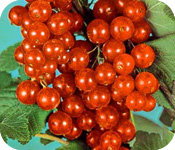
Fruit: Fully set strigs will be
a pendulous chain of small berries. The fruit is easier to pick
if their strigs are long and have "handles" (clear lengths at the
bases) for holding onto while harvesting. Black currants commonly
ripen from the top down, encouraging birds to strip berries as they
color. Modern red currant varieties have been selected for their
ability to ripen all the berries on a strig at once. Berries of
red, white and pink currants are translucent; black currants are
matte brown-purple. The berries contain 3 - 12 minute, bony seeds.
CULTURE
Location: Currants like morning sun, afternoon part-shade
and buoyant air circulation. They can be grown in the high shade
of fruit trees such as persimmon, as well as on the north side of
buildings. The leaves sunburn readily and the plants collapse quickly
when the soil or air temperature exceeds 85° F. Currants can withstand
ocean winds but the salt air will burn the leaves and turn them
ragged.
Soil: Currants are not finicky about soil but, in keeping
with their proclivity for cold, prefer heavier soils richer in clay.
A thick mulch of some organic material also keeps the soil cool
in summer while adding humus to the soil. Sandy soils are less suitable
for currants because they dry out too fast. The plants will not
tolerate alkaline or salty soil.
Irrigation: With their fibrous,
shallow roots, currants are are ideal for drip irrigation. Keep
the plants watered until the fruit is harvested. At this point they
stop active growth and the watering frequency can be reduced. Plants
stressed for water are susceptible to mildew.
Fertilization: Apply
nitrogen at an annual rate of about four ounces per square yard.
With too much nitrogen the plants become more prone to disease.
Potassium deficiency, evidenced by marginal scorching of the leaves
is averted with about half an once of potassium to the square yard.
Avoid potassium chloride, because currants are sensitive to the
chloride ion.
Pruning: Annual pruning increases yields and keeps
plants manageable. Prune so that most fruits are borne on spurs
of two- or three-year old wood. A program of pruning will maintain
a continuous supply of such wood. In the winter of the plant's first
season, remove at ground level all but two or three stems. The following
winter again remove all but two or three that grew the previous
season, at which point the bush will have two or three each of one-
and two-year old stems. Continue this each season, but by the fourth
winter start cutting away at their bases any stems more than three
years old. Each winter also shorten long stems that have grown too
scraggly. Do not prune after spring growth has commenced. Plants
can be trained to a number of utilitarian and decorative forms.
Propagation: Currant seeds germinate
if stratified for three to four months at temperatures just above
freezing. Seedlings are prolific and do not vary much from parent.
Bushes grown from seed bear when two or three years old. Currants
are easily propagated by hardwood cuttings of one-year old wood.
Take one-foot cuttings of dormant wood in late winter, dip the base
in rooting hormone and pot in ordinary soil. Cuttings will quickly
root and are best kept in part shade for the first year. If the
plants are to be grown as standards, strip all buds off cutting
below soil line. Currants can also be grafted, but no advantage
is gained.
Pests and Diseases: Currants are
subject to a variety of insect and disease pests. Gall mite (not
reported yet in California) infests dormant buds during summer.
Affected buds swell, form dried rosettes, and fail to break during
following spring. Whole stem becomes blind and dies back to ground.
Plant should be removed and burned immediately upon detection. Aphids
commonly distort currant foliage causing red spots. Spider mites
are common and also cause foliar distortion. Clear-winged borers
lay their eggs on stems in late spring. The larvae hatch and bore
into the stems where they remain until the following season. An
infestation is usually detected only after the stem wilts and dies.
Borers will spread and generally cause loss of whole a planting
without quick control. Cut out affected stems, search for others
and spray. The leaves are not attractive to deer. The most feared
disease in black (rarely red) currant is reversion virus, and appears
as weakened, barren plants with pleated leaves. The virus, which
is spread by common and gall mites, is endemic in Europe but not
yet known in California. There is no cure; do not import plant material
from European sources. Ribes species are also host for white pine
blister rust, which causes few problems for currants but is lethal
for 5-needle pines, including California natives such as Western
White ( Pinus monticola ) and Sugar Pine ( P. lambertiana ). Currants
are banned in counties where these pines are grown for lumber. Botrytis
and Anthracnose can cause rot of leaves and loss of young growth,
usually stems lying on the ground or splashed during irrigation.
Gooseberry mildew infects currants, especially in humid areas, but
is not common in California. It is worst in coastal fog or where
irrigation is by overhead sprinkling. Keep plants turgid, never
water-stressed. Benomyl spray before flowering and after harvest
should control it. Currant roots are susceptible to both Oak Root
fungus ( Armillaria ) and Phytophthora .
Harvest: Most cultivars hold well
on the plant. For fresh eating let the berries hang for about three
weeks after they color up. If the fruits are to be stored at all,
they should be picked dry. To avoid damaging the fruits, pick a
whole strig by its stem, taking care not to damage the spur. Yields
vary greatly, depending on growing conditions and cultivar. Anywhere
from three pounds to over ten pounds may be harvested from a single
bush. Currants are unsurpassed for jelly, but are also good in pies
and sauces, especially when mixed with fruits that have body but
lack sprightliness. Currants have also been used for wine, said
by some to be similar in flavor to Graves or Rhine wines. Black
currants are the traditional source of the French liqueur, Cassis.
CULTIVARS
Red Currant Red currants are for culinary use: juice, jellies
and purees. Cultivars are selected for the clarity of juice, size
of berry and productivity.
Jonkheer van Tets Origin J. Maarse,
Schellenkhout (NL), 1931. Seedling of Fay's Prolific. Vigorous,
habit spreading, bush open. Blooms early, resists mildew. Fruits
earliest to ripen, tend to run off (drop) from strig.
Perfection Origin Charles Hooker,
Rochester NY, 1887. Bush upright, twiggy, roots particularly susceptible
to Armillaria. Strigs clustered at base of current year's growth,
fruits small to average, clear red, midseason.
Red Lake Origin W.H. Alderman,
Excelsior MN, 1933. Bush vigorous, much branching, roots most resistant
to Armillaria, tolerates some dryness. Resists mildew. Tends to
break dormancy early, with protracted bloom, some strigs ripening
as others are still in bloom. Earlier fruits will mature while soil
remains moist from winter rains. Berries dark red, rather small.
Wilder - R. Vulgare. Origin E.G.
Teas, Irvington IN, 1878. Seedling of Red Versailles. Bush spreading,
tends to layer self. Largest of red currants. Ripens late, hold
long on bush. Very productive of full strigs of rather oblate, pale
red berries.
White Currants An albino forms
of the red currant. More versatile but less colorful than the red;
fine for all culinary uses, but are of lower acidity, thus also
suitable for fresh eating. The best sorts are nearly transparent.
Weisse aus Juterbog - R. petraeum.
Origin Juterbog (D), 1890s. Bush slow growing, upright, sunburns
easily. Not productive, few berries on short strigs, not adapted
to California.
White Imperial - R. rubrum. Origin
S.D. Willard, Geneva, NY, 1890. Bush spreading, not upright, withstands
California conditions well. Very productive on long strigs of small
round berries. Lowest in acid of currants, suitable for dessert.
White Versailles - R. vulgare.
Origin Bertin, Versailles (F), 1840. Bush tall, branches few. Not
vigorous. Fairly productive of well-filled strigs. Berries round,
seedy. Midseason.
Pink Currants Pink Currants are
intermediate between red and white types, in degree of pigmentation.
Skin is colorless, flesh is pink. All are R. vulgare.
Gloire des Sablons Origin France,
ancient. Most common form of pink currant. Bush upright, not branching,
productive, berries quite large but few on strig.
Black Currants Black Currants have
a characteristic aroma, highly esteemed by natives of northern Europe.
Leaves also release the scent when rubbed. Fruit are astringent,
suitable only for culinary uses. Certain Canadian cultivars (Consort,
Crusader, Coronet) are R. nigrum X ussuriense hybrids, bred to resist
mildew and rust, are self- and inter-sterile and of inferior flavor,
are not recommended.
Blacksmith Origin Laxton Bros,
Bedford (GB), 1916. Bush very vigorous, quick to reach bearing size,
much branching. Productive, strigs long, flavor fair.
Boskoop Giant Origin Boskoop (NL),
1890s. Bush vigorous, upright, branching low. Requires pollinator.
Strigs few and short, berries not uniform in size. Flavor good.
Noir de Bourgogne Origin Dijon
(F), very ancient. The traditional black currant for making Cassis.
Bush very spreading, low open. Fairly productive, slow to begin
producing. Strigs short, many, berries of best flavor.
Wellington XXX Origin R. Wellington,
East Malling (GB), 1913. Bush spreading, often trailing and self-layering.
Withstands adverse conditions (sun). Berries tend to "run off",
shed before strig fully mature. Flavor fair.
Willoughby Origin Walter Willoughby,
Parkside, Sask., 1940. Bush open, spreading, hardy to cold and sun,
resists mildew. Fertile, short strigs, fair flavor.
Buffalo Currants Ribes aureum.
A distant relative of the common Ribes, Buffalo Currant is probably
closer to gooseberry. Native to American prairies, they are extraordinarily
hardy bushes and productive. The bush resembles common Ribes, but
is wider and weeping, with branch tips eventually touching the ground.
It needs no pruning and stems tend to go blind, shedding dormant
buds after the first year. It tolerates a wide range of soils, even
alkali, and does not require much winter chill. Leaves are small,
felty, gray-green and many-lobed. Flowers are profuse, showy, yellow
and fragrant, resemble Forsythia in bloom. It makes a prolific production
of pea-sized or larger, glossy brownish-purple, bland-flavored berries
with persistent style, that resemble American gooseberry when cooked.
They are palatable raw or cooked. Ripe fruits last long on the bush,
often 2 months. It is adaptable to a range of climates and the only
species recommended for southern California.
Crandall Origin uncertain, probably
Iowa, 1890s. Still the best for fruit quality. Bush rather weak,
weeping, fruit hidden inside foliage, difficult to find.
Jostaberry Jostaberries are hybrids
of black currant and the American gooseberry, R. hirtellum, produced
in Germany, 1930s-50s. They are currently a subject of commercial
promotion, but performance in California is disappointing. The bush
is very tall, thornless, tends not to branch and requires the space
of 2 currant bushes. The foliage is glossy, larger than gooseberry,
lobed, scentless and resists mildew. It survives full sunlight but
requires much winter chilling. The lateral buds usually shed, leaving
blind branches. Purple or brownish-red fruit are borne on lax, few-berried
strigs. They are the size of small gooseberry and lacking in flavor,
suitable only for experimentation. Buffalo currant produces comparable
fruit more abundantly in less space and is recommended instead.
New forms of Josta, backcrossed to the black currant parent, may
be better than original types.
|
|
|
AVAILABLE FROM:
This fruit is not carried by any of our member nurseries.
|
|