|
Species:
American Gooseberry (Ribes hirtellum), European Gooseberry (R. grossularia)
Related Species:
Currant (Ribes rubrum, R. petraeum, R. sativum),
Black Currant (R. nigrum, R. ussuriense), Buffalo Currant (R. aureum).
Adaptation:
Gooseberries grow best in summer humid, cool regions with great winter chilling. In California they are fairly productive in the coolest parts of the San Francisco Bay Area, the outer Coast Ranges and coastal northern California. They are probably not worth trying in southern California. except at high elevations. With proper attention gooseberries can be grown in containers.
DESCRIPTION
Growth Habit: Gooseberries are
deciduous shrubs, fast growing under optimum conditions to 3 feet
tall and 6 feet wide. The plant is suitable for training as a standard.
American types have weeping stems that will root wherever they touch
the ground and can be invasive. Annual growth is in a single flush
in spring. The roots are superficial, fine and easily damaged by
frequent cultivation.
Foliage:The buds perk up
early in the spring, dotting the stems with green when most other
plants are still tawny. The leaves are alternate, single, deeply
lobed, and glossy dark green (European types), or pale to gray-green
and sometimes finely pubescent (American types). The stems are thin,
becoming woody, with a large thorn at each axil. American gooseberry
stems are densely bristly, with one or more additional thorns at
each axil. Leaf size and number are reduced under heat or light
stress, and are easily burned by intense sunlight. Plants that have
been subject to drought may make a new growth flush after deep irrigation.
If the roots are lost, regrowth will wait until the following spring.
Flowers: The inconspicuous flowers,
green with pink flushed petals, open in early spring. They are borne
laterally on one-year old wood and on short spurs of older wood.
The flowers are self-fertile and pollinated by wind and insects,
including bees. Each flower bud opens to yield from one to four
flowers, depending on cultivar.
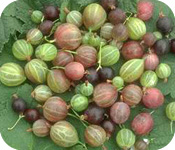
Fruit: The fruit, borne singly
or in pairs at the axils, is a berry with many minute seeds at the
center. A gooseberry may be green, white (gray-green), yellow, or
shades of red from pink to purple to almost black. Fruits of the
European gooseberry may be very large, like a small plum, but are
usually 1 inch long, less in width. American gooseberry fruits are
smaller (to 1/2 inch), perfectly round, all becoming pink to wine-red
at maturity. Skin color is most intense in full sunlight. Berries
generally drop when overripe. The fruit has a flavor all its own,
the best dessert cultivars as luscious as the best apple, strawberry
or grape.
CULTURE
Location: Gooseberries like morning
sun, afternoon part-shade and buoyant air circulation. They are
most productive in full sunlight but the leaves sunburn easily under
California conditions. They can be grown in the high shade of fruit
trees such as persimmon or on the north side of buildings. American
gooseberry are much more sun tolerant. Plants collapse quickly when
soil or air temperature exceeds 85° F.
Soil: Gooseberry plants are less
finicky about soil acidity than most other small fruits, and tolerate
a wide range of soils, except those that are waterlogged. Where
summers are hot, bushes will grow better and produce better fruit
in heavier soils, which retain more moisture and stay cooler. A
thick mulch of some organic material also helps keep the soil cool.
Sandy soils are less suitable for gooseberries because they dry
out too fast.
Irrigation: With their fibrous,
shallow roots gooseberries are ideal for drip system. Keep the plants
watered all season, since they will not regenerate buds or leaves
lost from drought stress. Plants stressed for water are susceptible
to mildew.
Fertilization: Gooseberries have
a high requirement for potassium and a moderate need for nitrogen,
although excessive amounts of nitrogen promote disease, especially
mildew. Between four and eight ounces of actual nitrogen per square
yard strikes a good balance between growth and disease tolerance.
The symptom of potassium deficiency is scorching of leaf margins.
Deficiency can be avoided with an annual dressing of half an ounce
of potassium per square yard. Gooseberry plants also have a fairly
high requirement for magnesium, so if the soil is very acidic and
needs lime, use dolomitic limestone, which supplies magnesium as
well as calcium.
Pruning: A gooseberry bush is usually
grown on a permanent short "leg" of about six inches, from which
the bush is continually renewed with new shoots arising at or near
ground level. Allow stems to grow for 4-5 years, then selectively
remove oldest stems to make room for new shoots. Snap off any branches
that form along or below the six-inch leg. Thorns make harvest tedious,
so pruning is done to open up the bush and make picking easier.
The plants may be grown as standards or cordons, but this requires
a lot of care and the fruit often sunburns.
Propagation: The ease with which
gooseberries propagate from cuttings depends on the cultivar. Generally,
American cultivars are easier to root than are European cultivars.
Take hardwood cutting in early fall, even before all the leaves
have dropped. The presence of a few leaves actually enhances rooting.
Make the cuttings about a foot long, but do not include tip growth,
dip the base in hormone and pot in ordinary soil. Keep in part shade
for the first year. Tip layering is a surer method of propagation,
though a single bush furnishes far fewer layers than cuttings. If
intended for training as standards or cordons, strip all buds off,
cutting below the soil line. Seeds require moist stratification,
just above freezing, for three to four months. The plants commence
bearing in 5 years from seed and 2 years from cuttings.
Pests and Diseases: Aphids commonly
attack young leaves, distorting them. Spider mites are common in
summer; spray immediately after harvest and thereafter on a regular
schedule. The clear-winged borer lays its eggs on stems in April.
The larvae hatch and bore into the central pith down to soil line
and emerge to pupate in the fall. An infestation is usually detected
only after the stem wilts and dies. Borers will spread and generally
causes loss of whole planting without quick control. Cut out affected
stems, search for others and spray. The gooseberry sawfly is present
in the Pacific Northwest but has not yet been detected in California.
Its small green worms will hollow out the berries, leaving an empty
husk. Ribes species are host for White Pine blister rust, which
causes few problems for gooseberry, but is lethal for 5-needle pines,
including California natives such as Western Pine (Pinus monticola)
and Sugar Pine (P. lambertiana). Gooseberries are banned in counties
where these pines are grown for lumber. Botrytis and Anthracnose
can cause rot of leaves and loss of young growth, particularly stems
lying on the ground or splashed during irrigation. Gooseberry mildew
is a common problem, affecting both European and American types.
It is worst in coastal fog, on drought-stressed plants, or where
irrigation is by overhead sprinkling. Keep plants turgid, never
stressed for water between irrigations. Benomyl spray before flowering
and after harvest should control it. Roots are susceptible to both
Oak Root fungus (Armillaria mellea) and Phytophthora.
Harvest: Average yield from one
gooseberry bush is between eight and ten pounds of fruit. Gooseberries
used for culinary purposes such as tarts, etc. are usually picked
underripe. A classic gooseberry concoction is a fool, made by folding
cream into the stewed fruit. For dessert purposes, however, the
fruit must be fully ripe.
CULTIVARS
The European gooseberry
is the classic gooseberry of cookery and and desserts. The American
gooseberry is smaller, adapted to more demanding cultural conditions
and more productive, but without much character and generally inferior
for all purposes. As the European can be grown in all Californian
conditions suited for the gooseberry culture, the American is not
recommended. Market demand for American gooseberries is static,
while appreciation for the true European berry is growing. Experimentation
with European types is limited under California conditions, and
many cultivars have been introduced in recent years. Only those
with proven production are described. Growers in unsuitable climates,
looking for a substitute for gooseberry, should consider the Jostaberry
or Buffalo Currant (Ribes aureum).
AMERICAN GOOSEBERRY
Glenndale Origin USDA, Glenn Dale,
MD, 1932. Ribes missouriense X R. grossularia. Bush very tall, fountain
shaped, generally rooting at tips. Prolific production of very small,
dark red to purple berries. Tolerates bright sun, was bred for growers
at extreme southern limit of gooseberry culture.
Oregon Champion Hybrid from cross
of Crown Bob with Houghton. Origin O. Dickinson, Salem, 1876. Bush
tall, weeping but rarely rooting at tips. Stems bristly, spiny.
Begins growth very early. Somewhat tolerant of Armillaria. Prolific,
fruits small, acid, hard and green when commercially harvested,
becoming bland, sweet, greenish yellow upon maturity. Most common
of gooseberry cultivars; another cv. 'Mountain' is often sold for
it by unscrupulous nurserymen. 'Mountain' is more vigorous, sprawling,
fruit brick to deep red.
EUROPEAN GOOSEBERRY
Careless Origin Britain. Bush spreading,
tending to few branches. Few thorns. Rather prolific. Fruits yellow,
rather elongated, becoming brown where sunburned, rather bland.
Used for cooking in Europe; quality is higher in USA.
Early Sulphur Syn. Yellow Rough.
Origin Britain. Bush slow growing, susceptible to Armillaria. Slow
to come into bearing. Fruits somewhat pear-shaped, deep yellow,
smallish, with few bristles. Flavor very good.
Hinnonmakis Yellow Hybrid from
Finland, somewhat resistant to mildew. Fruit ripens midseason with
a smooth, yellow skin. Fruit size is variable, excellent flavor.
Telegraph Bush short, rather skimpy.
Quite productive of outstandingly large, yellow fruits of fair flavor.
Berries resist sunburn. Grown for size.
Whinham's Industry Origin Britain.
Bush slow growing. Fair production of round yellow berries, with
many innocuous violet-red bristles, giving an overall red color
to fruit. Flavor good.
Whitesmith Origin Britain. Bush
very dense, requires thinning to permit harvest. Somewhat tolerant
of Armillaria. Fruits scattered throughout bush, medium, round to
oval, pale green to white when ripe. Good flavor. |
|
|
AVAILABLE FROM:
Burnt Ridge Nursery
Onalaska, WA
Fowler Nurseries
Newcastle, CA
Hidden Springs Nursery
Cookeville, Tenn.
Louisiana Nursery
Opelousas, LA
Northwoods Wholesale Nursery
Mollala, OR
One Green World
Molalla OR
Oregon Exotics
Grants Pass, OR
Raintree Nursery
Morton, WA
|
|