|
Related
Species:
Summer grape (Vitis aestivalis), California
Grape (V.californica), American Grape, Fox Grape (V.labrusca),
River Bank Grape (V.riparia), Sand Grape (V.rupestris), European
Grape (V.vinifera).
Distant affinity:
Pawpaw (Asimina triloba), Biriba (Rollinia
deliciosa), Wild Sweetsop (R. mucosa), Keppel Apple (Stelechocarpus
burakol).
Adaptation:
Muscadines are well adapted to the warm, humid
conditions of the southeastern U.S., where the American and the
European grape do not prosper. Its lack of frost hardiness also
limits it to this same region, except for some West Coast locations.
The plant may be injured by minimum winter temperatures of 0°F,
and should not be grown in regions where temperatures frequently
go below 10°F. Muscadines can be grown in California and adjacent
areas, but are not as well adapted as other cultivated grapes. In
coastal areas of the West the lack of sufficient summer heat produces
berries that tend to be small and generally lacking in sugar. The
vines also do not fare well in the low humidity of many interior
sections. On the other hand muscadines perform satisfactorily in
the warmer grape growing regions of California, Oregon and Washington.
DESCRIPTION
Growth Habits: Muscadines are vigorous,
deciduous vines growing 60-100 ft. in the wild. Botanically, they
differ in significant ways from other grapes and are placed in a
separate sub-genus, Muscadinia. In contrast to most other grapes,
muscadines have a tight, non-shedding bark, warty shoots and unbranched
tendrils.
Foliage: The slightly lobed, 2-1/2
to 5 inch leaves are rounded to broadly ovate with coarsely serrate
edges and an acuminate point. Dark green above and green tinged
yellow beneath, the leaves are glossy on both sides, becoming firm
and subglabrous at maturity.
Flowers: Muscadines are dioecious,
with male and female flowers on different plants. The small, greenish
flowers are borne in short, dense panicles. It appears that both
wind and insects play a role in the pollination of the female flowers.
Breeding and selection have produced self-fertile varieties with
near-perfect flowers, which also serve as a pollen sources for the
female plants. For best results a perfect-flowered vine should be
within 25 ft. of female vines, or every third vine when planted
in a mixed single row. Muscadines do not readily hybridize with
other grape species.
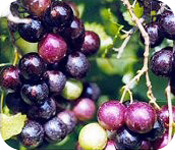
Fruit: The fruit is borne in small,
loose clusters of 3-40 grapes, quite unlike the large, tight bunches
characteristic of European and American grapes. The round, 1 to
1-1/2 inch fruits have a thick, tough skin and contain up to 5 hard,
oblong seeds. In color the fruits range from greenish bronze through
bronze, pinkish red, purple and almost black. Sugar content varies
from about 16% to 25% for the sweetest cultivars. The wild fruits
and some older cultivars have a musky quality similar to American
grapes, although not as pronounced. Modern cultivars have a unique
fruity flavor with very little muskiness. The flavor and appearance
of the dark colored muscadine fruits are remarkably similar to the
jaboticaba.
CULTURE
Location: As with all grapes, muscadines
need full sun with good air drainage. If hardiness is questionable,
they can be planted against a south-facing wall.
Soil: Muscadine grapes grow well
on a wide range of soils but best results are obtained from well-drained
sandy loams with a pH of 5.5 to 6.5. They will not tolerate low,
wet ground. High pH can be corrected by adding sulfur and thoroughly
working it into the soil. The vines are shallow rooted with most
of their feeder roots in the top 12 in. of soil.
Irrigation: Regions with 30 inches
of annual rainfall usually get enough rain to sustain the plants,
unless summer dry spells stretch out past 60 days. In areas with
less than that total, supplemental watering may be required. Drip
irrigation is economical and satisfactory. In regions of dry summers,
young vines may need watering during their first 2 or 4 growing
seasons to help establish root systems. Fertilizing: Nitrogenous
fertilizers or complete fertilizers high in nitrogen are recommended.
In the first year apply 1/2 lb. of 10-10-10NPK after planting and
then 1/8 lb. of ammonium nitrate in late May and again in early
June. Spread the fertilizer in two parallel bands 12 to 14 inches
from the trunk. Repeat in the second year, doubling the amounts
and lengthening the bands to 48 inches. Thereafter, apply 2 to 4 pounds
of the complete fertilizer each March and 1/2 pound of ammonium
nitrate each June in a 6 foot long band beginning 1foot from the
tree.
Pruning: Annual pruning must be
severe to keep new fruiting wood coming and to prevent vines from
becoming tangled masses of unproductive wood. The basic framework
of a vine consists of the trunk, permanent arms, and the fruiting
spurs. Vines must be pruned each dormant season to maintain this
framework. Current season shoots bear the fruit, but to be productive,
these shoots must arise from buds set on last season's growth, since
shoots from older wood are generally sterile. It is important to
leave the correct amount of fruiting wood. Pruning is basically
the same for all trellis systems. Only the arrangement of the fruiting
arm is different. Two systems of training are used, the upright
or vertical and the overhead or horizontal system. In the upright
system, a 3-wire trellis is used, the lower wire being 2 ft. from
the ground and the others 2 ft. apart. On the trellis the arms may
be horizontal along the wires or fan-shaped from a low trunk. With
this system the cane is taken to the top wire and the first year
or when vigorous enough, and then topped to make it branch. The
resulting laterals are trained along the wire to make the arms.
The overhead trellis provides more bearing surface per vine. The
vines form a complete canopy about 7 ft. from the ground. The vines
are trained to a single trunk 7 ft. tall with the arms radiating
from the top of the trunk like spokes of a wheel. A mature vine
will have about 8arms. During the dormant season each year, cut
back all shoot growth of the past summer to fruiting spurs 4 to
5 in. long. Remove shoots entirely that are not needed for spurs
of fruiting arms. On young vines leave spurs of one year fruiting
wood about 6 in. apart. As the vines get older, they develop clusters
of spurs, or spur systems. Generally, thinning of these spurs is
necessary after the fourth or fifth fruiting year. This thinning
will force new spur growth to replace older spurs.
Propagation: Muscadines are commonly
propagated by layering, as cuttings root with difficulty. The layering
may be done at any time, but is commonly done in midsummer. Canes
of the current season's growth are bent down and covered with earth,
the tips being left uncovered. By fall the cane will be developed
roots and is severed from the parent. Seedling plants can also be
grafted to desirable cultivars. Bench grafting is the method commonly
used. Muscadine rootstock is not suitable for American and European
grapes because of compatibility problems.
Pests and Diseases: Muscadine grapes
are much less bothered by diseases than American and European grapes.
They are essentially immune to phylloxera, nematodes and Pierce's
disease. In its native region several fungal diseases afflict the
plant, including bitter rot (Melanoconium fuligineum) and powdery
mildew (Uncinula necator) which attack the fruit, angular leaf spot
(Mycosphaerella angulata) which affects the leaves and and black
rot (Guignardia bidwellii) which attacks leaves, flower clusters
and fruit. In the West only mildew is likely to be a problem. Leaf
hoppers, aphids and flea beetles are occasional insect pests. As
with all grapes, birds can also be a problem.
Harvest: In most cultivars the
grapes in a given cluster ripen at different times and must be individually
picked. The fruit also tends to fall when ripe. This tendency to
drop can be used to harvest the ripe berries by spreading a tarpaulin
or such on the ground and giving the vine a hard shake. Muscadine
grapes start ripening mid September to late October. A mature vine
can yield 20lbs. or more of fruit. The grapes keep well, particularly
when lightly refrigerated Muscadine grapes are pleasant enough to
eat out of hand despite the seeds and somewhat tough skin of some
culivars. They come into their best, however, in making distinctive
jellies, jams and juices. The grapes also make an excellent dessert
wine with a flavor reminiscent of muscat wines.
Commercial Potential: In its home
range in season the grapes are a common roadside item, where jellies,
fresh juice and even wine are also often sold. If sufficient production
were available, there is no reason that muscadine grapes elsewhere
should not have as much market appeal as Concord grapes. In the
West, however, they are likely to remain a home grown fruit.
CULTIVARS
Several dozen different
muscadine cultivars are currently available from various sources
with additional ones continuing to be developed. Some of the better
known and better quality varieties are described below.
Female (Pistillate) Varieties
Black Beauty Large fruit, 1-1/4
inch in diameter, skin black. Quality very good. Sugar content 24.5%.
Ripens mid to late-season. Vine very vigorous. Clusters large. One
of the best black muscadines ever developed.
Black Fry Large fruit, up to 1-1/4
inch in diameter, skin black. Quality excellent, comparable with
Fry. Sugar content 20%. Ripens uniformly, early to midseason. Vine
very productive, disease resistant. Clusters large.
Darlene Large fruit, 1-1/4 inch
in diameter, skin bronze. Consistently large size throughout vine.
Excellent, melting quality. Sugar content 24%.
Fry Very large fruit, up to 1-3/8
inch in diameter, skin bronze. Quality very good before fully ripe.
Sugar content 21%. Ripens midseason. Vine moderately vigorous. Production
good. Susceptible to black rot. Clusters very large.
Higgins Fruit very large, skin
pink to reddish-bronze, moderately thick yet tender. Quality good
when fully ripe. Sugar content 17%. Ripens mid to late-season. Vines
moderately vigorous. Production heavy to over-productive. Clusters
large, compact.
Jumbo Large fruit, largest of any
muscadine cultivar so far introduced, skin black. Quality good.
Sugar content 16%. Ripens midseason to late. The fruit ripens irregularly
over several weeks, making it an excellent cultivar for home use.
Vine productive, disease resistant. Clusters large.
Scuppernong Medium to large fruit,
skin bronze, medium to thin. Flesh sweet with excellent and distinctive
flavor. Sugar content 17%. Quality excellent. Ripens early. Vines
vigorous, production good. Clusters medium.
Sugargate Very large fruit, skin
black. Excellent flavor. Sugar content 21%. Fruit ripens earliest
of all varieties. Vines very vigorous, production good. Large clusters.
One of the best of all dark fruited varieties for home use.
Summit Large fruit, skin bronze.
Skin thinnest of any large-fruited cultivar. Quality very good.
Sugar content 20%. Ripens midseason. Vine vigorous, very productive.
Disease resistant. Clusters large.
Supreme Large fruit, 1-1/4 inch
in diameter, skin black. Excellent quality. Sugar content 23%. Very
vigorous, very productive. Disease resistant. Large clusters.
Sweet Jenny Very large fruit, up
to 1-1/2 inch in diameter, skin bronze. Quality very good. Sugar
content 24%. Ripens early to midseason. Vine vigorous, very productive.
Disease resistant. Clusters large.
Self-fertile Varieties
Carlos Fruit small, 1/2 in. in
diameter, skin bronze. Flavor pleasing, similar to Scuppernong.
Sugar content 16 %. Vine vigorous, very productive. Hardy. Clusters
intermediate. One of the best bronze muscadines for wine making.
Cowart Fruit very large, skin black.
One of the largest self-fertile cultivars. Quality very good. Sugar
content 19%. Ripens medium early. Vine vigorous, productive. Disease
resistance good. Clusters very large.
Dixieland Fruit large, skin bronze.
One of the largest of self-fertile cultivars. Flavor excellent.
Sugar content 22%. Ripens midseason. Similar to Fry in flavor, color
and size. Vine vigorous, productive.
Dixie Red Large fruit, skin light
red. Similar to Cowart in size. Quality very good. Sugar content
18-19%. Ripens in midseason. Vine vigorous, high yielding. Clusters
very large, containing 12 to 30 berries.
Fry Seedless Medium-sized fruit
similar in color to Redgate. Sugar content 20%. Vigorous vine. Needs
to be pollinated by another self-fertile cultivar. Tolerant to disease.
Erratic yields.
Magnolia Large fruit, skin white,
smooth, attractive. Quality excellent. Sugar content 16%. Ripens
in late midseason. Excellent for wine making. Vine vigorous, very
productive. Clusters medium to large.
Nesbitt Large fruit, up to 1-1/8
inch in diameter, skin black. Quality very good. Sugar content 20%.
Ripens over a period of 4 or 5 weeks beginning in early September.
Vine vigor medium, production very good. Clusters medium to large.
Noble Medium-sized fruit, skin
black. Quality good. Sugar content 18%. Ripens early to midseason.
Vine vigor medium, very productive. Disease resistance good, except
for powdery mildew. Clusters large. Excellent for making a red table
wine.
Redgate Medium-sized fruit, skin
light to dark red. Quality very good. Ripens late to midseason,
does not shatter. Uniform ripening of clusters. Clusters very large,
up to 40 berries per cluster.
Regale Medium-sized fruit, skin
black. Quality good, high acid taste. Ripens early to midseason.
Vine vigorous, production good. Clusters medium. Recommended for
red wine, juice and jelly.
Sterling Large fruit, skin yellow
bronze. Quality good, similar to Scuppernong. Ripens late midseason.
Vine moderately vigorous, productive. Disease resistance good. Clusters
medium.
|
|
|
AVAILABLE FROM:
Bay Laurel Nursery
Atascadero, CA
Burnt Ridge Nursery
Onalaska, WA
Exotica Nursery Inc.
Vista, CA
Fowler Nurseries
Newcastle, CA
Green Mart
Orange, CA
Hidden Springs Nursery
Cookeville, Tenn.
Jene’s Tropicals
St Petersburg, FL
Laguna Hills Nursery
El Toro, CA
Louisiana Nursery
Opelousas, LA
Northwoods Wholesale Nursery
Mollala, OR
One Green World
Molalla OR
Oregon Exotics
Grants Pass, OR
Pacific Tree Farms
Chula Vista, CA
Raintree Nursery
Morton, WA
Lon Rombough
Aurora, OR
Sherwood’s Greenhouses
Sibley, Louisiana
Trees of Antiquity
Paso Robles, CA
Tropical Oasis Farms
Cucamonga, CA
Just Fruits and Exotics
Crawfordville, FL
|
|