|
Adaptation:
The plants need a long growing season (about
150 frost-free days) which will not be hampered by late winter or
early autumn freezes. When fully dormant, they can withstand temperatures
to about -25° F (and perhaps a bit lower.) However they must acclimate
to cold slowly and any sudden plunge in temperature may cause trunk
splitting and subsequent damage to the vine. All cultivars need
a certain period of winter chilling and their needs vary, dependent
upon cultivar, however, the exact amounts needed has not yet been
established. To date, all cultivars that have been grown in both
high chill and low chill areas have produced equally well. Late
winter freezing temperatures will kill any exposed buds. The plants
can be successfully grown in large containers.
DESCRIPTION
Growth Habit: In the forests where
it is native, it is a climbing vine (liana), sometimes climbing
one hundred feet high into trees. In cultivation it is more well-behaved
but must be supported by a trellising system. The plant has a more
delicate appearance than regular kiwifruit.
Foliage: Leaves are elongated and
generally 2 to 5 inches long and attached to the stem on red petioles.
They are usually serrated and far less leathery and fuzzy than regular
kiwifruit.
Flowers: The flowers are about
one-halfinch in diameter, white to cream colored, somewhat fragrant,
and produced as singlets to triplets in the leaf axiles. Flowering
period extends over several weeks from early May to June, depending
on climatic conditions. Plants are dioecious, having male and female
flowers on separate plants, thus needing plants of both sexes to
produce crops. However, self-fruiting females are known to exist.
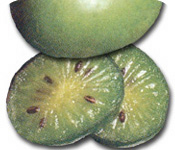
Fruit: The fruit are generally
green, fuzzless, and the size of grapes. Cut open, they look much
like regular kiwifruit with its small black seeds, emerald green
color, and typical rayed pattern. Although typically green in both
the skin and flesh, some cultivars have various amount of red, either
in the skin, flesh or both. Hardy kiwifruits are generally sweeter
than regular kiwifruit. Sugar levels vary, ranging from 14% (as
with kiwifruit) up to 29%. Additional differences between cultivars
can include perceived aroma of the fruit as well as bitterness of
the skin. Commercial cultivation has begun for this crop in many
regions of the United States due to the plants ability to grow in
harsher climates than the kiwifruit.
CULTURE
Location: The vines will tolerate some shade but prefer
a sunny location where they can ramble across some type of trellising
system. They should have some protection from strong winds Site
Preparation: Hardy kiwi plants need a substantial trellis, patio
cover, or other permanent place to grow upon. For the trellis system,
either a single wire or T-bar system can be installed. Both have
a 4inch by 4inch redwood post of 8feet. For the T-bar, a 2inch
by 6inch crossarm about 4feet long is bolted in place. Bury the
post 2feet into the ground and cement in if at all possible. At
each end of the system, a cemented deadman should be in place. Run
wires across the posts and anchor tautly to the deadman. When using
a patio cover, no extra trellising needs to be in place. Simply
run the plant up a corner post to the top and allow the plant to
then form a spoke work of shoots which would resemble an umbrella.
Soils: Hardy kiwi prefer well-drained, somewhat acid (pH5-6.5)
soils. Neutral soils are acceptable but the leaves may show nitrogen
deficiency when the soils become too basic. The plants will not
tolerate salty soils.
Irrigation: Hardy kiwi plants need large volumes
of water during the entire growing season but must also be in well-drained
soils. Watering regularly in the heat of the summer is a must. Never
allow a plant to undergo drought stress. Symptoms of drought stress
are drooping leaves, browning of the leaves around the edges, and
complete defoliation with regrowth of new shoots when the stress
is continuous. More plants probably die from water related problems
than any other reason.
Fertilization: Based on work done on the
regular kiwifruit, hardy kiwi plants are heavy nitrogen feeders
which should be applied in abundance during the first half of the
growing season. Late season applications of nitrogen will enhance
fruit size but are discouraged as fruit then tends to store poorly.
In basic soils, a citrus and avocado tree fertilizer should be broadcast
about the vine and watered in well in early March. Follow up the
initial fertilizing by supplemental additions to early summer. In
other areas, use a high nitrogen fertilizer which contains trace
elements unless it is known that the particular soil is deficient
in another nutrient. Mulching with manures and/or straws is very
beneficial. However, do not put the mulch directly in contact with
the vine as crown rot will occur.
Pruning: For best fruit production,
pruning in the winter is a must. All pruning techniques are usually
based on a "cane replacement" and differ only based on the trellising
method used. Kiwi vines need to be supported and this is usually
done in one of three ways: single wire, 3-5wire on a T-bar system,
or onto a patio cover. In all cases, one stem is trained up to a
wire at six feet and then allowed to grow along the wire. When growth
ends in a "pig-tailing" of the shoot, it is cut behind the entanglement
and new a shoot allowed to grow from a leaf base. After two years
multiple shoots will now emerge from the lateral mainline. During
the growing season, each lateral cane will send out a new shoot
about 1/3of the way from its own starting point. The next winter,
prune off the older cane at the point that it connects with last
summers new shoot. This process repeats itself every year.
Propagation: In areas where the
regular kiwifruit will grow, scions of the hardy kiwi may be grafted
directly onto kiwifruit rootstock. Otherwise, one must either root
their own from hardwood or greenwood cuttings or buy established
plants.
Pests and diseases: Plants are
relatively free from problems, possibly due to their lack of heavy
planting into areas so that pests begin to take a liking to the
leaves, trunk, or roots. One odd problem is the fact that the trunks
have a catnip-like aroma which cats love to rub against. When plants
are small, this can be a problem as they can rub off any new shoots
which emerge in the spring. Garden snails can also be a problem
on younger plantings. Other pests include deer that browse on the
leaves and gophers that attack the roots. Scale insects can damage
if populations build up too extensively. Greenhouse thrips may also
damage the fruit.
Harvest: Ripening depends both on the cultivar grown and local climatic
conditions. The Cordifolia cultivar ripens first in early September
while the Anna (Ananasnaja) may need to wait until lateOctober/earlyNovember
before it sweetens to its best. Hardy kiwifruits drop or come off
easily when they are ripe. Usually they are picked at the mature-ripe
stage and allowed to ripen off of the vine as is done with kiwifruit.
CULTIVARS
Females Many cultivars are known
although no real attempt has been yet made to determine the best
for specific climates or regions. The following is a partial listing
of cultivars:
- Ananasnaja (Anna)
- Cordifolia
- Dumbarton Oaks
- Geneva
- Issai (2 distinct self-fruitful cultivars from Japan)
- Ken's Red
- Michigan State
- 119-40B (Claimed self-fruitful)
- Red Princess
- Seedling selections by Professor Meader
- 74 Series
Males Various males are known but
no extensive work has been done to determine pollen count or viability,
flowering times, or vigorousness. If available, pollen from the
regular kiwifruit works well but the seed resulting is usually sterile.
|
|
|
AVAILABLE FROM:
This fruit is not carried by any of our member nurseries.
|
|