|
Species:
Myrciaria cauliflora Berg., M. jaboticaba
Berg., M. tenella Berg., M. trunciflora Berg.
Related Species:
Guavaberry, Rumberry (Myrciaria floribunda),
Yellow Jaboticaba (M. glomerata), Camu-camu (M. paraensis). Blue
Grape (M. vexator).
Distant affinity:
Eugenias (Eugenia spp.), Feijoa (Feijoa sellowiana),
Guavas (Psidium spp.).
Adaptation:
In Brazil jaboticabas grow from sea-level
to elevations of more than 3,000ft. Different plants vary markedly
in how much frost they can take without severe damage, probably
reflecting the species that a given plant belongs to. Some plants
can take 24°F or lower and survive; others are damaged at 27°F.
In 1917, a young tree at Brooksville, Florida survived a temperature
drop to 18°F. with only the foliage and branches killed back. In
California jaboticabas have been successfully grown in San Diego,
Spring Valley, Bostonia, Encinitas, South Los Angeles and as far
north as the San Jose and San Francisco Bay areas. The plant makes
a suitable container specimen.
DESCRIPTION
Growth Habit: The jaboticaba is
a slow growing large shrub or small, bushy tree. It reaches a height
of 10 - 15feet in California and 12 - 45feet in Brazil, depending
on the species. The trees are profusely branched, beginning close
to the ground and slanting upward and outward so that the dense,
rounded crown may attain an ultimate spread as wide as it is tall.
The thin, beige to reddish bark flakes off much like that of the
guava. The jaboticaba makes an attractive landscape plant.
Foliage: The evergreen, opposite
leaves are lanceolate to elliptic, 1 - 4inches in length and 1/2
- 3/4inch wide. In color they are a glossy dark green with a leathery
texture. The size, shape and texture varies somewhat from one species
to another.
Flowers: The small yellow-white
flowers dramatically emerge from the multiple trunks, limbs and
large branches in groups of four. It has been reported from Brazil
that solitary jaboticaba trees bear poorly compared with those planted
in groups, which indicates that cross-pollination enhances productivity.
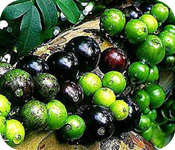
Fruits: Jaboticaba fruit is grape-like
in appearance and texture but with a thicker, tougher skin. Most
California fruit is dark purple to almost black in color. Averages
size is one inch in diameter but can run from 3/4 to 1-1/2inches,
depending on species and variety. The gelatinous whitish pulp contains
from one to four small seeds and has a pleasant, subacid flavor
markedly similar to certain muscadine grapes. The skin has a slight
resinous flavor that is not objectionable. Fruit may be produced
singly or in clusters from the ground up all over the trunk and
main branches, and the plant may fruit up to five times per year.
Fresh fruit is delicious eaten out-of-hand and can be made into
jellies, jams and wine. The skin is high in tannin and should not
be consumed in large quantities over a long period of time.
CULTURE
Location: Jaboticaba trees are will take full sun or some
shade and are small enough fit into many parts of the garden landscape.
They are fairly wind tolerant but do not like salty sea air. Small,
young trees do best with some protection.
Soil: Jaboticabas grow
and fruit best in rich deep soil with a pH of 5.5 to 6.5. Although
it is not well adapted to alkaline soils, it may be grown successfully
by mulching and applying necessary nutrient sprays containing iron.
The tree is not tolerant of salty or poorly drained soil. It has
grown and borne well on sand in Central Florida.
Fertilization:
For young plants half ratio fertilizer at monthly intervals will
speed the plant's very slow growth rate. Any well-balanced fertilizer
applied three times per year will keep the plant healthy. Because
of its shallow root system, it is suggested that a series of small
holes be dug and filled with organic material around the plant's
base. The organic material can contain a balanced fertilizer which
will be released during irrigation.
Irrigation: Water should be
supplied as needed to maintain good soil moisture and prevent wilting,
but constant flooding is undesirable. As the root system is somewhat
shallow, irrigation is usually required when the upper inch or two
of soil become dry.
Pruning: Pruning of jaboticabas is not usually
needed, but when pruned as a hedge, the fruit is not destroyed since
it is formed only on the inner branches and trunk.
Frost Protection:
Although Jaboticabas can tolerate a few degrees of frost, they do
best under frost-free conditions. In areas where frost may be a
problem, providing them with some overhead protection or planting
them next to a wall or a building may be sufficient. The smallish
plants are also fairly easy to cover during cold snaps by placing
carpeting, plastic sheeting, etc. over a frame around them. Potted
specimens can be moved to a frost-secure area.
Propagation: Most seeds are polyembryonic,
producing a plant that is true or close to the parent plant. The
seeds germinate in about one month. A suggested potting mixture
is 2parts peat, 2parts coarse sand and 1part coarse perlite,
wood shavings or compost. Selected strains can be reproduced by
inarching (approach grafting) or air-layering. Budding is not easily
accomplished because of the thinness of the bark and the hardness
of the of the wood. Veneer or side grafts are fairly successful.
The grafted plant will fruit considerably earlier than a seedling.
One may expect a grafted plant to produce fruit within three years,
It can take from 8 to 15years for a seedling to mature into a fruiting
tree. It is this very slow growth that has kept this plant from
becoming as popular as it deserves to be. Grafting older trees over
to a different variety is inadvisable because it is the trunk and
inner branches which produce the fruit. One would have to cut the
tree back to a one-inch stump in order to change its fruiting nature.
When planting a jaboticaba, the crown (uppermost) roots should be
2 to 3inches higher than the surrounding soil levels to provide
water runoff. Peat, compost or rotted manure may be mixed with the
soil from the planting hole to improve it. The soil should be a
well-aerated mixture.
Pests and diseases: The fruit and
flowers of some varieties are susceptible to a fungus caused rust
during wet periods. Many flowers may desiccate during dry periods.
Birds, raccoons and opossums are all attracted to fruiting trees.
Deer will sometimes browse on the new foliage, but jaboticaba roots
are not particularly attractive to gophers.
Harvest: Jaboticaba fruits
are ready to harvest when they have developed a full color and are
somewhat soft like a ripe grape. They are mostly eaten out-of-hand
in South America. By squeezing the fruit between the thumb and forefinger,
one can cause the skin to split and the pulp to slip into the mouth.
The peeled fruits are often used for making jelly and marmalade,
with the addition of pectin. Jaboticaba wine is made to a limited
extent in Brazil.
Commercial Potential: Jaboticabas are a significant
commercial fruit in Brazil and to a limited extent in other parts
of South America where they thrive. They are a very tasty fresh
fruit, and if they were more plentiful and were properly promoted,
they could have a commercial future in this country. Their relative
frost sensitivity combined with their slowness to fruit from seedlings
is a major drawback to commercial success.
CULTIVARS
Branca Produces large bright green
flavorful fruit. Medium size and heavy producer.
Paulista Large to very large fruit,
skin thick and leathery. Flesh juicy, subacid to sweet. Quality
very good, ripens relatively late. Resistant to rust. Tree strong
growing, highly productive though it bears a single crop. Introduced
into California in 1904.
Rajada Fruit very large, skin green-bronze,
thinner than that of Paulista. Flavor sweet and very good. Tree
much like that of Paulista. Midseason.
Sabara Most prized and most often
planted tree in Brazil. Fruit is small, thin-skinned and sweet.
Tree medium-sized, precocious and very productive. Produces 4crops
per year. Susceptible to flower and fruit rust.
Ponhema Produces a large, leathery
skinned fruit with a pointed apex. Must be fully ripe for eating
raw. Mostly used in jellies or preserves. Tree is very large and
a heavy producer. |
|
|
AVAILABLE FROM:
Alan’s Tropical Fruit Trees
Largo, FL
J.D. Andersen Nursery
Fallbrook, CA
Atkins Nursery, Inc.
Fallbrook, CA
California Tropical Fruit Tree Nursery
Vista, CA
Exotica Nursery Inc.
Vista, CA
Jene’s Tropicals
St Petersburg, FL
Laguna Hills Nursery
El Toro, CA
Roger & Shirley Meyer
Fountain Valley, CA
Ong Nursery
San Diego, CA
Pacific Tree Farms
Chula Vista, CA
Papaya Tree Nursery
Granada Hills, CA
Ben Poirier
Fallbrook, CA
Tropical Oasis Farms
Cucamonga, CA
Montoso Gardens
Maricao, Puerto Rico
|
|