|
Related
Species:
Breadfruit (Artocarpus altilis), Breadnut
(A. altilis 'Seminifera'), Champedak (A. integer), Lakoocha (A.
lakoocha), Marang (A. odoratissimus). Distant affinity: Figs (Ficus
spp.), Mulberries (Morus spp.), African Breadfruit (Treculia african).
Adaptation:
Jackfruit is adapted to humid tropical and
near-tropical climates. Mature trees have survived temperatures
of about 27°F in southern Florida, but these were frozen to large
limbs. Young trees are likely to be killed at temperatures below
32°F. Unlike its relative, the breadfruit, the jackfruit is not
injured by cool weather several degrees above freezing. There are
only a dozen or so bearing jackfruit trees today in southern Florida,
and these are valued mainly as curiosities. There are also several
trees planted in the Asian exhibit at the San Diego Zoo. What they
will do or how high they will grow remains a question. The tree
is too large to make a suitable container-grown plant.
DESCRIPTION
Growth Habit: The jackfruit tree
is handsome and stately. In the tropics it grows to an enormous
size, like a large eastern oak. In California it is very doubtful
that it would ever approach this size. All parts contain a sticky,
white latex.
Foliage: The leaves are oblong,
oval, or elliptic in form, 4 to 6inches in length, leathery, glossy,
and deep green in color. Juvenile leaves are lobed.
Flowers: Male and female flowers
are borne in separate flower-heads. Male flower-heads are on new
wood among the leaves or above the female. They are swollen, oblong,
from an inch to four inches long and up to an inch wide at the widest
part. They are pale green at first, then darken. When mature the
head is covered with yellow pollen that falls rapidly after flowering.
The female heads appear on short, stout twigs that emerge from the
trunk and large branches, or even from the soil-covered base of
very old trees. They look like the male heads but without pollen,
and soon begins to swell. The stalks of both male and female flower-heads
are encircled by a small green ring.
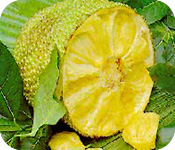
Fruit: Jackfruit is the largest
tree-borne fruit in the world, reaching 80 pounds in weight and
up to 36inches long and 20inches in diameter. The exterior of
the compound fruit is green or yellow when ripe. The interior consists
of large edible bulbs of yellow, banana-flavored flesh that encloses
a smooth, oval, light-brown seed. The seed is 3/4 to 1-1/2inches
long and 1/2 to 3/4inches thick and is white and crisp within.
There may be 100 or up to 500seeds in a single fruit, which are
viable for no more than three or four days. When fully ripe, the
unopened jackfruit emits a strong disagreeable odor, resembling
that of decayed onions, while the pulp of the opened fruit smells
of pineapple and banana. There are two main varieties. In one, the
fruits have small, fibrous, soft, mushy, but very sweet carpels
with a texture somewhat akin to a raw oysters. The other variety
is crisp and almost crunchy though not quite as sweet. This form
is the more important commercially and is more palatable to western
tastes.
CULTURE
Location: The jackfruit tree should have a well-drained,
frost-free location that is sunny and warm.
Soil: The jackfruit
flourishes in rich, deep soil of medium or open texture. Planting
on top of an old compost heap would be ideal. The faster one can
force a tropical plant to grow, the better the chance of keeping
it alive. The tree needs the best drainage and cannot tolerate "wet
feet".
Irrigation: The tree will not tolerate drought. Water frequently
during warm months and warm periods in cooler months. Less water
is necessary during colder weather.
Fertilization: The jackfruit's
requirements are not known, but frequent, weak solutions of all-purpose
fertilizer will speed the plant's growth without causing burn. In
the regions where it is commonly grown, it succeeds without much
care from man, the sole necessity being abundant moisture. Frost
protection: Although mature jackfruit trees will take several degrees
of frost, it is prudent to provide young plants with overhead protection
if possible and plant them on the south side of a wall or building.
Small plants should be given complete protection with a covering
on cold nights and even a light bulb if possible.
Propagation:Propagation
is usually by seeds, which can be kept no longer than a month before
planting. Germination requires 3 to 8weeks. The seedlings should
be moved when no more than 4leaves have appeared. A more advanced
seedling, with its long and delicate tap root is very difficult
to transplant successfully. Cutting-grown plants and grafted seedlings
are possible. Air-layering is common in India.
Pruning: Little or no pruning is
required other than to remove any dead branches from the interior
of the tree, so that sufficient light is obtained for the developing
fruit.
Pests and diseases: A variety of
pests and diseases afflict the jackfruit tree and fruit regions
where it is commonly grown. In California the white fly is a minor
pest.
Harvest:
Jackfruits mature 3 to 8months from flowering. When mature, there
is usually a change of fruit color from light green to yellow-brown.
Spines, closely spaced, yield to moderate pressure, and there is
a dull, hollow sound when the fruit is tapped. After ripening, they
turn brown and deteriorate rather quickly. Cold storage trials indicate
that ripe fruits can be kept for 3 to 6weeks at 52° to 55°F and
relative humidity of 85% to 95%. Immature fruit is boiled, fried,
or roasted. Chunks are cooked in lightly salted water until tender
and then served. The only handicap is copious gummy latex which
accumulates on utensils and hands unless they are first rubbed with
cooking oil. The seeds can also be boiled or roasted and eaten similar
to chestnuts. In Southeast Asia dried slices of unripe jackfruit
are sold in the markets. The ripe bulbs, fermented and then distilled,
produce a potent liquor.
CULTIVARS
In Malaysia and India there are named types of fruit.
One that has caused a lot of interest is Singapore, or Ceylon, a
remarkable yearly bearer producing fruit in 18months to 2-1/2years
from transplanting. The fruit is of medium size with small, fibrous
carpels which are very sweet. It was introduced into India from
Ceylon and planted extensively in 1949. Other excellent varieties
are Safeda, Khaja, Bhusila, Bhadaiyan and Handia. In Australia,
some of the varieties are: Galaxy, Fitzroy, Nahen, Cheenax, Kapa,
Mutton, and Varikkha. None of these appear to be available in the
US at this time. |
|
|
AVAILABLE FROM:
This fruit is not carried by any of our member nurseries.
|
|