|
home > glossary > jelly palm > long description |
|
|
|
|
|
Related
Species:
Yatay Palm (Butia yatay).
Adaptation:
The jelly palm is the hardiest feather-leafed
palm currently in wide cultivation, withstanding low temperatures
of at least 15°F (USDA Zones 8B-10B). They grow well in central
and northern California, Florida and the Gulf and Atlantic Coasts
into the Carolinas. Their small size and slow growth habit make
jelly palms good container specimens.
DESCRIPTION
Growth Habits: The trees are slow-growing
to about 15 feet with a canopy of 40-50 leaves. The trunk is heavy
and patterned with stubs of old leaves. Jelly palms vary considerably
in nature, the forms differing in ultimate height, trunk thickness,
leaf color and amount of arching, and fruit color and taste. Their
neat, compact growth makesthem very attractive landscape features.
They are widely used as specimen trees in California and northern
Florida, where they also function well in median and avenue plantings.The
trees very wind-tolerant.
Foliage: The arching, blue-green,
4-6 foot, pinnate leaves are crowded with many upward-pointing leaflets
that form a pronounced V-shape. The petiole is armed with stout,
sharp teeth along the margin. The leaflets are about 2-1/2 feet
long and 1inch wide.
Flowers: Numerous, very small creamy
yellow to reddish flowers are borne on once-branched, 3-4 ft. long
inflorescences bearing separate male and female flowers. Pollination
is by wind and insects.
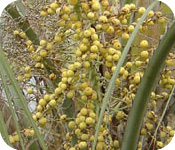
Fruit: The one-inch, yellow to
orange-colored fruits are round to oval-shaped, and hang in large
sprays from the tree. Each fruit contains a single seed. The sweet-tart
flavor is reminiscent of both apricots and a pineapple-banana mixture.
CULTURE
Location: Jelly palms do best in
a sunny location but will take some shade. Wind is no problem because
of their high tolerance to it.
Soil: The trees are widely adaptable
to most soil conditions and have a moderate salt tolerance.
Irrigation: Jelly palms are highly
drought-tolerant, but appreciate an occasional watering in summer-dry
areas. Fertilizing: The trees seem to thrive with little or no fertilizing,
although they respond to a spring fertilizing with a complete fertilizer.
Another light fertilizing in mid-summer is also helpful.
Pruning: The only pruning necessary
is the removal of lower leaves as they become untidy looking.
Propagation: Propagation is from
seed, which germinate in six months or more. Germination is faster
after dry storage.
Pests and Diseases: The major pest
problem is scale. Major disease or physiological problems are ganoderma,
stigmina leaf spot, graphiola false smut and phytophthora bud rot.
Harvest: Jelly palm fruits are
picked as they ripen. If whole bunches are harvested, they tend
to ripen all at once. The fruits can be eaten fresh and pureed,
or used to make an excellent jelly as well as wine. They can be
stored for about a week under refrigeration.
|
|
|
AVAILABLE FROM:
Alan’s Tropical Fruit Trees
Largo, FL
J.D. Andersen Nursery
Fallbrook, CA
Exotica Nursery Inc.
Vista, CA
Jene’s Tropicals
St Petersburg, FL
Louisiana Nursery
Opelousas, LA
Northwoods Wholesale Nursery
Mollala, OR
Oregon Exotics
Grants Pass, OR
Pacific Tree Farms
Chula Vista, CA
Papaya Tree Nursery
Granada Hills, CA
Ben Poirier
Fallbrook, CA
Tropical Oasis Farms
Cucamonga, CA
|
|
|
|