|
Related
Species:
Indian Jujube (Ziziphus mauritiana).
Distant affinity:
Purple Haw (Colubrina texensis), Raisin Tree
(Hovenia dulcis).
Adaptation:
The jujube can withstand a wide range of temperatures;
virtually no temperature seems to be too high in summertime. Winter
dormancy allows it to withstand temperatures to about -28°F, yet
it requires only a small amount of winter chill in order for it
to set fruit. The plant revels in summer sun and heat, with the
lack of either limiting fruit production more than winter cold.
Yet jujubes have fruited in the Puget Sound and low Cascade regions
of Washington State as well as in Pennsylvania. Fruiting of some
cultivars has also been reported in northern Florida.The Indian
jujube, which is more sensitive to frost, is grown in Florida, but
the fruit is considered inferior. Jujube trees are not particularly
suitable for container culture, but can be grown in this manner
in a large container.
DESCRIPTION
Growth Habit: The jujube is a small,
deciduous tree, growing to 40 feet tall in Florida, but smaller
in size in California. The naturally drooping tree is graceful,
ornamental and often thorny with branches growing in a zig-zag pattern.
The wood is very hard and strong. Jujube cultivars vary in size
and conformation, with some being very narrow in habit and others
being more widespread. One cultivar, the So, seems to be fairly
dwarfing in habit. After 30 years of growth in an average site,
trees can be 30 feet tall with a crown diameter of up to 15 feet.
Plants send up suckers (often with intimidating spines) from their
roots, and these suckers can appear many feet from the mother plant.
Currently, these root suckers must be controlled by mowing or hoeing.
Foliage: The small, ovate or oval
leaves are 1-2 inches long and a shiny bright green. In the autumn,
the leaves turn bright yellow before falling. There are usually
two spines at the base of each leaf. Some spines may be hooked while
others are long daggers. Virtually thornless cultivars are known.
As the growing season commences, each node of a woody branch produces
one to ten branchlets. Most of these are deciduous, falling from
the plant in autumn.
Flowers: The inconspicuous, 1/5
inch diameter, white to greenish-yellow flowers are somewhat fragrant
and produced in large numbers in the leaf axils. The flowering period
extends over several months from late spring into summer. However,
individual flowers are receptive to pollen for only one day or less.
Pollination needs of the jujube are not clearly defined, but appear
to be done by ants or other insects and possibly by the wind. Most
jujube cultivars produce fruit without cross-pollination . The jujube
is well protected from late spring frosts by delayed budding until
all chance of cold weather has passed.
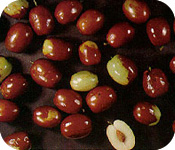
Fruit: The fruit is a drupe, varying
from round to elongate and from cherry-size to plum-size depending
on cultivar. It has a thin, edible skin surrounding whitish flesh
of sweet, agreeable flavor. The single hard stone contains two seeds.
The immature fruit is green in color, but as it ripens it goes through
a yellow-green stage with mahogany-colored spots appearing on the
skin as the fruit ripens further. The fully mature fruit is entirely
red. Shortly after becoming fully red, the fruit begins to soften
and wrinkle. The fruit can be eaten after it becomes wrinkled, but
most people prefer them during the interval between the yellow-green
stage and the full red stage. At this stage the flesh is crisp and
sweet, reminiscent of an apple. Under dry conditions jujubes lose
moisture, shrivel and become spongy inside. Tests in Russia indicate
a very high vitamin C content. The fruit has been used medicinally
for millennia by many culture. One of its most popular uses is as
a tea for sore throat.
CULTURE
Location: Jujubes should be given
a warm, sunny location, but are otherwise relatively undemanding.
Given adequate heat and sun, the trees will thrive without any special
care. They should not be planted in the shade of other trees
Soils: Jujubes tolerate many types
of soils, but prefer a sandy, well-drained soils and do less well
in heavy, poorly drained soil. They are able to grow in soils with
high salinity or high alkalinity.
Irrigation: One of the outstanding
qualities of the jujube tree are its tolerance of drought conditions.
Regular watering, though, is important to assure a quality fruit
crop.
Fertilization: Fertilizer requirements
have not been studied, but jujubes appear to do well with little
or no fertilization. Light broadcast applications of a balanced
fertilizer such as 8-8-8 NPK at two-month intervals during the growing
season would probably speed growth. Do not fertilize until the newly
planted tree has several months to get established.
Pruning: Unpruned trees produce
as well as trees that have been pruned. Extensive winter pruning,
however, will keep the plants in better health and produce more
easily obtainable fruit.
Propagation: Most Chinese cultivars
in the U.S. are grafted or budded onto a thorny rootstalk which
produces many suckers from the roots. There is evidence that jujube
cultivars will root on hard or soft wood cuttings. However, successes
have been limited to date with this process of plant reproduction.
Jujubes also can be propagated from seed, although they do not come
true. Most jujube cultivars produce fruit without cross-pollination,
but seeds from such self-pollination are usually not viable (such
as from the Li or Lang cultivars)
Jujubes should be set out 10 to 15 feet apart since they require
high light intensities for good production. Upon setting out new,
bare root trees, top the plant to 3 or 4 feet and remove all side
branches to leave only a whip. New, stronger branches will emerge
from each bud just below the point where the old branches were pruned.
Pests and diseases: The Chinese
jujube appears to have no serious disease, insect, or nematode pests
in the U.S., hence, no spraying is necessary. Only the pocket gopher
has shown a liking for the roots. One disease, witches broom, is
prevalent in China and Korea and could be destructive to a new industry
if allowed to enter into non-endemic areas.
Harvest: The crop ripens non-simultaneously,
and fruit can be picked for several weeks from a single tree. If
picked green, jujubes will not ripen. Ripe fruits may be stored
at room temperature for about a week.The fruit may be eaten fresh,
dried or candied. Fresh fruit is much prized by certain cultures
and is easily sold in Chinese, Korean, Vietnamese, and Indian markets.
Tree dried fruit stores indefinitely and may have good marketing
potential as it dries on the tree without the use of a sulfur preservative.
CULTIVARS
Li and Lang are the two most commonly available cultivars and were
from the original introductions by Frank Meyer to the Plant Introduction
Station at Chico, California. The following is a list of currently
propagated cultivars, based on the fruit ripening times in southern
California. As interest increases, new cultivars will be brought
out of China and Russia.
Early Ripening
Li Large, round fruit up to 3ounces
in mid-August. May be picked at the yellow-green stage. Tree is
many-branched, yet narrow and upright. Best eaten fresh. Best first
tree to have.
Mid Season
Ed Hegard Very similar to the Lang and Thornless.
GA-866 An outstandingly sweet selection
out of the Chico Research program. Large, elongated fruit.
Jin An excellent elongated fruit.
Very chewy when allowed to dry on the tree.
Globe A new, Chinese introduction.
Honey Jar Another new, Chinese
introduction.
Lang Large, pear-shaped fruit which
must be fully colored to be best eating. This fruit is best to let
dry on the tree. Tree is upright and virtually spineless.
Redlands #4 Collected at an old
homestead in Redlands, California. Very large, sweet, round fruit.
So A tree of most beautiful shape.
At each node of the stem the branch decides to go off in a new direction.
Hence, a very zig-zag branching pattern which casts a beautiful
shadow in the wintertime. Tree is somewhat dwarfed.
Sugar Cane Small to medium fruit
which can be round to elongated. Extremely sweet fruit but on a
very spiny plant. The fruit is worth the spines!
Thornless Just as the name implies.
Very few, if any spines occur. A fruit very similar to the Lang.
Late Season
Admiral Wilkes Collected on a South
Seas expedition in the 1840's and planted on the Capitol grounds
in Washington, D.C. Elongated fruit which has been the very last
to ripen, generally in mid to late November.
Chico (GI 7-62) Fruit is round
but flattened on the bottom. Looks like small apples. Excellent
either fresh or dried.
GI-1183 Another cultivar from the
Chico program. Large, sweet fruit.
Sherwood A seedling plant from
Louisiana. The fruit is very dense and sweet. Tree is very narrow
and upright with leaves that are weeping in habit.
Silverhill An elongated fruit which
has cropped well even in northern Florida. Virtually spineless.
Tigerstooth Very similar to Silverhill.
Topeka From eastern Kansas and
an excellent, late cropping fruit.
|
|
|
AVAILABLE FROM:
Alan’s Tropical Fruit Trees
Largo, FL
J.D. Andersen Nursery
Fallbrook, CA
Bay Laurel Nursery
Atascadero, CA
Burnt Ridge Nursery
Onalaska, WA
California Tropical Fruit Tree Nursery
Vista, CA
Exotica Nursery Inc.
Vista, CA
Fowler Nurseries
Newcastle, CA
Hidden Springs Nursery
Cookeville, Tenn.
Jene’s Tropicals
St Petersburg, FL
Laguna Hills Nursery
El Toro, CA
Louisiana Nursery
Opelousas, LA
Roger & Shirley Meyer
Fountain Valley, CA
Northwoods Wholesale Nursery
Mollala, OR
One Green World
Molalla OR
Oregon Exotics
Grants Pass, OR
Pacific Tree Farms
Chula Vista, CA
Papaya Tree Nursery
Granada Hills, CA
Raintree Nursery
Morton, WA
Sherwood’s Greenhouses
Sibley, Louisiana
Tropical Oasis Farms
Cucamonga, CA
Just Fruits and Exotics
Crawfordville, FL
|
|