|
Distant
affinity:
Apples (Malus spp.), Medlar (Mispilus germanica),
Stone Fruit (Prunus spp.), Pears (Pyrus spp.) and others.
Adaptation:
The loquat is adapted to a subtropical to
mild-temperature climate. Where the climate is too cool or excessively
warm and moist, the tree is grown as an ornamental but will not
bear fruit. Well established trees can tolerate a low temperature
of 12°F. The killing temperature for the flower bud is about 19°F,
and for the mature flower about 26°F. At 25°F the seed is killed,
causing the fruit to fall. Extreme summer heat is also detrimental
to the crop, and dry, hot winds cause leaf scorch. High heat and
sunlight during the winter often results in sunburned fruit. The
white-fleshed varieties are better adapted to cool coastal areas.
In a large tub the loquat makes a good container specimen.
DESCRIPTION
Growth Habits: The loquat is a
large evergreen shrub or small tree with a rounded crown, short
trunk and woolly new twigs. The tree can grow 20 to 30 ft. high,
but is usually much smaller than this- about 10 ft. Loquats are
easy to grow and are often used as an ornamental. Their boldly textured
foliage add a tropical look to the garden and contrast well with
many other plants. Because of the shallow root system of the loquat,
care should be taken in mechanical cultivation not to damage the
roots.
Foliage: Loquat leaves are generally
eliptical-lanceolate, 5 to 12 inches long and 3 to 4 inches wide.
They are dark green and glossy on the upper surface, whitish or
rusty-hairy beneath, thick and stiff, with conspicuous parallel,
oblique veins. The new growth is sometimes tinged with red. The
leaves are narrow in some cultivars and broad in others.
Flowers: Small, white, sweetly
fragrant flowers are borne in fall or early winter in panicles at
the ends of the branches. Before they open, the flower clusters
have an unusual rusty-wooly texture.
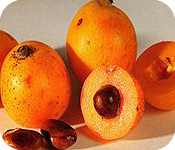
Fruit: Loquat fruits, growing in
clusters, are oval, rounded or pear-shaped, 1 to 2 inches long with
a smooth or downy, yellow or orange, sometimes red-blushed skin.
The succulent, tangy flesh is white, yellow or orange and sweet
to subacid or acid, depending on the cultivar. Each fruit contains
three to five large brown seeds. The loquat is normally pollinated
by bees. Some cultivars are self-infertile and others are only partially
self-fertile. Flowers of the early and late flushes tend to have
abnormal stamens and very little viable pollen. Thinning of flowers
and young fruits in the cluster, or clipping off all or part of
flower and fruit clusters is sometimes done to enhance fruit size.
Under most conditions the loquat tends to develop an alternate-bearing
pattern, which can be modified somewhat by cluster thinning in heavy
production years. For the highest quality fruit the clusters are
sometimes bagged to protect from sunburn and eliminate bird damage.
CULTURE
Location: Loquats are wind tolerant and grow best in full
sun, but also do well in partial shade. The round headed trees can
be used to shade a patio. Loquats also make attractive espaliers.
Soil: Loquats grow well on a variety of soils of moderate fertility,
from light sandy loam to heavy clay and even limestone soils, but
need good drainage.
Irrigation: Loquat trees are drought
tolerant, but they will produce higher quality fruit with regular,
deep watering. The trees should be watered at the swelling of blossoms
and 2 to 3 waterings should be given during harvest time. The trees
will not tolerate standing water.
Fertilizing: Loquats benefit from
regular, light applications of nitrogen fertilizers, but too much
nitrogen will reduce flowering. A good formula for applications
of chemical fertilizer is 1 lb. of 6-6-6NPK three times a year
during the period of active growth for each tree 8 to 10 feet in
height. To control excessive growth, other authorities recommend
fertilizing only once a year in midwinter.
Pruning: Judicious pruning should be done just
after harvest, otherwise terminal shoots become too numerous and
cause a decline in vigor. The objective of pruning is a low head
to facilitate fruit thinning and harvest. Prune also to remove crossing
branches and thin dense growth to let light into the center of the
tree. Loquats respond well to more severe pruning.
Propagation: Generally seeds are
used for propagation only when the tree is grown for ornamental
purposes or for use as rootstock. For rootstock the seed are washed
and planted in flats or pots soon after removal from the fruit and
the seedlings are transplanted when 6 to 7 inches high. When the
stem is 1/2 inch thick at the base, the seedlings are ready to be
top-worked. Loquats can be propagated by various grafting methods,
including shield-budding or side-veneer grafting and cleft-grafting.
The use of loquat seedling rootstock usually results in a comparatively
large tree with a high canopy. Cultivars grown on quince rootstock
produce a dwarfed tree of early bearing character. The smaller tree
has no effect on fruit size and gives adequate fruit production
with the advantage of easier picking. Loquat cuttings are not easy
to root. Grafted trees will begin to bear fruit in 2 to 3 years,
compared to 8 to 10 years in seedling trees.
Pests and Diseases: In California
there are few pests that bother loquats. Occasionally infestations
of black scale may appear. Fruit flies are a serious pests in areas
where they are problem. Birds will also peck at the ripe fruit and
damage it, and deer will browse on the foliage. Fire blight caused
by Erwinia amylovora is a major enemy of the loquat in California,
particularly in areas with late spring and summer rains or high
humidity. The disease is spread by bees during flowering. Fire blight
can be controlled somewhat by the use of preventive fungicides or
bactericides and by removal of the the scorched-looking branches,
cutting well into live wood. The prunings should be burned or or
sealed in a plastic bag before disposal. Crown rot caused by Phytophthora
and cankers caused by Pseudomonas Eriobotrya are also occasional
problems.
Harvest: Loquat fruits should be
allowed to ripen fully before harvesting. They reach maturity in
about 90days from full flower opening. When ripe the fruit develops
a distinctive color, depending on the cultivar, and begins to soften.
Unripe fruits do not ripen properly off the tree and are excessively
acid. Harvest time in California is from March to June. The fruit
is difficult to separate from the cluster stems without tearing
and must be carefully clipped individually or the whole cluster
removed and the fruit then snipped off. Ripe fruit may be stored
in the refrigerator for 1 to 2weeks. The loquat is comparable to
the apple in many aspects, with a high sugar, acid and pectin content.
It is eaten as a fresh fruit and mixes well with other fruits in
fresh fruit salads or fruit cups. Firm, slightly immature fruits
are best for making pies or tarts. The fruits are also commonly
used to make jam, jelly and chutney, and are delicious poached in
light syrup. Loquats can also be used to make wine.
Commercial Potential: In California,
only in the coastal areas from Santa Barbara to San Diego counties
is the fruit produced regularly in quantity and of sufficiently
good quality to make commercial production feasible. Harvesting
is somewhat labor intensive and the difficulty of handling the fragile
fruit in addition to the relatively short self life and storage
ability, limit the loquat as a major commercial fruit. Even so,
the availability of loquats when few or no other local fruits are
in the market is a factor in their favor. The fruit is also popular
in ethnic markets and is offered in limited amounts in specialty
fruit stores and through Farmer's Markets in many communities.
CULTIVARS
Orange-fleshed Varieties
Big Jim Originated in San Diego,
Calif. by Jim Neitzel. Large, roundish to oblong fruit, 1-1/4 to
1-1/2 inches in diameter. Skin pale orange-yellow, medium-thick,
easy to peel. Flesh orange-yellow, very sweet but with some acidity,
of excellent flavor. Ripens midseason, March to April. Tree vigorous,
upright, highly productive.
Early Red Originated by C. P. Taft
in 1909. Medium-large, pear-shaped fruit, borne in compact clusters.
Skin orange-red with white dots, tough, acid. Flesh orange very
juicy, sweet, of fair to excellent flavor. Seeds usually 2 or 3.
Ripens very early, late January or early February in California.
Gold Nugget (Thales, Placentia)
Large, round to oblong-obovate fruit. Skin yellow-orange to orange,
not thick, tender. Flesh orange-colored, juicy, firm and meaty.
Flavor sweet, somewhat reminiscent of apricot, quality good. Seeds
4 or 5, the seed cavity not large. Ripens late. Fruits borne only
a few to a cluster, keep and ship well. Tree vigorous, upright,
self-fertile.
Mogi Selected from numerous seedlings
planted at Mogi, Japan. Small, elliptical fruit, weight 40-50grams.
Skin light yellow. Flesh relatively sweet. Ripens in early spring.
Tree cold-sensitive, self-fertile. Constitutes 60% of the Japanese
crop of loquats.
Mrs. Cooksey New Zealand cultivar.
Large fruit, up to 1-1/2 inches long and 1inch in diameter. Yellow
flesh of very good flavor.
Strawberry Medium-sized fruit with
yellow flesh. Named for the strawberry-like flavor detected by some
tasters.
Tanaka Named after Dr. Yoshio Tanaka.
Very large fruit, usually obovoid, weight 2 to 3 ounces. Skin orange-yellow,
attractive. Flesh firm, rich orange, aromatic, slightly acidic to
sweet, of excellent flavor. Seeds 2 to 4. Ripens very late, the
beginning of May in California. Keeps unusually long, if left for
a week it wrinkles and dries but does not rot. Tree vigorous and
productive.
Wolfe Originated in Homestead,
Florida by Carl W. Campbell. Fruit obovoid to slightly pyriform.
Skin yellow, relatively thick. Flesh juicy, firm, flavor excellent.
Seeds usually 1 to 3. Ripens in winter and early spring, several
days later than Advance. Suitable for all purposes, but excellent
for cooking. Tree to 25 feet tall. Blooms during fall and early
winter.
White-fleshed Varieties
Advance Medium to large, pear-shaped
to eliptic-round fruit, deep yellow in color, borne in large, compact
clusters. Skin downy, thick and tough. Flesh whitish, translucent,
melting and very juicy. Flavor subacid, very pleasant, quality good.
Ripens in midseason. Seeds commonly 4 or 5, the seed cavity not
large. Tree is a natural dwarf, height 5 feet. Highly resistant
to fire blight. Self-infertile, pollinate with Gold Nugget.
Benlehr Originated as a seedling
on the property of Charles E. Benlehr of Encinitas, Calif. Medium-sized
oval to oblong fruit, 1-1/2 to 1-3/4 inches long. Skin thin, peels
very well. Flesh white and juicy, flavor sweet, quality excellent.
Seeds 3 or 4.
Champagne Fruit medium to large,
oval to pyriform. Fruit cluster large, loose. Skin deep yellow in
color with a grayish bloom, thick, tough, somewhat astringent. Flesh
whitish, translucent, melting and very juicy. Flavor mildly subacid,
sprightly and pleasant, quality very good. Ripens late. Seeds 3
or 4, seed cavity not large. Perishable, good for preserving. Tree
self-infertile, prolific.
Herd's Mammoth Fruit large, long
and slightly tapering at the stem end. Flesh yellow orange with
white to cream-colored flesh, good quality. Ripens earlier than
Victory. Subject to black spot.
Victory (Chatsworth Victory) Large,
oval fruit. Skin yellow to orange, becoming amber on the side exposed
to the sun. Flesh white to cream-colored, juicy and sweet. Ripens
in midseason to occasionally early. The most popular cultivar in
Western Australia.
Vista White Small to medium-sized,
roundish fruit with blunt calyx end. Skin light yellow. Flesh pure
white, very high in sugar content. Ripens 1 to 3 weeks later than
Gold Nugget. Excellent for dessert. |
|
|
AVAILABLE FROM:
Alan’s Tropical Fruit Trees
Largo, FL
J.D. Andersen Nursery
Fallbrook, CA
Atkins Nursery, Inc.
Fallbrook, CA
California Tropical Fruit Tree Nursery
Vista, CA
Exotica Nursery Inc.
Vista, CA
Green Mart
Orange, CA
Jene’s Tropicals
St Petersburg, FL
Laguna Hills Nursery
El Toro, CA
Louisiana Nursery
Opelousas, LA
Roger & Shirley Meyer
Fountain Valley, CA
Northwoods Wholesale Nursery
Mollala, OR
Ong Nursery
San Diego, CA
Oregon Exotics
Grants Pass, OR
Pacific Tree Farms
Chula Vista, CA
Papaya Tree Nursery
Granada Hills, CA
Ben Poirier
Fallbrook, CA
Tropical Oasis Farms
Cucamonga, CA
Just Fruits and Exotics
Crawfordville, FL
|
|