|
Distant
affinity:
Akee ( Blighia sapida ), Longan ( Dimocarpus
longan ), Rambutan ( Nephelium lappaceum ), Pulasan ( N. mutabile
), Fijian longan ( Pometia pinnata ).
Adaptation:
Lychees require seasonal temperature variations
for best flowering and fruiting, Warm, humid summers are best for
flowering and fruit development, and a certain amount of winter
chilling is necessary for flower bud development. Most varieties
need between 100 and 200hours of standard chilling (32° - 45°F).
Cool winters with low rainfall are ideal for lychees. The trees
become more hardy as they age. Mature trees have survived temperatures
as low as 25°F when fully hardened off. Young trees may be killed
by a light frost. Lychees can be successfully grown in frost-free
coastal areas of California. There are trees in San Diego, California
that are over 90years old with no sign of decline in sight. It
first fruited in Santa Barbara in 1914. They can be grown for a
short period in a large container.
DESCRIPTION
Growth Habit: The lychee tree is
handsome, dense, round-topped and slow-growing with smooth, gray,
brittle trunk and limbs. Under ideal conditions they may reach 40feet
high, but they are usually much smaller The tree in full fruit is
a stunning sight.
Foliage: The leathery, pinnate
leaves are divided into four to eight leaflets. They are reddish
when young, becoming shiny and bright green. Lychee trees have full
foliage and branch to the ground.
Flowers: The tiny petalless, yellowish-green
flowers are borne in in terminal clusters to 30inches. Lychees
are eye-catching in spring when the huge sprays of flowers adorn
the tree. Flowering precedes fruit maturity by approximately 140days.
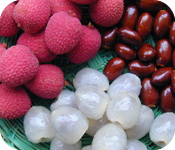
Fruits: The fruit is covered by
a leathery rind or pedicarp which is pink to strawberry-red in color
and rough in texture. A greenish-yellow variety is not grown in
California at present. Fruit shape is oval, heart-shaped or nearly
round, 1 to 1-1/2inches in length. The edible portion or aril is
white, translucent, firm and juicy. The flavor is sweet, fragrant
and delicious. Inside the aril is a seed that varies considerably
in size. The most desirable varieties contain atrophied seeds which
are called "chicken tongue". They are very small, up to 1/2inch
in length. Larger seeds vary between 1/2 to 1inch in length and
are plumper than the chicken tongues. There is also a distinction
between the lychee that leaks juice when the skin is broken and
the "dry and clean" varieties which are more desirable. In some
areas lychees tend to be alternate bearers. Fruit splitting is usually
caused by fluctuating soil moisture levels.
CULTURE
Location: Lychees need full sun, but young trees must be
protected from heat, frost and high winds.
Soil: The tree needs
a well-drained soil that is rich in organic matter. A soil pH between
5.5 and 7.5 is acceptable, but plants grow much better in soils
with a pH at the low end of this range. Apply a thick layer of organic
mulch to the soil after planting.
Irrigation: The lychee will not
tolerate standing water, but requires very moist soil, so water
the tree regularly when it is growing actively. The trees are very
sensitive to damage from salts in the soil or in water. Leach the
soil regularly in the Southwest.
Fertilization: Young trees tend
to grow slowly, and many gardeners tend to give them too much fertilizer
in an attempt to push them along. Young trees should receive only
light applications of a complete fertilizer. Mature trees are heavier
feeders and should be fertilized regularly from spring to late summer.
Use fertilizers formulated for acid-loving plants. Chelated iron
and soil sulfur may be necessary in areas with alkaline soils.
Pruning:
Prune young trees to establish a strong, permanent structure for
easy harvest. After that, removing crossing or damaged branches
is all this is necessary, although he trees can be pruned more heavily
to control size. V-shaped crotches should be avoided because of
the wood's brittle nature.
Frost Protection: Lychees need warmth
and a frost-free environment, but can often withstand light freezes
with some kind of overhead protection. When they are young, this
can be provided by building a frame around the plants and covering
it with bedding, plastic sheeting, etc. when frost threatens. Electric
light bulbs can also be used for added warmth.
Propagation: Air-layering is the
most common method of propagating lychees because grafting is difficult
and seedlings are not reliable producers of quality fruit. To grow
a plant from seed it is important to remember that seeds remain
viable for no more than a day or two under dry conditions. Young
seedlings grow vigorously until they reach 7 or 8inches in height.
They will stay at this height for up to two years without further
noticeable growth. Wedge and bud grafts are possible, but seldom
used. When planting a Lychee, hole preparation is the same as for
planting avocados. If planting marcots directly, most leaves should
be removed. A round of hog wire covered with plastic gives excellent
wind protection and also holds moisture in. In case of a freeze,
one has only to throw a blanket over the top. The plastic should
not touch the plant. This protection should be planned on and taken
care of the day the plant goes into the ground.
Pests and Diseases: Mites, scale
and aphids occasionally infest lychees. Birds are often attracted
to lychees, eating both the immature and the ripe fruit. It may
be necessary to cover the plants with a protective netting.
Harvest: The Fruit must be allowed to ripen fully on the
tree. Overly mature fruit darken in color and lose their luster.
The flavor lacks the richness associated with a certain amount of
acidity. To harvest, snip off entire fruit clusters, keeping a short
piece of the stem attached. Lychees can be stored for up five weeks
in the refrigerator. They can also be frozen or dried. Lychees will
begin to deteriorate within three days at room temperature.
CULTIVARS
Amboina Medium, bright red, borne
in clusters of 6 to 20. Ripens April to May. Slow-growing tree.
Bears regularly in warm climates.
Bengal Introduced by USDA in 1929
from Calcutta. Fruits are similar to Brewster but more elongated
with smaller seeds. Firm flesh. Dry and clean type. Large, very
vigorous tree. Easy to grow.
Brewster Large, conical or wedge-shaped
red fruit with soft flesh. Slightly acid with fully formed large
seeds. Commercial crop in Florida. Mid-season fruiting. Large, vigorous,
upright tree.
Groff Small, dull red, spiny, borne
in clusters of 20 to 40. Small seed. Ripens August to September.
Latest ripening variety. Upright tree.
Hak ip Medium-red fruit sometimes
with green tinges with soft skin. Flesh is crisp sweet and occasionally
pinkish.
Kwa luk Large, red fruit with green
tip and typical green line. Exceptional flavor and fragrance. In
the past was a fruit given to person of honor. Dry and clean type.
Mauritius (Kwai Mi) Ripens early.
Medium size, slightly oval, reddish-brown fruit. Firm, good-quality
fruit. Tends to have chicken-tongue seeds.
No Mai Tsze Large, red, dry and
clean type. Leading variety in China. Small seeds. One of the best
for drying.
Tai tsao Fruit ripens early. Somewhat
egg-shaped, bright red, rough skin. Crisp, sweet, firm flesh. Leaks
juice when skin is broken. |
|
|
AVAILABLE FROM:
Alan’s Tropical Fruit Trees
Largo, FL
J.D. Andersen Nursery
Fallbrook, CA
Atkins Nursery, Inc.
Fallbrook, CA
California Tropical Fruit Tree Nursery
Vista, CA
Exotica Nursery Inc.
Vista, CA
Green Mart
Orange, CA
Jene’s Tropicals
St Petersburg, FL
Laguna Hills Nursery
El Toro, CA
Roger & Shirley Meyer
Fountain Valley, CA
Ong Nursery
San Diego, CA
Oregon Exotics
Grants Pass, OR
Pacific Tree Farms
Chula Vista, CA
Papaya Tree Nursery
Granada Hills, CA
Ben Poirier
Fallbrook, CA
Tropical Oasis Farms
Cucamonga, CA
Fruit Lover’s Nursery
Pahoa, Hawaii
Montoso Gardens
Maricao, Puerto Rico
|
|