|
Related
Species:
Bindjai (Mangifera caesia), Horse Mango (M.
foetida), Kuweni mango (M. odorata).
Distant affinity:
Cashew (Anacardium occidentale), Gandaria
(Bouea gandaria), Pistachio (Pistacia vera), Marula (Sclerocarya
birrea), Ambarella (Spondias cytherea), Yellow Mombin (Spondias
mombin), Red Mombin (Spondias purpurea), Imbu (Spondias tuberosa).
Forms:
The mango exists in two races, one from India
and the other from the Philippines and Southeast Asia. The Indian
race is intolerant of humidity, has flushes of bright red new growth
that are subject to mildew, and bears monoembryonic fruit of high
color and regular form. The Philippine race tolerates excess moisture,
has pale green or red new growth and resists mildew. Its polyembryonic
fruit is pale green and elongated kidney-shaped. Philippines types
from Mexico have proven to be the hardiest mangos in California.
Adaptation:
Mangos basically require a frost-free climate.
Flowers and small fruit can be killed if temperatures drop below
40°F, even for a short period. Young trees may be seriously damaged
if the temperature drops below 30°F, but mature trees may withstand
very short periods of temperatures as low as 25°F. The mango must
have warm, dry weather to set fruit. In southern California the
best locations are in the foothills, away from immediate marine
influence. It is worth a trial in the warmest cove locations in
the California Central Valley, but is more speculative in the coastal
counties north of Santa Barbara, where only the most cold adapted
varieties are likely to succeed. Mangos luxuriate in summer heat
and resent cool summer fog. Wet, humid weather favors anthracnose
and poor fruit set. Dwarf cultivars are suitable for culture in
large containers or in a greenhouse.
DESCRIPTION
Growth Habit: Mango trees make
handsome landscape specimens and shade trees. They are erect and
fast growing with sufficient heat, and the canopy can be broad and
rounded, or more upright, with a relatively slender crown. It is
ultimately a large tree, to 65 ft., but usually half that size in
California. The tree is long-lived with some specimens known to
be over 300 years old and still fruiting. In deep soil the taproot
descends to a depth of 20 ft, and the profuse, wide-spreading feeder
roots also send down many anchor roots which penetrate for several
feet.
Foliage: The leaves are dark green
above and pale below, usually red while young. The midrib is pale
and conspicuous and the many horizontal veins distinct. Full-grown
leaves may be 4 to 12-1/2 in. long and 3/4 to 2 in. wide, and are
generally borne in clusters separated by a length of naked stem
bearing no buds. These naked stems mark successive flushes of growth.
Each flush of growth will harden off to a rich green color before
the next flush of growth begins.
Flowers: The yellowish or reddish
flowers are borne in inflorescences which appear at branch terminals,
in dense panicles of up to 2000 minute flowers. These flowers respire
a volatile substance, causing allergic and respiratory problems
for some persons. Pollinators are flies, hoverflies, rarely bees.
Few of the flowers in each inflorescence are perfect, so most do
not produce pollen and are incapable of producing fruit. Pollen
cannot be shed in high humidity or rain. Fertilization is also ineffective
when night temperatures are below 55°F. Mangos are monoecious and
self-fertile, so a single tree will produce fruit without cross
pollination. Polyembryonic types may not require pollination at
all. Branches may be ringed to induce flowering, but the results
are mixed.
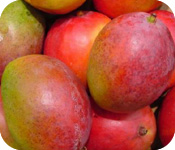
Fruits: The fruits grow at the
end of a long, stringlike stem (the former panicle), with sometimes
two or more fruits to a stem. The fruits are 2 to 9 inches long
and may be kidney shaped, ovate or (rarely) round. They range in
size from 8 ounces to around 24 ounces. The flower scar at the apex
is prominent, in some cultivars bulging from the fruit. The leathery
skin is waxy and smooth, and when ripe entirely pale green or yellow
marked with red, according to cultivar. It is inedible and contains
a sap that is irritating to some people. The quality of the fruit
is based on the scarcity of fiber and minimal turpentine taste.
The flesh of a mango is peachlike and juicy, with more or less numerous
fibers radiating from the husk of the single large kidney-shaped
seed. Fibers are more pronounced in fruits grown with hard water
and chemical fertilizers. The flavor is pleasant and rich and high
in sugars and acid. The seed may either have a single embryo, producing
one seedling, or polyembryonic, producing several seedlings that
are identical but not always true to the parent type. It is impossible
to distinguish true-to-type from zygotic seedlings from the same
fruit. Some seedlings produce numerous tiny, parthenocarpic fruits
which fail to develop and abort. Mango trees tend to be alternate
bearing.
CULTURE
Location: The mango grows to a
good size and casts a dense shade, but the roots are not destructive.
It requires full sun and perfect air drainage in winter. It does
best at the top or middle level of a slope. A windbreak should be
provided in exposed areas. The trees may also need staking. In the
desert it needs the shade of other trees; or plant on the north
side of the house. In the garden or near the coast, plant against
a south wall, or in an area surrounded by paving, to provide maximum
heat. In the greenhouse, full light and free air movement are important
to avoid disease.
Soil: Mangos will grow in almost
any well-drained soil whether sandy, loam or clay, but avoid heavy,
wet soils. A pH between 5.5 and 7.5 is preferred. They are somewhat
tolerant of alkalinity. For good growth, mangos needs a deep soil
to accommodate their extensive root systems.
Irrigation: Irrigation should start
when the weather warms: February in the desert, April at the coast.
Continue every one to two weeks, more often in light soils, nearly
continuously in the desert, until the fruit is harvested. Irrigation
may be discontinued when rains are sufficient to maintain soil moisture.
In the greenhouse keep watered until the fruit is harvested, then
reduce to the minimum required to avoid wilting. Watering is then
increased after one to two months to initiate a new bloom and growth
cycle.
Fertilization: Mango trees require
regular applications of nitrogen fertilizer to promote healthy growth
flushes and flower production. Chelated micronutrients, especially
iron, are also often necessary. A feeding program similar to one
used for citrus is satisfactory, but do not fertilize after midsummer.
Organic fertilizers perform best, since the trees are subject to
fertilizer burn. Young trees are particularly sensitive to over-fertilizing,
but respond well to fish emulsion. Sandy soils require more fertilizer
than loam or clay.
Pruning: Healthy trees require
little pruning, although pruning to stimulate new growth promotes
uniform annual bearing. Removing some flower clusters during a heavy
bloom year may also alleviate alternate bearing. Mangos may be pruned
to control size in late winter or early spring without a loss of
fruit. Sap and debris can cause severe dermatitis, similar to poison
oak. It is best to avoid burning prunings or litter.
Frost Protection: During the first
two years, the trees should be given some protection such as an
overhead cover during any frost threat. Once the tree is 3 to 4 feet
high, overhead protection is difficult but still worthwhile, especially
if an unusual cold snap is predicted. Frost damage can also be avoided
by erecting an overhead lath shelter, orchard heating, placing lights
under the canopy, or using foam or straw trunk wraps. Do not prune
dead parts until all frost danger is past.
Propagation: Seedlings are a gamble.
Supermarket fruits may have been treated to sterilize, or chilled
too long to remain viable. These seeds are normally discolored gray.
To grow mangos from seed, remove the husk and plant the seed (before
it dries out) with the hump at soil level. The seeds normally germinate
in two to four weeks, and do best with bottom heat. Multiple polyembryonic
seedlings should be carefully separated as soon as they have sprouted
so not to loose the cotyledons. Seedling mangos will bloom and bear
in three to six years. Some success at grafting can be obtained
in April and September, but better luck is more likely during May
through August. Small plants with a diameter of a pencil graft well
with the common whip graft. On larger trees the crown groove bark
graft allows several scions to be put on at once. Fully grown trees
may be topworked by crown or groove bark graft, or prune hard and
whip graft sprouts later. Plastic bagging with a few drops of moisture
improves the graft's chances of being successful. Graft in the second
year, using cleft, side or tongue (splice) graft in midsummer. Scion
and stock should be swelling for a new flush of growth. Grafts are
most successful if the leaves are allowed to remain below the graft,
but remove suckers. Use pencil-sized scions of hard wood with three
or four nodes. Cover with loose punctured white paper bag for shade.
If top working, do not dehorn the entire tree at one time; leave
at least two fully leafed branches intact. Marcottage is feasible
in humid climates or greenhouses, but results in few plants. Although
budding is rare in California; it can be done by using a shield
bud in an inverted T, at the moment the tree begins a new growth
flush. Cuttings are rarely successful, although experiments have
shown that rooting may be improved by treating with ethylene, which
destroys the root-inhibiting hormone in the cambium. The Mango is
a suitable and productive tree for growing in a container or greenhouse.
Start with established plants of named cultivars. Select the finest
Indian cultivars, which are most rewarding for the effort involved.
A large tub is required, with casters for easy moving. In the greenhouse,
the atmosphere should be kept dry as possible to avoid anthracnose.
Place a fan nearby to move the air around trees and use ventilators.
The plants should be hosed down in the morning on a weekly basis
to control mites. A regular spraying of appropriate pesticides for
anthracnose and mealybug may also be needed. The location of the
intended planting will dictate the choice of cultivars. Seedlings
selected under California conditions have provided cultivars suitable
for coastal counties. Florida cultivars are generally more suitable
in the desert and Central Valley.
Pests and Diseases: Scale, mealybugs
and mites are frequent pests in the greenhouse and orchard. In the
greenhouse, thrips often turn leaves rusty brown. Malathion is the
conventional spray for insect pests; sulfur works on mites. Gophers
are attracted to the roots. The flower panicles, young fruit and
leaves are subject to powdery mildew (Oidium mangiferae), especially
in rainy weather or frequent fog. A spray of powdered kelp at bud
break will often control it. Sodium bicarbonate and fungicide sprays
are also effective. Trees planted in pavement openings seldom develop
mildew. Bacterial spot (Colletotrichum oleosporides) distorts and
turns developing leaves black and disfigures developing fruit. Infection
may spread to fresh young growth. Anthracnose can be controlled
with bimonthly applications of copper spray or captan as a growth
flush begins, and until the flowers open. Resume spraying when the
fruits begin to form. Mango trees are very sensitive to root loss
that can occur from digging, transplanting or gopher damage. "Soft
nose," a physical disorder of shriveling at the fruit apex, seems
associated with excessive nitrogen in soil. Exposed fruits sunburn
in high temperatures. Fruit
Harvest: Mango fruit matures in
100 to 150 days after flowering. The fruit will have the best flavor
if allowed to ripen on the tree, although winter-maturing fruits
must be ripened indoors in coastal California. Ripening fruit turns
the characteristic color of the variety and begins to soften to
the touch, much like a peach. Commercial marketability requires
13% dissolved solids (sugars). When the first fruit shows color
on tree, all of that size fruit or larger may be removed; repeat
when remaining fruit colors. Do not store below 50°F.The fruit
ripens best if placed stem end down in trays at room temperature
and covered with a dampened cloth to avoid shriveling. Mangos ripen
in June from January bloom in interior California, and October from
April bloom on the coast. Less time is required to mature greenhouse
fruit.
Commercial Potential: The mango
is the apple (or peach) of the tropics, and one of the most commonly
eaten fruits in tropical countries around the world. The fruit is
grown commercially on a small scale in Florida. In California a
large planting in the Coachella Valley has now reached production
stage. The quality of the fruit is generally comparable to Florida
mangos, but has other advantages., i.e. the lack of fruit fly and
seed weevil populations. Mexico, and to a lesser extent Central
America, is a major supplier to U.S. markets today.
CULTIVARS
Aloha Origin San Diego, Jerry Staedeli,
1971. From Hawaiian seed. Tree spreading, light bearer, according
to rootstock affinity. Fruit large (14-18 oz.), dull yellow covered
with red. Early (Oct-Nov). Susceptible to anthracnose. For coast.
Brooks Origin Miami, 1916. Seedling
of Sandersha. Tree somewhat dwarf. Fruit medium to large (10-20 oz.),
kidney-shaped, green with yellow shoulder, rather fibrous. Very
late. Resistant to anthracnose. For greenhouse and containers.
Cambodiana Origin Miami, 1910.
Seedling of Saigon. Philippine type. Fruit small to medium, elongated
ovate, yellow-green, juicy, flavor acid. Early. For greenhouse.
Carabao Origin Philippines. Philippine
type. Fruit medium (10 oz.), elongated, kidney-shaped, light green
blushed yellow. Seed very large, flesh stringy, acid, juicy. Early
midseason. For greenhouse.
Carrie Origin Delray Beach, Florida,
1940. Seedling of Sophie Fry. Tree dwarf. Fruit varies from small
to 12oz., regular ovate, green-yellow, fiberless, flavor high.
Early. For foothills, interior and greenhouse.
Cooper (syn. Cooper No. 1 or 3)
Origin Hollywood, Floyd Cooper, 1948. Tree spreading, dense. Fruit
large (16-20 oz.), long, green. Flesh high quality. Late. For foothills.
Costa Rica Origin East Los Angeles,
Gilbert Guyenne, 1980. From seed from Costa Rica. Fruit small to
10 oz., elongated, flat, pale green, juicy. Very early. For coast
and foothills.
Doubikin Origin Kelmscott, West
Africa, Arnold Doubikin, 1965. Two sibling seedlings of Kensington
pass under this name. Tree dwarf, rounded, slow growing, fruits
in two years from seed. Polyembryonic. Fruit round, large (12-16 oz.),
midseason. For coast, foothills, greenhouse.
Earlygold Origin Pine Island, Florida,
1943. Tree upright. Fruit medium to 12 oz., obliquely round, orange
with red blush, fiberless, seed often abortive. Very early. Resistant
to anthracnose. For coast.
Edgehill Origin Vista, Calif.,
Paul Thomson, 1920s. Indian type. Tree upright, hardy, vigorous.
Monoembryonic. Blooms early. Produces small to medium (8-12 oz.),
almost fiberless fruit, green with red blush. Resists mildew, subject
to soft nose. Midseason (Nov-Dec). For foothills.
Edward Origin Miami, Edward Simmons,
1948. Hybrid of Haden X Carabao. Intermediate between Indian and
Philippine forms. Tree dense, compact. Fruit medium to large, elongated
ovate, apex often oblique, yellow green with red blush. Seed very
small, easily removed. Flavor excellent. Early. For interior.
Fascell Origin Miami, 1936. Seedling
of Brooks. Pat. #451. Tree open, slow. Fruit medium to large, elongated
flattened, yellow with pink blush, flesh acid. Early. For coast
and inland.
Gouveia Origin Honolulu, Ruth Gouveia,
1946. Tree upright, open, Fruit medium to large,(10-20 oz.), long
ovate, green becoming bright red. Sweet, juicy, no fiber. Late,
uneven ripening. For coast and inland.
Haden Origin Coconut Grove, Capt.
Haden, 1910. seedling of Mulgoba. Indian type. Tree spreading. Fruit
large (to 24 oz.), regular ovate, yellow almost covered with red,
flavor mild, little fiber. Early. Susceptible to anthracnose and
alternate bearing, traits imparted to its progeny. For interior
and greenhouse.
Irwin Origin Miami, F.D. Irwin,
1945. Seedling of Lippens. Florida's leading local market cultivar.
Tree very small. Fruit medium, 12-16 oz., elongated, ovate regular
in form, orange yellow with deep blush, flesh bland, fiberless.
Mid-season. For foothills, interior, greenhouse.
Julie Origin Trinidad. Tree dwarf,
slow growing. Fruit small (6-10 oz.), flat oblong, obliquely almost
two-nosed, orange, rather fibrous, juicy, sweet. Late. For containers,
greenhouse.
Keitt Origin Homestead, 1945. Probably
seedling of Mulgoba. Fruit large (20-26 oz.), ovate with slightly
oblique apex, green, flesh rich, fiber only around seed. Resists
mildew. Late. For interior. Florida fruiting July Aug., sometimes
to Sept.
Kensington Pride (syns. Pride of
Bowen, Bowen Special) Origin Bowen, Queensland, 1960s. Generally
propagated as seedling strain. Polyembryonic. Tree rounded, vigorous.
Fruit medium to large, almost round with pink blush. Flavor sweet.
Standard Australian mango cv. Fruit tends to drop at small size.
Midseason. For foothills.
Kent Origin Coconut Grove, 1944.
Seedling of Brooks. Tree upright. Fruit large (20-26 oz.), regular
ovate, greenish yellow with red shoulder, flesh rich, fiberless.
Late midseason. For interior.
MacPherson Origin Encinitas, L.L.
Bucklew, 1944. Tree dense, low branching. Fruit small (6-8 oz.),
yellow-green with red blush, flesh fairly good. Midseason. For coast.
Manila Origin Mexico, a seedling
race common in Veracruz state. A seedling strain from Hawaii. Philippine
type. Tree dwarf, dense. Fruit small to 10 oz., shaped long, flat,
yellow, flavor sharp. Subject to anthracnose. Early (Oct-Dec), late
picked fruit best. For coast and foothills.
Mulgoba Origin Bombay; distinct
from ancient cv. Mulgoa. Fruit medium, 16 oz., greenhouse.
Ott Origin La Habra heights, William
Ott, 1948. Seedling of Saigon. Tree dwarf. Fruit medium, to six
inches, orange-yellow with pink blush. Season very early.
Piña (syn. Pineapple) Origin Mexico,
a seedling strain. Philippine type. Tree upright. Fruit small to
12 oz., shape ovoid, orange yellow. Flavor suggests pineapple. Early
midseason (Nov-Dec). For foothills.
Pirie (syn. Paheri) Origin India,
ancient. Tree broad, spreading. Fruit small (8-10 oz.), almost round,
apex oblique, yellow with red blush. Juicy, fiberless, rich flavor.
Alternate bearing; blooms every 18 months. Early midseason. For
greenhouse.
Reliable Origin San Diego, Calif.,
Jerry Staedeli, 1966. Seedling of Sensation. Tree broad, dense,
slow. Fruit size varies from 10-20 oz., shape oblong, yellow blushed
red. Rarely misses a crop. Subject to anthracnose, soft nose. Long
ripening season (Oct-Feb). For coast and foothills.
Sensation Origin Miami, 1941. Tree
broad, rounded. Fruit small, round with oblique apex, yellow with
red blush, fibers few. Late. For interior.
T1 Origin Vista, Paul Thomson,
1969. Seedling of Edgehill. Tree low, spreading. Vigor dependent
upon rootstock. Fruit medium to large, 6-8 inches, shape broad oval,
green with red blush, fiberless. Subject to anthracnose, resists
mildew, soft nose. Late midseason (Dec-Jan), very late on coast
(Jan-Feb). For coast, foothills, interior, containers.
Thomson (syn. Thomson Large Seedling)
Origin Vista, Paul Thomson, 1966. Manila seedling, polyembryonic.
Tree spreading, vigor dependent upon rootstock. Fruit small to medium,
(6-12 oz.), yellow, shape flat, to eight inches. Resists mildew.
High fiber under chemical fertilizer regime. Season early, long
(September-November), ripens well indoors if picked prematurely.
For coast.
Tommy Atkins Originated from a
seed planted in the 1920s at Fort Lauderdale, Florida. Commercially
grown for export in Florida. Tree full, dense. Fruit medium to large,
16 oz. with thick skin, regular ovate, orange-yellow covered with
red and heavy purple bloom. Firm, juicy, medium fiber, fair to good
quality. Flavor poor when over fertilized and irrigated. Resists
anthracnose. Early, ripens well if picked immature. For interior.
VillaseÑor Origin Los Angeles,
1950s, Sr. VillaseÑor. Tree dwarf, spreading, responds to strong
rootstock. Fruit medium, to 12 oz., shape ovate, color greenish
yellow, pink blush, flavor mild. Late midseason (Dec Jan). For coast,
foothills.
Winters (syn, M20222, Southland)
Origin Miami, USDA, 1959. Seedling of Ono, Philippine type, polyembryonic.
Tree broad, production variable. Fruit medium, to 14 oz., smaller
in desert, shape half-round, yellow blushed red. Subject to anthracnose,
resists soft nose. Parthenocarpic fruit will reach full size. Season
midseason (Nov-Dec), ripens well if picked immature. For coast,
foothills, interior.
Zill Origin Lake Worth, 1930. Seedling
of Haden. Tree very spreading, open. Fruit small, 8-12 oz., almost
round, apex oblique, yellow with blush, little fiber. Ripens early.
For greenhouse.
|
|
|
AVAILABLE FROM:
Alan’s Tropical Fruit Trees
Largo, FL
J.D. Andersen Nursery
Fallbrook, CA
Atkins Nursery, Inc.
Fallbrook, CA
California Tropical Fruit Tree Nursery
Vista, CA
Exotica Nursery Inc.
Vista, CA
Green Mart
Orange, CA
Laguna Hills Nursery
El Toro, CA
Roger & Shirley Meyer
Fountain Valley, CA
Ong Nursery
San Diego, CA
Oregon Exotics
Grants Pass, OR
Pacific Tree Farms
Chula Vista, CA
Papaya Tree Nursery
Granada Hills, CA
Ben Poirier
Fallbrook, CA
Tropical Oasis Farms
Cucamonga, CA
Montoso Gardens
Maricao, Puerto Rico
|
|