|
|
|
|
|
Distant
affinity:
Baobob, (Adansonia digitata), Durian (Durio
zibethinus), Almirajo (Patinoa almirajo), Chupa-chupa, South American
Sapote (Quararibea cordata).
Adaptation:
Tropical estuaries are the native habitat
of the Malabar chestnut, so it is perhaps best suited to Hawaii
and southern Florida. Even so, the plant also grows well in the
milder parts of southern California. Several handsome specimens
are thriving in the Quail Gardens collection near Encinitas, Calif.,
which has more cold and wind than many home gardens. The plant will
tolerate brief exposure to temperatures as low as 28°F, but may
drop some or most of its leaves. Malabar chestnuts make attractive
potted plants and add an attractive tropical note to patios and
sun rooms.
DESCRIPTION
Growth Habit: The Malabar chestnut
is a very showy evergreen tree with greenish bark that can grow
to 60 ft. in the tropics. In California the growth is more like
10 to 15 ft. tall with a spread of 8 to 10 feet.
Foliage: The shiny, bright
green, alternate palmately compound leaves of the Malabar chestnut
grow to about 12 inches long and are quickly shed. They are larger
and showier than Chorisia speciosa, the popular floss-silk tree.
Young leaves and flowers are cooked and used as a vegetable.
Flowers: The petals of the very
large creamy white flowers of the Malabar chestnut curl back to
the base of the flower, leaving only the spectacular clusters of
3 to 4 inch cream-white stamens.
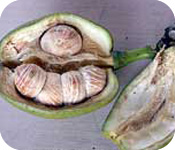
Fruit: The five-valved fruit of
Malabar chestnut is an ovoid, woody green pod which may reach 4
to 12inches in length and 2 to 2-1/2 inches in diameter, bearing
some resemblance to kapok or silk floss seed pods. The tightly packed
seeds (nuts) inside enlarge until the pod bursts and the seed fall
to the ground. The rounded seeds are without floss and 1/2 inch
or larger in diameter. They are edible raw or roasted.
CULTURE
Location: A frost-free location
with some protection from hot, drying winds is the best choice for
the plant. It will take full sun to partial shade. Overall, the
tree is a handsome landscape addition.
Soils: Malabar chestnuts are not
overly fussy about soil as long as it is well drained.
Irrigation: The Malabar chestnut
needs consistent and regular watering, although logic would suggest
that in California the plant should be kept on the dry side during
the cold winter months.
Fertilization: Malabar chestnuts
need only a light monthly fertilizing with a balanced, all-purpose
fertilizer during the warm months.
Pruning: The Malabar chestnut seldom
needs pruning.
Propagation: The tree may be propagated
by seed and cuttings, and probably by air-layering.
Pests and diseases: The Malabar
chestnut appears to be largely free of pests and diseases in California.
Container specimens should be watched for usual house plant pests
such as mealybugs.
Harvest: The nuts of the Malabar
chestnut are harvested when the seed pods burst. The raw nuts taste
like peanuts and will keep for months in a cool, dry place. Roasted
or fried in oil they have the flavor of chestnuts, and can be ground
into a flour for bread baking.
|
|
|
AVAILABLE FROM:
Alan’s Tropical Fruit Trees
Largo, FL
Exotica Nursery Inc.
Vista, CA
Green Mart
Orange, CA
Jene’s Tropicals
St Petersburg, FL
Laguna Hills Nursery
El Toro, CA
Ong Nursery
San Diego, CA
Pacific Tree Farms
Chula Vista, CA
Papaya Tree Nursery
Granada Hills, CA
Ben Poirier
Fallbrook, CA
|
|
|
|