|
home > glossary > miracle fruit > long description |
|
|
|
|
|
DESCRIPTION
Growth Habit: Miracle fruit is
an evergreen bush or tree growing to 18 ft. in its native habitat,
but rarely to 5 ft. otherwise.
Foliage: The plant has deep green, elongated leaves which grow in
a spire-like habit. Both regular and large-leaf and a hairy-leaf
form are known.
Flowers: The small 1/4 inch white flowers of miracle
fruit are produced in flushes through many months of the year.
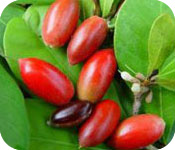
Fruit:
The fruit is a small bright red, ellipsoid berry approximately 2
to 3 cm long and containing a single seed. Although not sweet itself,
when a single fruit is eaten and the fleshy pulp allowed to coat
the taste buds of the tongue and inside of the mouth, an extraordinary
effect occurs. The fruit will now allow one to eat a slice of lemon
or lime without wincing. The marvelous aroma and inherent sweetness
of the citrus remains but the sourness is almost completely covered.
The effect remains for some 30 minutes or more.
CULTURE
Location: As an indoor plant, provide the plant with bright
light such as a well lit window. In the summer the plant can be
moved with care to a warm, lightly shaded spot. Soils: An acid soil
is a must for miracle fruit. They prefer a soil acidity of pH 4.5
to 5.8. This can be achieved by planting in equal parts Canadian
acid peat and pine bark. Also peat and perlite mixes are said to
give excellent result. In the basic soils of California, the plants
slowly die back until virtually only the stems remain. Allow the
roots of the plant to fill the container before transplanting into
a larger one.
Irrigation: Be sure that the soil is well draining
as the plants do not like to sit in wet soils. Coming from a tropical
climate they need highly humid conditions. When indoors, especially
during the winter months, a small clear plastic bag put around the
plant and supported by wood or a wire frame is helpful in maintaining
humidity. Also, placing the plant container on a tray with stones
on the bottom and filled with water to the top of the stones will
add humidity to the local area. Misting the leaves with good water
also helps.
Fertilization: Use a water soluble fertilizer such as
Miracid and follow the label directions. Use sparingly with frequency
dependent on the growing season, fertilizing more frequently during
the summer months
Pruning: In general, there is no need to prune
the miracle fruit plant.
Propagation: Propagation of miracle
fruit is usually either by seed or cuttings. As the seed viability
is short, plant the cleaned seed immediately just below the soil
line When shipping cleaned seed for others to plant, package in
a small plastic bag and enclose a slightly moistened toweling. Seed
that are allowed to dry can be shipped for at least two weeks but
rapidly loose their viability.
Pests and diseases: Watch for mealybugs,
spider mites and other indoor potted plant pests. Waterlogged plant
will succumb to root rot.
Commercial Potential: The plant is not
important as a food crop. Attempts to exploit the striking effect
on perception of sour flavors in development of artificial sweeteners
have not been successful but are continuing.
CULTIVARS
Hirsutus A form with hairy leaves
introduced into Florida from Africa some years ago. Small, oval,
red fruits; larger than those of the common smooth-leaf type. |
|
|
AVAILABLE FROM:
Alan’s Tropical Fruit Trees
Largo, FL
J.D. Andersen Nursery
Fallbrook, CA
Exotica Nursery Inc.
Vista, CA
Green Mart
Orange, CA
Jene’s Tropicals
St Petersburg, FL
Roger & Shirley Meyer
Fountain Valley, CA
Papaya Tree Nursery
Granada Hills, CA
Ben Poirier
Fallbrook, CA
Tropical Oasis Farms
Cucamonga, CA
Montoso Gardens
Maricao, Puerto Rico
|
|
|
|