|
Species:
White Mulberry (Morus alba L.), Black Mulberry
(M. nigra L.), American Mulberry, Red Mulberry (M. rubra L.). Hybrid
forms exist between Morus alba and M. rubra.
Related Species:
Korean Mulberry (Morus australis), Himalayan
Mulberry (M. laevigata).
Distant affinity:
Breadfruit (Artocarpus altilis), Jackfruit
(A. heterophyllus), Fig (Ficus spp.), Che (Cudrania tricuspidata),
African Breadfruit (Treculia african).
Adaptation:
The white mulberry, and to a lesser extent
the red mulberry, are quite tolerant of drought, pollution and poor
soil. The white mulberry is considered a weed tree in many parts
of the country including urban areas. The black mulberry is more
fastidious, faring less well in cold climates or areas with humid
summers. The white mulberry is the most cold-hardy of the three
species, although this varies from one clone to another. Some are
damaged at 25°F, while others are unfazed at -25°F. Red mulberries
are hardy to sub-zero temperatures. The black mulberry is the least
cold-hardy of the three, although again cold tolerance seems to
depend on the clone. In general it is limited to USDA Hardiness
Zone 7 (0° to 10°F average minimum) or warmer. They have been planted
only to a limited extent in America, mostly on the Pacific Coast.
The mulberry makes a good town tree which will grow well in a tub.
DESCRIPTION
Growth Habit: All three mulberry
species are deciduous trees of varying sizes. White mulberries can
grow to 80 ft. and are the most variable in form, including drooping
and pyramidal shapes. In the South on rich soils the red mulberry
can reach 70 ft. in height. The black mulberry is the smallest of
the three, sometimes growing to 30 ft. in height, but it tends to
be a bush if not trained when it is young. The species vary greatly
in longevity. Red mulberry trees rarely live more than 75 years,
while black mulberries have been known to bear fruit for hundreds
of years. The mulberry makes an attractive tree which will bear
fruit while still small and young.
Foliage: The white mulberry is
so-named for the color of its buds, rather than the color of its
fruit. The thin, glossy, light green leaves are variously lobed
even on the same plant. Some are unlobed while others are glove-shaped.
Leaves of the red mulberry are larger and thicker, blunt toothed
and often lobed. They are rough on their upper surfaces and pubescent
underneath. The smaller black mulberry leaves are similar to those
of the red mulberry, but with sturdier twigs and fatter buds. The
species vary in the time of year they begin to leaf-out. White mulberries
generally come out in early spring, almost two months before black
mulberries.
Flowers: Mulberry trees are either
dioecious or monoecious, and sometimes will change from one sex
to another. The flowers are held on short, green, pendulous, nondescript
catkins that appear in the axils of the current season's growth
and on spurs on older wood. They are wind pollinated and some cultivars
will set fruit without any pollination. Cross-pollination is not
necessary. In California mulberries set fruit without pollination.
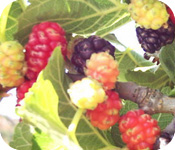
Fruit: Botanically the fruit is
not a berry but a collective fruit, in appearance like a swollen
loganberry. When the flowers are pollinated, they and their fleshy
bases begin to swell. Ultimately they become completely altered
in texture and color, becoming succulent, fat and full of juice.
In appearance, each tiny swollen flower roughly resembles the individual
drupe of a blackberry. The color of the fruit does not identify
the mulberry species. White mulberries, for example, can produce
white, lavender or black fruit. White mulberry fruits are generally
very sweet but often lacking in needed tartness. Red mulberry fruits
are usually deep red, almost black, and in the best clones have
a flavor that almost equals that of the black mulberry. Black mulberry
fruits are large and juicy, with a good balance of sweetness and
tartness that makes them the best flavored species of mulberry.
The refreshing tart taste is in some ways reminiscent of grapefruit.
Mulberries ripen over an extended period of time unlike many other
fruits which seem to come all at once.
CULTURE
Location: Mulberries need full
sun and also adequate space. The distance between trees should be
at least 15 ft. The trees should not be planted near a sidewalk.
The fallen fruit will not only stain the walkway, but are likely
to be tracked indoors. The trees are quite wind-resistant with some
cultivars used as windbreaks in the Great Plains region.
Soil: Mulberries like a warm, well-drained
soil, preferably a deep loam. Shallow soils such as those frequently
found on chalk or gravel are not recommended.
Irrigation: Although somewhat drought-resistant,
mulberries need to be watered in dry seasons. If the roots become
too dry during drought, the fruit is likely to drop before it has
fully ripened.
Fertilization: Mulberries generally
thrive with minimal fertilization. An annual application of a balanced
fertilizer such as 10:10:10 NPK will maintain satisfactory growth.
In California mulberries usually need only nitrogen.
Pruning: No special pruning techniques
are needed after the branches have been trained to a sturdy framework,
except to remove dead or overcrowded wood. A mulberry tree can be
kept to a tidy form by developing a set of main branches, and then
pruning laterals to 6 leaves in July in order to develop spurs near
the main branches. It is not advisable to prune the trees heavily
since the plant is inclined to bleed at the cuts. Cuts of more than
two inches in diameter generally do not heal and should be avoided
at all cost. The bleeding will be less severe if the tree is pruned
while it is dormant.
Propagation: Mulberries can be
grown from seed, although the plants can take 10years or more to
bear. Seed should be sown as soon as extracted from the fruit, although
white mulberry seeds germinate better after stratifying one to three
months before planting. Sprig budding is the most common method
for grafting mulberries. A T-cut is made in the rootstock and a
smooth, sloping cut is made on the lower end of the scion. The scion
is then inserted into the T and wrapped and sealed. Other types
of grafts are also usually successful, although there may be incompatibility
between white and black mulberries. Hardwood, softwood and root
cuttings also are suitable methods for propagating mulberries. Softwood
cuttings of white mulberries root easily when taken in midsummer
and treated with rooting hormone. Red mulberries are less easily
rooted. Black mulberries are also somewhat difficult to propagate
since they tend to bleed a lot.
Pests and Diseases: Mulberries
are generally free of pests and diseases, although cankers and dieback
can occur. In some areas "popcorn disease" is an occasional problem,
in which fruits swell to resemble popped corn. M.alba/M.rubra
hybrids are particularly prone to this condition. The disease carries
on from one season to the next, so collecting and burning infected
fruits help control it. The ripe fruit is very attractive to birds,
but there is usually enough fruit left over for harvesting.
Harvest: White and red mulberry
fruits (and hybrid fruits) are ready for harvest in late spring.
The fruit of black mulberries ripen in summer to late summer. The
fruits of white mulberries are often harvested by spreading a sheet
on the ground and shaking the limbs. A surprising quantity can be
gathered from a comparatively small and young tree. Black mulberry
fruits are more difficult to pick. As the berries are squeezed to
pull them loose, they tend to collapse, staining the hands (and
clothing) with blood red juice. Unwashed the berries will keep several
days in a refrigerator in a covered container. The ripe fruits of
the black mulberry contain about 9% sugar with malic and citric
acid. The berries can be eaten out of hand or used in any way that
other berries are used, such as in pies, tarts, puddings or sweetened
and pureed as a sauce. Slightly unripe fruits are best for making
pies and tarts. Mulberries blend well with other fruits, especially
pears and apples. They can also be made into wine and make an excellent
dried fruit, especially the black varieties.
CULTIVARS
Black Persian M. nigra. Large black
fruit, over an inch long and almost as wide. Juicy with a rich,
subacid flavor. The tree is fairly drought-resistant once established.
Collier M. alba X M. rubra. Medium-sized,
purplish-black fruit, 1-1/8 inches long and 3/8 inch in diameter.
Flavor sweet, with just a trace of tartness. Quality very good,
on par with Illinois Everbearing. Ripens over a long period. Tree
of medium size, spreading , relatively hardy, very productive.
Downing The original Downing was
a M. alba var. multicaulis plant grown fromseed sown about 1846.
The fruit was black with excellent flavor and ripened from June
to September. Other varieties have subsequently been sold under
the same name.
Illinois Everbearing M. alba X
M. rubra. Originated in White County, Illinois. Introduced in 1958.
Black, nearly seedless fruit large and very long, averaging 12 per
ounce. Flavor good to very good, very sweet, considered best by
by many. Matures over along season. Tree vigorous and somewhat dwarfed,
extremely hardy and productive.
Kaester M. nigra. Originated in
Los Angeles. Introduced in 1971 by Nelson Westree. Large black or
deep purple, elongated fruit, 1-1/2 inches long and 1/2 inch in
diameter. Flavor very sweet, with good sweet/tart balance. Tree
bears heavily.
Pakistan Originated in Islamabad,
Pakistan. Extremely large ruby-red fruit 2-1/2 to 3-1/2 inches long
and 3/8 inch in diameter. Flesh firmer than most other named cultivars.
Sweet with a fine balance of flavors. Quality excellent. Tree spreading
with large heart-shaped leaves. Recommended for the deep South and
mild winter areas such as southern California, but usually performs
satisfactorily in cooler areas.
Riviera Originated in Vista, Calif.
Elongated, deep purple-black fruits, 1 to 1-1/2 inches in length,
1/2inch in diameter. Flesh slightly juicy and very sweet. Very
good dessert quality. Ripens over a long period, from April to June.
Russian (Tatarica) Introduced into
Europe from China about 1,500 years ago. Fruit reddish-black, of
good quality when completely ripe. Tree bushy, to 35ft. tall, very
hardy and drought resistant. Planted widely for windbreaks and wildlife
food.
Shangri-La Originated in Naples,
Fla. Large, black fruit. Good mulberry for the Deep South and other
areas. Hardy in U.S.D.A. Zones 7-9. Tree has very large, heart-shaped
leaves.
Tehama (Giant White) Originated
in Tehama County, Calif. Very large, white-colored, plump fruit,
2-3/4 inches in length and 1/2 inch wide. Very sweet, succulent,
melting flesh. Attractive, large-leaved tree. Probably best adapted
to mild winter areas.
Wellington Originated in Geneva,
N.Y. Reddish-black medium-sized fruit, 1-1/4 inches long, 3/8 inch
in diameter. Form long, slender and cylindrical. Flesh soft, of
good flavor. Ripens over a period of several weeks. Tree is heavy
producer. May be the old cultivar New American, which was also sold
many years ago as Downing.
|
|
|
AVAILABLE FROM:
Alan’s Tropical Fruit Trees
Largo, FL
J.D. Andersen Nursery
Fallbrook, CA
Bay Laurel Nursery
Atascadero, CA
Burnt Ridge Nursery
Onalaska, WA
California Tropical Fruit Tree Nursery
Vista, CA
Exotica Nursery Inc.
Vista, CA
Fowler Nurseries
Newcastle, CA
Hidden Springs Nursery
Cookeville, Tenn.
Jene’s Tropicals
St Petersburg, FL
Laguna Hills Nursery
El Toro, CA
Louisiana Nursery
Opelousas, LA
Northwoods Wholesale Nursery
Mollala, OR
One Green World
Molalla OR
Oregon Exotics
Grants Pass, OR
Pacific Tree Farms
Chula Vista, CA
Papaya Tree Nursery
Granada Hills, CA
Ben Poirier
Fallbrook, CA
Raintree Nursery
Morton, WA
Sherwood’s Greenhouses
Sibley, Louisiana
Trees of Antiquity
Paso Robles, CA
Montoso Gardens
Maricao, Puerto Rico
Just Fruits and Exotics
Crawfordville, FL
|
|