|
Related
Species:
Wild Olive (Olea africana), Oleaster (O. europaea
var. oleaster).
Distant affinity:
American Olive (Osmanthus americana), Fragrant
Olive (O. fragrans).
Adaptation:
The olive requires a long, hot growing season
to properly ripen the fruit, no late spring frosts to kill the blossoms
and sufficient winter chill to insure fruit set. Home grown olives
generally fruit satisfactorily in the warmer coastal valleys of
California. Virtually all U.S. commercial olive production is concentrated
in California's Central Valley, with a small pocket of olive acreage
outside Phoenix. The tree may be grown as an ornamental where winter
temperatures do not drop below 12°F. Green fruit is damaged at
about 28°, but ripe fruit will withstand somewhat lower temperatures.
Hot, dry winds may be harmful during the period when the flowers
are open and the young fruits are setting. The trees survive and
fruit well even with considerable neglect. Olives can also be grown
in a large container, and has even appeared in shows as a bonsai.
DESCRIPTION
Growth Habits: The olive is an
evergreen tree growing to 50 ft. in height with a spread of about
30ft. The tree can be kept to about 20 ft. with regular pruning.
The graceful, billowing appearance of the olive tree can be rather
attractive. In an all-green garden its grayish foliage serves as
an interesting accent. The attractive, gnarled branching pattern
is also quite distinctive. Olives are long-lived with a life expectancy
of 500 years. The trees are also tenacious, easily sprouting back
even when chopped to the ground.
Foliage: The olive's feather-shaped
leaves grow opposite one another. Their skin is rich in tannin,
giving the mature leaf its gray-green appearance. The leaves are
replaced every two or three years, leaf-fall usually occurring at
the same time new growth appears in the spring.
Flowers: The small, fragrant, cream-colored
olive flowers are largely hidden by the evergreen leaves and grow
on a long stem arising from the leaf axils. The olive produces two
kinds of
Flowers: a perfect flower containing
both male and female parts, and a staminate flower with stamens
only. The flowers are largely wind pollinated with most olive varieties
being self-pollinating, although fruit set is usually improved by
cross pollination with other varieties. There are self-incompatible
varieties that do not set fruit without other varieties nearby,
and there are varieties that are incompatible with certain others.
Incompatibility can also occur for environmental reasons such as
high temperatures.
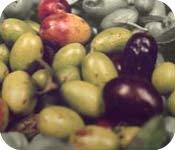
Fruit: The olive fruit is a green
drupe, becoming generally blackish-purple when fully ripe. A few
varieties are green when ripe and some turn a shade of copper brown.
The cultivars vary considerably in size, shape, oil-content and
flavor. The shapes range from almost round to oval or elongated
with pointed ends. Raw olives contain an alkaloid that makes them
bitter and unpalatable. A few varieties are sweet enough to be eaten
after sun drying. Thinning the crop will give larger fruit size.
This should be done as soon as possible after fruit set. Thin until
remaining fruit average about 2 or 3 per foot of twig. The trees
reach bearing age in about 4 years.
CULTURE
Location: Plant olive trees in
full sun and away from sidewalks to avoid stains from fallen ripe
fruit. Non-fruiting trees are available which can be planted in
areas where fruit may be a problem. Strong winds will "sculpt" the
trees, but otherwise they are quite wind-tolerant. Soils: Olives
will grow well on almost any well-drained soil up to pH 8.5 and
are tolerant of mild saline conditions.
Irrigation: Irrigation is a necessity
in California with its dry summers. A monthly deep watering of home
grown trees is normally adequate. Because of its small leaves, with
their protective cuticle and slow transpiration, the olive tree
survives even extended dry periods.
Fertilization: Fertilizing olive
trees with additional supplies of nitrogen has proved beneficial.
In California farmers systematically apply fertilizers well ahead
of the time flowers develop so the trees can absorb the nitrogen
before fruit set. Many growers in Mediterranean countries apply
organic fertilizers every other year.
Pruning: Proper pruning is important
for the olive. Pruning both regulates production and shapes the
tree for easier harvest. The trees can withstand radical pruning,
so it is relatively easy to keep them at a desired height. The problem
of alternate bearing can also be avoided with careful pruning every
year. It should be kept in mind that the olive never bears fruit
in the same place twice, and usually bears on the previous year's
growth. For a single trunk, prune suckers and any branches growing
below the point where branching is desired. For the gnarled effect
of several trunks, stake out basal suckers and lower branches at
the desired angle. Prune flowering branches in early summer to prevent
olives from forming. Olive trees can also be pruned to espaliers.
Propagation: None of the cultivated
varieties can be propagated by seed. Seed propagated trees revert
to the original small-fruited wild variety. The seedlings can, of
course, be grafted or chip budded with material from desired cultivars.
The variety of an olive tree can also be changed by bark grafting
or top working. Another method of propagation is transplanting suckers
that grow at the base of mature trees. However, these would have
to be grafted if the suckers grew from the seedling rootstock. A
commonly practiced method is propagation from cuttings. Twelve to
fourteen inch long, one to three inch wide cuttings from the two year
old wood of a mature tree is treated with a rooting hormone, planted
in a light rooting medium and kept moist. Trees grown from such
cuttings can be further grafted with wood from another cultivar.
Cutting grown trees bear fruit in about four years.
Pests and diseases: The olive tree
is affected by some pests and diseases, although it has fewer problems
than most fruit trees. Around the Mediterranean the major pests
are medfly and the olive fruit fly, Dacus oleae. In California,
verticillium wilt is a serious fungal disease. There is no effective
treatment other than avoiding planting on infested soils and removing
damaged trees and branches. A bacterial disease known as olive knot
is spread by pruning with infected tools during rainy months. Because
the olive has fewer natural enemies than other crops, and because
the oil in olives retains the odor of chemical treatments, the olive
is one of the least sprayed crops.
Harvest: Olive fruits that are
to be processed as green olives are picked while they are still
green but have reached full size. They can also be picked for processing
at any later stage up through full ripeness. Ripe olives bruise
easily and should be handled with care. Mold is also a problem for
the fruit between picking and curing. There are several classical
ways of curing olives. A common method is the lye-cure process in
which green or near-ripe olives are soaked in a series of lye solutions
for a period of time to remove the bitter principle and then transferred
to water and finally a mild saline solution. Other processing methods
include water curing, salt curing and Greek-style curing. Explicit
directions for various curing and marinating methods can be found
in several publications including Maggie Blyth Klein's book, Feast
of the Olives, and the University of California Agricultural Sciences
Publications Leaflet 21131. Both green-cured and ripe-cured olives
are popular as a relish or snack. For California canned commercial
olives, black olives are identical to green olives. The black color
is obtained by exposure to air after lye extraction and has nothing
to do with ripeness. Home production of olive oil is not recommended.
The equipment required and the sheer mass of fruit needed are beyond
most households.
Commercial Potential: Commercial
olive production is a multimillion dollar business in California.
In the Mediterranean region olives and olive oil are common ingredients
of everyday foods. Raw olives are sometimes sold in speciality produce
stores, and home growers in California often sell their excess crop
to others interested in home curing. There is also a growing interest
in specialty olive oils, often produced commercially from small
groves of olive trees.
CULTIVARS
Over the centuries mankind
has produced and propagated a myriad of olive varieties. Today several
dozen varieties are grown commercially around the world. Five commercially
important varieties are grown in California: Manzanillo, Sevillano,
Mission, Ascolano and Barouni, listed in descending order of crop
size. Some representative olive cultivars including the commercial
California varieties are listed below.
Ascolano Very large, ellipsoidal
fruit. Skin color very light even when ripe, pit very small. Fruit
is tender and must be handled carefully. Contains very little bitterness
and requires only moderate lye treatment. Excellent for pickles,
but needs proper aeration during pickling to develop "ripe" color.
Tree a heavy bearer, widely adapted.
Barouni Large fruit, almost as
large as Sevillano. Trees spreading and easy to harvest. Withstands
extremely high temperatures. The variety usually shipped to the
East Coast for making home-cured olives. Originally from Tunisia.
Gordal Medium to large, plump fruit,
ripening early. Resembles Sevillano. A popular pickling olive and
principal cultivar in Spain, producer of most of the world's table
olives.
Manzanillo Large, rounded-oval
fruit. Skin brilliant purple, changing to deep blue-black when mature.
Resists bruising. Ripens early, several weeks earlier than Mission.
The pulp parts readily with its bitterness and is exceedingly rich
when pickled. Excellent for oil and pickles. Tree spreading, vigorous,
a prolific bearer.
Mission Medium-sized, oval fruit.
Skin deep purple changing to jet-black when ripe. Flesh very bitter
but firm, freestone. Ripens rather late. Good for pickling and oil,
specially ripe pickles. Most widely used for cold-pressed olive
oil in California. Tree vigorous, heavy-bearing. More cold resistant
than other cultivars. Grown at the old missions in California.
Picholine Small, elongated fruit.
Skin light green, changing to wine red, then red-black when ripe.
Pulp fleshy, firm-textured. Tree vigorous, medium-sized, bears heavy
crops regularly. Cured olives have a delicate, subtle, lightly salty,
nut-like flavor. Usually salt-brine cured. Popular in gourmet and
specialty markets.
Rubra Medium-small, ovate fruit.
Skin jet-black when ripe. Ripens 3 to 4 weeks earlier than Mission.
Best suited for oil, but is also used for pickling. Tree large,
precocious, often producing fruit the second year. An exceptionally
prolific bearer. Very hardy and reliable even in dry situations.
Originated in France.
Sevillano Very large fruit, bluish-black
when ripe. The largest California commercial variety. Stone large,
clinging. Ripens early. Low oil content, only useful in pickling.
Used for making Sicilian style salt brine cured olives, also the
leading canning cultivar. Tree a strong grower and regular bearer.
Require deep, rich, well drained soil. Will not stand much cold. |
|
|
AVAILABLE FROM:
Alan’s Tropical Fruit Trees
Largo, FL
Pacific Tree Farms
Chula Vista, CA
Just Fruits and Exotics
Crawfordville, FL
|
|