|
Related
Species:
Babaco (Carica pentagona ), Mountain Papaya
( C. pubescens ), Chamburo ( C. stipulata ).
Adaptation:
Papayas have exacting climate requirements
for vigorous growth and fruit production. They must have warmth
throughout the year and will be damaged by light frosts. Brief exposure
to 32°F is damaging and prolonged cold without overhead sprinkling
will kill the plants. Cold, wet soil is almost always lethal. Cool
temperatures will also alter fruit flavor. Papayas make excellent
container and greenhouse specimens where soil moisture and temperature
can be moderated.
DESCRIPTION
Growth Habit: The papaya is a short-lived,
fast-growing, woody, large herb to 10 or 12 feet in height. It generally
branches only when injured. All parts contain latex. The hollow
green or deep purple trunk is straight and cylindrical with prominent
leaf scars. Its diameter may be from 2 or 3 inches to over a foot
at the base.
Foliage:The leaves emerge directly
from the upper part of the stem in a spiral on nearly horizontal
petioles 1 to 3-1/2 feet long. The blade, deeply divided into 5
to 9 main segments, varies from 1 to 2 feet in width, and has prominent
yellowish ribs and veins. The life of a leaf is 4 to 6 months.
Flowers: The five-petalled flowers
are fleshy, waxy and slightly fragrant. Some plants bear only short-stalked
female flowers, or bisexual (perfect) flowers also on short stalks,
while others may bear only male flowers, clustered on panicles 5
or 6 feet long. Some plants may have both male and female flowers.
Others at certain seasons produce short-stalked male flowers, at
other times perfect flowers. This change of sex may occur temporarily
during high temperatures in midsummer. Male or bisexual plants may
change completely to female plants after being beheaded. Certain
varieties have a propensity for producing certain types of flowers.
For example, the Solo variety has flowers of both sexes 66% of the
time, so two out of three plants will produce fruit, even if planted
singly. How pollination takes place in papayas is not known with
certainty. Wind is probably the main agent, as the pollen is light
and abundant, but thrips and moths may assist. Hand pollination
is sometimes necessary to get a proper fruit set.
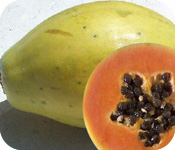
Fruit: There are two types of papayas,
Hawaiian and Mexican. The Hawaiian varieties are the papayas commonly
found in supermarkets. These pear-shaped fruit generally weigh about
1pound and have yellow skin when ripe. The flesh is bright orange
or pinkish, depending on variety, with small black seeds clustered
in the center. Hawaiian papayas are easier to harvest because the
plants seldom grow taller than 8 feet. Mexican papayas are much
larger the the Hawaiian types and may weigh up to 10 pounds and
be more than 15 inches long. The flesh may be yellow, orange or
pink. The flavor is less intense than that the Hawaiian papaya but
still is delicious and extremely enjoyable. They are slightly easier
to grow than Hawaiian papayas. A properly ripened papaya is juicy,
sweetish and somewhat like a cantaloupe in flavor, although musky
in some types. The fruit (and leaves) contain papain which helps
digestion and is used to tenderize meat. The edible seeds have a
spicy flavor somewhat reminiscent of black pepper.
CULTURE
Location: Papayas like to be warm
with both sunshine and reflected heat, so the hottest place against
the house where nothing else seems happy is an ideal location. They
also like to be as free from wind as possible, although this is
not as critical as their need for sun. Papayas can be grown successfully
in shade, but the fruit is rarely sweet. They are best planted in
mounds or against the foundation of a building where water can be
controlled.
Soils: Papayas need a light, well-drained
soil. They are easily killed by excess moisture. The soil needs
to be moist in hot weather and dry in cold weather. Since this is
the opposite of California's rain pattern, in addition to good drainage,
plastic coverings to prevent over-wetting in winter may also be
worthwhile. Papayas do not tolerate salty water or soil.
Irrigation: Watering is the most
critical aspect in raising papayas. The plants should be kept on
to the dry side to avoid root rot, but also need enough water to
support their large leaves. In winter the plant prefers to remain
as dry as possible. A plant that has been injured by frost is particularly
susceptible to root rot.
Fertilization: The fast-growing
papaya requires regular applications of nitrogen fertilizers but
the exact rates have not been established. Feed monthly and adjust
according to the plant's response. They can take fairly hot organic
fertilizing such as chicken manure if used with deep irrigation
after warm weather has started. Phosphorus deficiency casuses dark
green foliage with a reddish-purple discoloration of leaf veins
and stalks.
Pruning: Papayas do not need to
be pruned, but some growers pinch the seedlings or cut back established
plants to encourage multiple trunks.
Frost Protection: Papayas need
warmth and a frost-free environment, but can often withstand light
freezes with some kind of overhead protection. This can be provided
by building a frame around the plants and covering it with bedding,
plastic sheeting, etc. when frost threatens. Electric light bulbs
can also be used for added warmth. Potted specimens can be moved
to a frost-secure area. Prolonged cold, even if it does not freeze,
may adversely affect the plants and the fruit. Mexican papayas are
more hardy than Hawaiian varieties.
Propagation: Papayas are normally
propagated by seed. To start a plant, extract the seeds from ripe
papayas and wash them to remove the gelatinous covering. They are
then dried, dusted with a fungicide and planted as soon as possible
(the seeds loose their viability rapidly in storage). Plant the
seeds in warm (80°F), sterile potting mix. Seeds should be planted
in sterile soil as young papaya seedlings have a high mortality
rate from damping off. Potting soil can be sterilized by mixing
50-50 with vermiculite and placing in an oven at 200°F for one
hour. Under ideal conditions the seeds may germinate in about two
weeks, but may take three to five weeks. Gibberellic acid can be
used to speed up germination in some seasons. Seedlings usually
begin flowering 9 - 12 months after they germinate. Seedling papayas
do not transplant well. Plant them in large containers so the seedlings
will have to be transplanted only once, when they go into the ground.
Transplant carefully, making sure not to damage the root ball. To
prevent damping off, drench the potting mix with a fungicide containing
benomyl or captan. Set the plants a little high to allow for settling.
A plastic mulch will help keep the soil warm and dry in wet winter
areas, but remove it as soon as the weather becomes warm. Plant
at least three or four plants to insure yourself of having females
or plant hermaphroditic plants. Papaya plants can also be grown
from cuttings, which should be hardened off for a few days and then
propped up with the tip touching moist, fertile soil until roots
form. Semihardwood cuttings planted during the summer root rapidly
and should fruit the following year.
Pests and diseases: Thrips, mites
and white flies as well as red spider and fruit spotting bugs
are potential problems in some areas. The plants may also be attacked
by mildew, anthracnose, root rot and various virus diseases Fruit
flies often ruin the fruit in Florida and Hawaii. Nematodes can
attack the roots and are often a factor in the decline of individual
plant. Gopher damage can be avoided by planting in wire baskets.
Papaya plants should probably be replaced every 4 years or so.
Harvest: Papayas are ready to harvest
when most of the skin is yellow-green. After several days of ripening
at room temperature, they will be almost fully yellow and slightly
soft to the touch. Dark green fruit will not ripen properly off
the tree, even though it may turn yellow on the outside. Mature
fruit can be stored at 45°F for about 3 weeks. Papayas are often
sliced and eaten by themselves or served with a myriad of other
foods. They can also be cooked to make chutney or various desserts.
Green papayas should not be eaten raw because of the latex they
contain, although they are frequently boiled and eaten as a vegetable.
In the West Indies, young leaves are cooked and eaten like spinach.
In India, seeds are sometimes used as an adulterant in whole black
pepper.
CULTIVARS
Kamiya A selection from Waimanalo.
Solo type. Small to medium-sized fruit. Distinct, blocky shape,
very short neck. Deep yellow-orange skin and flesh, firm, juicy,
very sweet. Dwarf, high-yielding plant. Fairly recent release from
the University of Hawaii.
Mexican Red A rose-fleshed papaya
that is lighter in flavor than Mexican Yellow. Medium to very large
fruit. Generally not as sweet as Hawaiian types.
Mexican Yellow A very sweet and
flavorful, yellow-fleshed papaya. Medium to large fruit, can grow
up to 10 pounds. Generally not as sweet as Hawaiian types.
Solo Fruit round and shallowly
furrowed in female plants, pear-shaped in bisexual plants. Weight
1.1 to 2.2 pounds. Skin smooth, flesh firm, reddish-orange, very
sweet, of excellent quality. Produces no male plants, only bisexual
and female in a 2 to 1 ratio. Introduced into Hawaii from Barbados
in 1911. Named Solo in 1919.
Sunrise (Sunrise Solo) Pear-shaped
fruit with a slight neck. Averages 22 to 26 ounces depending on
location. Skin smooth, flesh firm, reddish-orange, sweet, sugar
content high. Quality similar to Solo. Seed cavity not as deeply
indented as other Solo strains, making seed removal easier. Plant
precocious, maturing fruit about 9months after transplanting, at
a height of about 3feet.
Sunset (Sunset Solo) Solo type.
Small to medium-sized, pear-shaped fruit. Orange-red skin and flesh.
Very sweet. Dwarf, high yielding plant. Originated at the University
of Hawaii.
Vista Solo Medium to large fruit
depending on climate, 5 inches wide, up to 18 inches long. Skin
yellow, flesh orange to yellow-orange. Hardy, compact Solo type
producing high quality fruit. Needs fairly hot weather to develop
sweetness. Self-fertile. Originated in Vista, Calif. by Ralph Corwin.
Waimanalo (Waimanalo Solo, X-77)
Fruit round with a short neck, average weight 16 to 39 ounces. Skin
smooth, and glossy, cavity star-shaped. Flesh thick, firm, orange-yellow
in color, flavor and quality high, keeps well. Recommended for fresh
market and processing. Fruits of female plants rough in appearance.
Average height to the first flower is 32 inches.
|
|
|
AVAILABLE FROM:
Alan’s Tropical Fruit Trees
Largo, FL
J.D. Andersen Nursery
Fallbrook, CA
California Tropical Fruit Tree Nursery
Vista, CA
Exotica Nursery Inc.
Vista, CA
Jene’s Tropicals
St Petersburg, FL
Laguna Hills Nursery
El Toro, CA
Roger & Shirley Meyer
Fountain Valley, CA
Ong Nursery
San Diego, CA
Oregon Exotics
Grants Pass, OR
Pacific Tree Farms
Chula Vista, CA
Papaya Tree Nursery
Granada Hills, CA
Ben Poirier
Fallbrook, CA
Tropical Oasis Farms
Cucamonga, CA
Pacific Tropical Gardens
Keau’au, Hawaii
|
|