|
Related
Species:
Asimina incarna, A. longifolia, A. obovata,
A. parviflora, A. pygmaea, A. reticulata, A. tetramera, A. X nashii.
These eight Asimina species grow in the southeastern United States.
Distant affinity:
Cherimoya (Annona cherimola), Soursop (Annona
muricata), Custard Apple (Annona reticulata), Sugar Apple, Sweetsop
(Annona squamosa), Atemoya (Annona squamosa X A. cherimola).
Adaptation:
The pawpaw is adapted to the humid continental
climate of its native habitat. It is seldom found near the Atlantic
or Gulf coasts. It requires a minimum of 400 hours of winter chill
and at least 160 frost-free days. Pawpaws appear to be sensitive
to low humidities, dry winds and cool maritime summers. It has been
successfully grown in parts of California and the Pacific Northwest
that meet its growing requirements. It has grown well in the San
Jose area (USDA Climate Zone 9 or Sunset Climate Zone 15). The climatic
conditions of Southern California make growing the pawpaw there
more difficult. The deep winter dormancy of the tree makes it highly
frost tolerant, withstanding temperatures of -25°F or lower (hardy
to USDA Climate Zone 5). Pawpaws can be grown as container specimens,
although this is not often practiced. A deep pot is needed to accommodate
the root system.
DESCRIPTION
Growth Habit: The pawpaw is a deciduous,
often narrowly conical tree growing from about 12 feet to around
20 feet. Pawpaw trees are prone to producing root suckers a few
feet from the trunk. When these are permitted to grow, the single-clone
pawpaw patch comes into being. The prevailing experiences of many
individuals is that the pawpaw is a slow grower, particularly when
it is young. However, under optimal greenhouse conditions, including
photo-period extension light of approximately 16 hours, top growth
of up to 5 feet can be attained in three months.
Foliage: The dark green, obovate-oblong,
drooping leaves grow up to 12 inches long, giving the pawpaw an
interesting tropical appearance. The leaves turn yellow and begin
to fall in mid-autumn and leaf out again in late spring after the
tree has bloomed.
Flowers: Dormant, velvety, dark
brown flower buds develop in the axils of the previous years' leaves.
They produce maroon, upside-down flowers up to 2 inches across.
The normal bloom period consists of about 6 weeks during March to
May depending on variety, latitude and climatic conditions. The
blossom consists of 2 whorls of 3 petals each, and the calyx has
3 sepals. Each flower contains several ovaries which explains why
a single flower can produce multiple fruits.
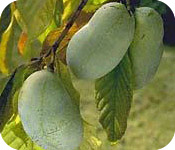
Fruit: The pawpaw is the largest
edible fruit native to America. Individual fruits weigh 5 to 16
ounces and are 3 to 6 inches in length. The larger sizes will appear
plump, similar to the mango. The fruit usually has 10 to 14 seeds
in two rows. The brownish to blackish seeds are shaped like lima
beans, with a length of 1/2 to 1-1/2 inches. Pawpaw fruits often
occur as clusters of up to nine individual fruits. The ripe fruit
is soft and thin skinned.
CULTURE
Location: The young plant is very
sensitive to full sunlight and requires filtered sun for the first
year or two. The use of tree shelters is an ideal solution to the
problem, permitting the plant to receive a full day of filtered
sunlight. Once established, pawpaws prefer full sun. The large dangling
leaves dislike strong winds. Overall the tree is an excellent edible
landscape addition.
Soil: Pawpaws do best in deep,
fertile soil that is moist, but well-drained and slightly acid (pH 5-7).
The addition of compost to most western soils makes them more hospitable
to the pawpaw. Avoid heavy, wet, alkaline soil.
Irrigation: The pawpaw needs regular
watering during the growing season. The soil should be kept moist
but avoid waterlogging.
Fertilization: The pawpaw responds
to the application of an organic or granular fertilizer high in
potassium twice a year. For container growing, 250-500 ppm of
soluble 20-20-20 NPK plus soluble trace elements during growth phase
is optimal.
Pruning: Ordinarily little pruning
is required, except to remove dead, damaged or wayward branches.
Periodic pruning may be used to stimulate some new growth each year
on older trees, since it is new growth that produces fruit the following
season.
Propagation: To break dormancy
Pawpaw seed must receive a 90 to 120 day stratification, i.e. exposure
to cold temperatures. To accomplish this, the seed should be placed
in plastic freezer zipper bag containing a handful of moist sphagnum
moss and refrigerated at 32°-40°F. The over wintering of field
planted seeds normally accomplishes this stratification requirement.
Germination of pawpaw seed is hypogeal--the shoot emerges without
any cotyledons. Under ideal greenhouse culture, germination can
be expected in about seven weeks. Seeds field-planted in the fall
will emerge the following July or August. But before the shoot emerges,
the seed will have sent down a 10 inch long tap root. Hardwood cuttings
are essentially impossible to root, while root cuttings have been
variable to disappointing. Some success has been reported using
softwood cuttings under intermittent mist with bottom heat (80°F)
and supplemental light (14 hours). All grafting and budding techniques
can be performed on the pawpaw, but T-budding is not recommended.
Chip-budding has been reported to be successful. Scion wood should
be gathered while the tree is dormant and kept refrigerated. Grafting
can be done in the spring after vegetative growth begins. Young
pawpaw plants have fleshy, brittle roots with few fine root hairs,
making them difficult to transplant. It is important to follow these
helpful rules:
- Use seedlings, not root suckers.
- Move the tree with roots and soil intact. A container grown specimen is best.
- Transplant the tree in the spring after bud break.
- Give the plant good drainage and keep it well watered the first year.
Pests and diseases: Pawpaw trees
are relatively disease free, including a resistance to Oak Root
Fungus (Armillaria). A number of vertebrates such as foxes, opossums,
squirrels and raccoons will eat the fruit, although deer, goats
and rabbits will not eat the leaves or twigs. The attraction of
pawpaw roots to gophers is a somewhat unknown factor, but it seems
likely that they would not be the gopher's first choice. The Zebra
Swallowtail butterfly's larvae feed exclusively on young, pawpaw
foliage, but never in great numbers. On the West Coast, slugs, snails
and earwigs can be easily controlled by the application of Tanglefoot
to a band around the pawpaw tree trunk. It is important not to apply
Tanglefoot directly to the bark, however.
Pollination: Poor pollination has
always plagued the pawpaw in nature, and the problem has followed
them into domestication. Pawpaw flowers are perfect, in that they
have both male and female reproduction parts, but they are not self-pollinating.
The flowers are also protogynaus, i.e., the female stigma matures
and is no longer receptive when the male pollen is shed. In addition
pawpaws are self-incompatible, requiring cross pollination from
another unrelated pawpaw tree.
Bees show no interest in pawpaw flowers. The task of pollenization
is left to unenthusiastic species of flies and beetles. A better
solution for the home gardener is to hand pollinate, using a small,
soft artist's brush to transfer pollen to the stigma. Pollen is
ripe for gathering when the ball of anthers is brownish in color,
loose and friable. Pollen grains should appear as small beige-colored
particles on the brush hairs. The stigma is receptive when the tips
of the pistils are green, glossy and sticky, and the anther ball
is firm and greenish to light yellow in color.
Harvest: Pawpaw fruit ripens during
a four-week period between mid August and into October, depending
on various factors. When ripe, it is soft and yields easily to a
gentle squeeze, and has a pronounced perfumed fragrance. The skin
of the green fruit usually lightens in color as it ripens and often
develops blackish splotches which do not affect the flavor or edibility.
The yellow flesh is custard like and highly nutritious. The best
fruit has a complex, tropical flavor unlike any other temperate
zone fruit. At present, the primary use of pawpaws is for fresh
eating out of hand. The ripe fruit is very perishable with a shelf
life of 2 or 3 days, but will keep up to 3 weeks if it is refrigerated
at 40°-45°F.
Commercial Potential: Although
pawpaw fruit is not yet a commercially viable commodity, the domestication
process is well underway. Several academic institutions are setting
up seventeen Regional Variety Trial sites. Kentucky State University
is the site of Pawpaw National Clonal Germ-plasm Repository. The
pawpaw has also found its way to several overseas countries, and
a few of these are actively engaged in research. Pawpaw leaves and
twigs contain substances with promising anti-cancer and pesitcidal
properties.
Plant selection: A number of mail-order
sources of pawpaw plants now offer both grafted cultivars and seedlings.
Most seedling plants have been propagated from mixed seeds and will
eventually end up producing undesirable fruit. Purchasers are advised
to graft such plants to a known cultivar or order grafted plants
initially. Container grown plants are much more likely to survive
transplanting.
CULTIVARS Callaway (1990) lists
over 60 pawpaw cultivars, many of which are not available in the
nursery trade. The Kentucky State list of cultivars, while not as
extensive, is more current. The following cultivars are among the
best with regard to fruit quality:
Davis Fruit small. Flesh yellow,
green skin. Seeds large. Flavor good.
Mary Foos Johnson Similar to Sunflower.
Mitchell Fruit medium. Flesh golden,
slightly yellow skin. Flavor excellent.
Overleese Fruit large. Fewer seed
but large. Flesh yellow. Flavor excellent.
Prolific Fruit large. Flesh yellow.
Flavor excellent.
Sunflower Fruit medium large. Flesh
golden, yellowish skin. Few seeds. Flavor good. Purported to be
self-fertile.
Sweet Alice Fruit medium large.
Prolific bearer. Flesh yellow. Flavor good.
Taylor Fruit small. Flesh yellow,
green skin. Flavor mild, excellent.
Taytoo Fruit medium. Flesh yellow,
light green skin. Flavor excellent. Prolific bearer.
Wells Fruit quite large. Flesh
orange, green skin. Flavor superb. |
|
|
AVAILABLE FROM:
Alan’s Tropical Fruit Trees
Largo, FL
Bay Laurel Nursery
Atascadero, CA
Burnt Ridge Nursery
Onalaska, WA
Exotica Nursery Inc.
Vista, CA
Hidden Springs Nursery
Cookeville, Tenn.
Jene’s Tropicals
St Petersburg, FL
Louisiana Nursery
Opelousas, LA
Roger & Shirley Meyer
Fountain Valley, CA
Northwoods Wholesale Nursery
Mollala, OR
One Green World
Molalla OR
Oregon Exotics
Grants Pass, OR
Pacific Tree Farms
Chula Vista, CA
Papaya Tree Nursery
Granada Hills, CA
Ben Poirier
Fallbrook, CA
Raintree Nursery
Morton, WA
Sherwood’s Greenhouses
Sibley, Louisiana
Trees of Antiquity
Paso Robles, CA
Tropical Oasis Farms
Cucamonga, CA
Just Fruits and Exotics
Crawfordville, FL
|
|