|
Related
Species:
Wonderberry (Solanum X burbanikii), Tzimbalo
(S. caripense), Lulita (S. pectinatum), Lulo comun (S. pseudolulo),
Naranjilla (S. quitoense), Garden Huckleberry (S. scabrum), Cocona
(S. sessiliflorum)
Distant affinity:
Tree Tomato, Tamarillo (Cyphomandra betacea),
Casana (Cyphomandra casana), Tomato (Lycopersicon lycopsersicum),
Mexican Husk Tomato, Tomatillo (Physalis ixocarpa), Cape Gooseberry,
Poha Berry (Physalis peruviana) and others.
Adaptation:
The pepino dulce is a fairly hardy plant that
grows at altitudes ranging from near sea level to 10,000ft. in
its native regions. However it does best in a warm, relatively frost-free
climate. The plant will survive a low temperature of 27 to 28°F
if the freeze is not prolonged, but may loose many of its leaves.
It can be grown in many parts of central and southern California,
although it does best in locations away from the coast and is not
well suited for hot, interior gardens. Pepino dulce has been grown
and has fruited in the milder areas of northern California (Sunset
Climate Zones 16 and 17). The plant is small enough to be grown
satisfactorily in a container.
DESCRIPTION
Growth Habit: Pepino dulce is a
small, unarmed, herbaceous plant or bush with a woody base and fibrous
roots. Growth is erect or ascending to about 3 feet high and several
feet across. It is similar in these respects to a small tomato vine,
and like the tomato may need staking or other support.
Foliage: The bright green leaves
are sparsely covered with very small hairs. In appearance the pepino
dulce is much like a potato plant, but the leaves may take many
forms--simple and entire, lobed, or divided into leaflets.
Flowers: The small flowers are
blue, violet-purple or white marked with purple, and are similar
in form to unopened potato flowers. The pepino dulce is deemed to
be parthenocarpic but a much heavier crop results from self-pollination
or cross-pollination. The plants will not set fruit until the night
temperatures are above 65°F.
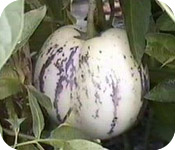
Fruit: The fruit also show considerable
diversity in size and shape. In the areas of its origin there are
small oblong types with many seeds, while others are pear or heart-shaped
with few or many seeds. Still others are round, slightly larger
than a baseball and completely seedless. The colors also vary--completely
purple, solid green or green with purple stripes, or cream colored
with or without purple stripes. The fruit of cultivars grown in
this country are usually round to egg-shaped, about 2 to 4 inches
long, with some growing up to 6 inches. The skin is typically yellow
or purplish green, often with numerous darker streaks or stripes.
The flesh is greenish to white and yellowish-orange. Better quality
fruit is moderately sweet, refreshing and juicy with a taste and
aroma similar to a combination of cantaloupe and honeydew melon.
In poor varieties there can be an unpleasant "soapy" aftertaste.
The fruit matures 30 to 80 days after pollination.
CULTURE
Location: The plant likes a sunny
or semi-shaded, frost-free location, sheltered from strong winds.
It does well planted next to a south-facing wall or in a patio.
Soil: The pepino dulce does best
in a fertile (but not too fertile), free draining, neutral soil
(pH of 6.5-7.5). It is not as tolerant of salinity as the tomato.
Mulching will help suppress weed growth.
Irrigation: The pepino dulce is
quite sensitive to moisture stress as their root systems spread
out and are quite shallow. Irrigation techniques are thus crucial
for the health of the plants as well as for pollination, fruit set
and quality of the fruit crop. Some growers feel that overhead sprinkling
may even favor increased pollination. Microjets appear to deliver
moisture better than trickle irrigation.
Fertilization: The plants should
be fertilized in a manner similar to a tomato plant, mixing in some
well-rotted manure to the plant site several weeks in advance and
supplementing with a 5-10-10 NPK granular fertilizer as needed.
Soils that are too rich produce vigorous vegetative growth which
can lead to reduced fruit set and quality, plus an increase in pest
problems.
Pruning: Pruning of the pepino
dulce is not needed unless the plant is being trained to a trellis.
In this case treat it as one would a tomato vine. Opening the the
fruits to light increases the purple striping and improves the general
appearance.
Frost Protection: In areas where
frost may be a problem, providing the plant with some overhead protection
or planting them next to a wall or a building may be sufficient
protection. Individual plants are small enough to be fairly easily
covered during cold snaps by placing plastic sheeting, etc. over
a frame around them. Plastic row covers will also provide some frost
protection for larger plantings. Potted specimens can be moved to
a frost-secure area.
Propagation: The pepino dulce can
be grown from seeds, but is usually propagated vegetatively from
cuttings. Three to five inch stem cuttings are taken leaving 4 or 5 leaves
at the upper end. Treatment with rooting hormones will help increase
uniformity in rooting and development of heavier root systems. The
cuttings are then placed in a fast-draining medium and placed under
mist or otherwise protected from excessive water loss. Bottom heat
also is helpful. With the right conditions most of the cuttings
quickly root and are ready for potting up in individual containers.
Rooted cuttings set out after the danger of frost (February to April)
should be large enough to start blooming shortly after planting.
The fruit will then have time to grow and ripen during the warm
summer months. When planted out, a spacing of about 2 to 3 ft. between
bushes is recommended.
Pests and Diseases: The plant is
affected by many of the diseases and pests that afflict tomatoes
and other solanaceous plants, including bacterial spot, anthracnose,
and blights caused by Alternaria spp. and Phytophthora spp. The
various pests include spider mite, cut worm, hornworm, leaf miner,
flea beetle, Colorado potato beetle and others. Fruit fly is a serious
pest where they are a problem. Greenhouse grown plants are particularly
prone to attack by spider mites, white flies and aphids
Harvest: Individual fruits should
not be picked until they are completely mature to assure the highest
flavor and sugar content. Different cultivars vary, but the ground
color of many mature fruits is somewhat yellow to light orange.
Ripe fruit also bruises easily and requires careful handling. Such
fruit should store well for 3 to 4 weeks at around 38°F under relatively
high humidity. Fruit destined for distant markets would need to
be picked earlier just before full ripeness. As it turns out this
happens to be a good time to pick the fruit. Studies have shown
that fruit in the middle degree of ripeness has the best performance
in cold storage. Over-ripe fruit suffers most from physiological
problems such as internal breakdown, discoloration and dehydration.
If harvested too early, insufficient ripening and development of
flavor and sweetness can result. The pepino dulce is commonly chilled
and eaten fresh much like a cantaloupe or other melon.
Commercial Potential: The pepino
dulce is a successful commercial crop in several countries such
as New Zealand and Chile, and there appears to be no reason it can't
find a niche in this country in Farmer's Market sales and elsewhere.
The fruit is strikingly attractive and its storage capability and
shelf life permit great flexibility in marketing. For good market
acceptance it is important to select cultivars with the sweetest
and most flavorful fruit. Additional breeding and selection is also
needed to further enhance these qualities.
CULTIVARS
Colossal Very large fruit, mostly
cream-colored with light markings of purple. Very juicy and sweet,
free of soapiness, of good melon-like flavor, especially when vine
ripened. Self-fertile, but yields larger fruit when cross-pollinated.
Ecuadorian Gold A market cultivar
in South America that produces good crops of pear-like fruits over
a long growing season. The fruit has an attractive color, is well-marked
and holds well on the plant. Self-fertile, but should be thinned
for better fruit size.
El Camino Released in New Zealand
in 1982 from material collected in Chile. Medium to large, egg-shaped
fruit with regular purple stripes. Sometimes produces off-flavored
fruits identifiable by their brownish-green color. One of two leading
commercial cultivars in New Zealand.
Miski Prolific Originated in San
Jose, Calif. by Nancy Garrison, as a seedling of the New Zealand
cultivar Miski. Fruit creamy white with a faint salmon glow, lightly
striped with purple. Flesh deep salmon. Flavor rich, sweet and aromatic,
with no soapiness. Seeds few or none. Matures early. Strong growing
plant, bears well without pollination.
New Yorker Introduced into California
by Vincent Rizzo of New York state from material obtained in Chile.
Medium to large, oval fruit, apex pointed. Skin smooth golden yellow
when mature, prominently striped with deep purple. Flesh firm, juicy,
yellow-orange. Flavor sweet, virtually free of soapiness. Seeds
few. Keeps for several weeks. Upright growth habit. Sets fruit well
without cross pollination.
Rio Bamba Originated in Vista,
Calif by Patrick J. Worley. Named after the city in Ecuador where
the original plant was collected. Medium-sized fruit, strongly striped
with purple. Flavor excellent. Vining growth habit, making an excellent
climber or a hanging basket plant. Dark-green leaves with reddish-purple
veins, purple stems. Flowers darker than normal, making an excellent
display.
Temptation Introduced by the Nurserymen's Association of Western
Australia. Large, high quality fruit.
Toma Introduced into New Zealand
from Chile in 1979, released there in 1983. Medium-sized, oval fruit,
4inches long, 3inches in diameter, apex pointed, shoulder well
rounded. Skin smooth, cream-colored when ripe, prominently striped
with dark purple. Flesh firm, light cream in color, very juicy.
Flavor sweet and refreshing, with ho hint of soapiness. Seeds usually
present. Keeping quality excellent. An important export cultivar
in Chile.
Vista Originated in Vista, Calif.
by Patrick J. Worley. A cross of Rio Bamba and a seedling from South
America. Medium-sized fruits have good flavor and aroma. Upright,
fairly compact plant of great vigor, self-fertile and heavy yielding.
Bright green, 3inch long leaves. |
|
|
AVAILABLE FROM:
Exotica Nursery Inc.
Vista, CA
Roger & Shirley Meyer
Fountain Valley, CA
Oregon Exotics
Grants Pass, OR
Pacific Tree Farms
Chula Vista, CA
Papaya Tree Nursery
Granada Hills, CA
|
|