|
Related
Species:
Mt. Atlas Pistache (Pistacia atlantica), Chinese
Pistache (P. chinesis), Terebinth Pistache (P. terebinthus)
Distant affinity:
Cashew (Anacardium occidentale), Mango (Mangifera
indica), Ambarella (Spondias cytherea), Yellow Mombin (Spondias
mombin), Red Mombin (Spondias purpurea), Imbu (Spondias tuberosa)
and others.
Adaptation:
Pistachios thrive in areas which have winters
cool enough to break bud dormancy and hot, long summers. They are
drought resistant and very tolerant of high summer temperatures,
but cannot tolerate excessive dampness and high humidity. The tree
has about the same cold resistance as almonds and olives but flowers
later in spring than almonds. Chill requirements are estimated at
600 to 1,500 hours. In this country the pistachio is best adapted
to the hot, drier regions of California and the Southwest, especially
California's central valley and southern California inland areas.
Pistachio trees are not particularly suitable as container plants.
DESCRIPTION
Growth Habits: The pistachio is
a broad, bushy, deciduous tree which grows slowly to a height and
spread of 25 to 30 feet, with one or several trunks. The trees are
inclined to spread and droop, and may initially need staking. Their
open habit and attractive foliage make them valuable ornamentals.
Under favorable conditions pistachio trees live and produce for
centuries.
Foliage: The large, grayish leaves
have 3 to 5 roundish, 2 to 4 inch-long leaflets.
Flowers: Pistachios are dioecious
with male and female flowers on separate trees. Male and female
trees must be present for fruit to set, or a branch from a male
tree may be grafted on a female tree. The small, brownish green
flowers are without petals and borne on axillary racemes or panicles
in early summer. Wind carries the pollen from the male to the female
flowers.
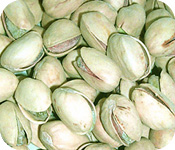
Fruit: The reddish, wrinkled fruits
are borne in heavy clusters somewhat like grapes. Although known
as a nut, the fruit of the pistachio is botanically a drupe, the
edible portion of which is the seed. The oblong kernel is about
1 inch in length and 1/2 inch in diameter and protected by a thin,
ivory-colored, bony shell. Normally the shells split longitudinally
along their sutures when mature. Under unfavorable conditions during
nut growth, the shells may not split open. The color of the kernel
varies from yellowish through shades of green, which extends throughout
the kernel. In general the deeper the shade of green, the more the
nuts are esteemed. Pistachio nuts are rich in oil, with an average
content of about 55%. The trees begin bearing in 5 to 8 years, but
full bearing is not attained until the 15th or 20th year. Pistachios
tend toward biennial bearing, producing heavy crop one year followed
by little or none the next. Production of nuts is also influenced
by drought, excessive rain, heat or cold and high winds.
CULTURE
Location: Pistachios should be planted in full sun. The
size of the slow growing trees can be further controlled by pruning.
When planting, avoid rough handling since the budded tops are easily
broken away from the understock.
Soil: The trees do best on soils
that are deep, friable and well drained but moisture retaining.
It can, however, survive in poor, stony, calcareous, highly alkaline
or slightly acid, or even saline soils. The root is deeply penetrating.
Irrigation: Pistachios will tolerate considerable drought but do
best with deep, infrequent waterings.
Fertilization: Since pistachios
grow slowly, they do not require large quantities of nitrogen fertilizer.
A spring feeding of a complete fertilizer such as 10-10-10 NPK should
be adequate.
Pruning: Pruning can be important to commercial growers
in order to shape the trees for mechanical harvesting, but less
so for the home orchardist. The trees should be trained to a modified
central leader with 4 or 5 main scaffold limbs branching about 4 ft.
from the ground. After initial training, little pruning is needed
except to remove interfering branches. Heavy pruning reduces yield.
Propagation: The pistachio is usually
propagated in California by budding or grafting selected scions
onto seedling stocks of P. atlantica, P. terebinthus and P. integerrima.
These rootstock species are used because of their vigor and resistance
to nematodes and soil borne fungi.
Pests and Diseases: A number of
fungi attack the pistachio. The most serious fungal disease in California
is Verticillium wilt, which can quickly kill trees of varying age.
Most pistachios are now grafted to Verticillium resistant P. integerrima
rootstock. The trees are also sensitive to the oak root fungus,
Armillaria mellea. Insect pests include the aphid, Anapleura lentisci
and several species of leaf-footed bugs and stink bugs. The nuts
are also very attractive to squirrels and some birds, including
bluejays and woodpeckers.
Harvest: The nuts are harvested when the husk or hull covering the
shell becomes fairly loose. A single shaking will bring down the
bulk of the matured nuts, which can be caught on a tarp or canvas.
A fully mature tree may produce as much as 50 pounds of dry, hulled
nuts. The hulls should be removed soon after to prevent staining
of the shells. To enhance splitting, the hulled nuts may then be
dipped into water to moisten the shell and spread out in the sun
to dry. One method of salting the split nuts is to boil them in
a salt solution for a few minutes, then redry and store them. Stored
in plastic bags pistachios will last for at least 4 to 6 weeks in
the refrigerator. Frozen they will last for months. The pistachio
is unique in the nut trade due to its semi-split shell which enables
the processor to roast and salt the kernel without removing the
shell, and which at the same time serves as a convenient form of
packaging. About 90% of California pistachios are consumed as in-shell
snacks. Shelled pistachios are utilized commercially in confectionery,
ice cream, candies, sausages, bakery goods and flavoring for puddings.
They can also be added to dressings, casseroles and other dishes.
Commercial Potential: Pistachio nuts are considered one of the prime
edible nuts, along with almonds, macadamias and cashews. The production
of pistachio nuts in California has increased dramatically in recent
years, from some 4-1/2 million pounds in 1977 to over 80 million
today. With additional promotion, production is estimated to ultimately
exceed 129 million pounds.
CULTIVARS Many varieties of pistachio
have been developed, because the crop has been grown for several
thousands of years. In California some 13 cultivars have been tested,
including Kerman, Ibrahmim, Owhadi, Safeed, Shasti and Wahedi (largest
nuts of any cultivar). The first nut bearing cultivars tested at
Chico, Calif. were Bronte, Buenzle, Minassian, Red Aleppo, Sfax
and Trabonella. Kerman is liked by importers and processors for
its size, crispness and snap when eaten. A sister seedling of Kerman,
Lassen, also produces good quality large-sized nuts. The standard
male cultivar is Peters. The Kerman and Peters cultivars are more
fully described below.
Kerman Female. Nut above average
in size. Shells split well, are easily opened by hand. Kernel size
above average, of high quality, readily shaken or knocked from tree
when ripe. Tree vigorous, upright-spreading. Blooms late, produces
heavily but biennially. By far the leading commercial cultivar in
the U.S. Originated in Chico, Calif. from seeds imported from Iran.
Peters Male. Good producer of pollen,
its blossoming coinciding with early blossoming cultivars, as well
as the later blooming Kerman. Has a tendency to be a loppy, weak
grower, especially when propagated on P. vera roots. Originated
in Fresno, Calif. by A. B. Peters. |
|
|
AVAILABLE FROM:
Oregon Exotics
Grants Pass, OR
Pacific Tree Farms
Chula Vista, CA
Papaya Tree Nursery
Granada Hills, CA
|
|