|
home > glossary > raisin tree > long description |
|
|
|
|
|
Distant
affinity:
Jujube (Ziziphus jujuba ), Indian Jujube (
Z. mauritiana ).
Adaptation:
The northern limits for winter survival and
fruit ripening of the tree has not been fully determined. It is
cold-hardy to about -10°F, and fruits ripen in eastern North America
at least as far north as southern New York. There is a 28-year old
specimen in the Asian section of the Los Angeles County Arboretum
and another specimen at nearby Huntington Gardens. Raisin tree plants
are not particularly suitable for container culture.
DESCRIPTION
Growth Habit: The raisin tree is
deciduous and can grow to a height of 70 feet or more, but cultivated
specimens typically reach a height of about 30 feet with a singular
trunk and a rounded head. The lower branches frequently drop off
leaving a fairly high crotch. Growth rate is moderate, perhaps a
foot or two per year, more when young and less when old. Raisin
trees are particularly handsome when planted in groups. The deeply
fissured bark is counterpointed by gently undulating branches and
overlapping leaves
Foliage: The cordate, glossy green
leaves are borne alternately. They are a large (up to six inches
in length), rather limp leaf which must be spread out to see its
shape.
Flowers: Racemes of small self-fruitful
flowers bloom in late spring. They are cream colored and compensate
for their small size by being clustered together in great masses.
Where summers are cool, bloom may be delayed even until the end
of summer with the result that fruit does not form or ripen.
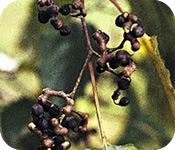
Fruit: The edible "raisins" are
not a fruit at all but a short, swollen mature flower stalk or peduncle
which supports the inedible seed pod. As the pod matures, the peduncle
of stem attaching it to the cluster swells, becomes knobby and turns
a translucent reddish brown. A pear-like flavor develops as the
sugars increase, and the peduncle is ready to eat when it falls
to the ground. Although the edible portions are small, close to
the size of a raisin, the crop is copious. The brown pod which is
actually the fruit is not used.
CULTURE
Location: Although native to partially
shaded sites, full sun helps hasten flowering and ripening. When
placed in a southwest corner, the tree provides summer shade and
allows winter sun to pass through the bare limbs.
Soil: The raisin tree tolerates
a wide range of soil conditions and thrives in sandy loam.
Irrigation: Although somewhat tolerant
of drought, raisin trees do best with a regular supply of moisture.
Fertilization: Little is known
about the fertilization needs of the tree, but a light to moderate
fertilizing in mid-spring is probably useful.
Pruning: The tree tends to prune
itself, dropping the lower branches as the tree grows.
Propagation: The seeds have an
impermeable seed coat that severely inhibits germination. Several
methods have been employed to get around the problem. The seed coat
can be scarified by nicking it with a file, or soaking the seed
in concentrated sulfuric acid for two hours. Wash the seed thoroughly
with water following the acid soak. The seed can also be soaked
in hot tap water (approximately 140°F) for three consecutive days.
Others have had some luck with freezing the seed. After treatment,
the seed are planted in potting soil, covered with clear plastic
wrap and placed in bright light. Seeds should germinate within a
week to a month or more. Plants grown from seed usually bear fruit
within 7 - 10 years, though bearing within 3 years is possible under
good conditions The plant can also be propagated by softwood cuttings
taken in late summer, and by root cuttings. Little work has been
done in the area of grafting.
Pests and diseases: Raisin trees
are apparently free of any significant pests and diseases. Deer
will probably browse the foliage, but the roots do not seem to be
attractive to gophers.
Harvest: Raisin tree peduncles
do not become tasty until very late in the season. They are excellent
to eat out of hand or may be used in anything where raisins are
normally used. The bonus with raisin tree "raisins" is that they
don't have to be dried. They are chopped and added to fruitcake
in Australia, and in China they are made into a beverage called
"tree honey" that is said to neutralize hangovers.
CULTIVARS
There are no known raisin
tree cultivars. |
|
|
AVAILABLE FROM:
Exotica Nursery Inc.
Vista, CA
Louisiana Nursery
Opelousas, LA
Roger & Shirley Meyer
Fountain Valley, CA
One Green World
Molalla OR
Oregon Exotics
Grants Pass, OR
Pacific Tree Farms
Chula Vista, CA
Sherwood’s Greenhouses
Sibley, Louisiana
Montoso Gardens
Maricao, Puerto Rico
|
|
|
|