|
Distant
affinity:
Star Apple (Chrysophyllum cainito), Abiu (Pouteria
caimito), Canistel (P. campechiana), Lucmo (P. lucuma), Sapote (P.
sapota), Green Sapote (P. viridis).
Adaptation:
Sapodillas are not strictly tropical and mature
trees can withstand temperatures of 26° to 28°F for several hours.
Young trees are more tender and can be killed by 30°F. The sapodilla
seems equally at home in humid and relatively dry environments.
Although it will grow in the milder parts of southern California,
whether it will fruit regularly remains to be seen. A tree in La
Mesa, Calif. has borne fruit. Cool California nights seem to be
a limiting factor. The slow-growing sapodilla makes a satisfactory
container or greenhouse specimen.
DESCRIPTION
Growth Habit: The sapodilla is
an attractive upright, slow-growing, long-lived evergreen tree.
Distinctly pyramidal when young, with age the tree may develops
a crown that is dense and rounded or sometimes open and somewhat
irregular in shape. It is strong and wind-resistant and rich in
a white, gummy latex. In the tropics it can grow to 100 feet, but
grafted cultivars are substantially shorter. A 40-year old tree
in La Mesa, California is only about 12 feet tall. Leaves: The leaves
are highly ornamental, 3 to 4-1/2 inches long and 1 to 1-1/2 inches
wide. They are medium green, glossy, alternate and spirally clustered
at the tip of forked twigs.
Flowers: Sapodilla flowers are
small, inconspicuous and bell-like, approximately 3/8 inch in diameter.
They are borne on slender stalks in the axil of the leaves. There
are several flushes of flowers throughout the year.
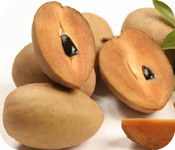
Fruit: The fruit is round to egg-shape,
2 - 4 inches in diameter. The skin is brown and scruffy when ripe.
The flesh varies from yellow to shades of brown and sometimes reddish-brown,
and may be smooth or of a granular texture. The flavor is sweet
and pleasant, ranging from a pear flavor to crunchy brown sugar.
Fruits can be seedless, but usually have from 3 to 12 hard, black,
shiny, flattened seeds about 3/4 inch long in the center of the
fruit.
CULTURE
Location: The sapodilla prefers
a sunny, warm, preferably frost free location. They are highly wind
tolerant and can take salt spray.
Soil: Sapodillas are well adapted
to many types of soil. It thrives in very poor soils but flourishes
also in deep, loose, organic soil, as well as light clay, sand or
lateritic gravel. Good drainage is essential, the tree doing poorly
in low, wet locations. It is highly drought resistant and approaches
the date palm in its tolerance of soil salinity.
Irrigation: The tree tolerates
dry conditions remarkably well. Most mature sapodilla trees receive
no watering, but irrigation in dry season will increase productivity.
Fertilization: Newly planted trees
need small and frequent feedings to become established. Fertilizers
that contain 6-8% nitrogen, 2-4% available phosphoric acid and 6-8%
potash give satisfactory results. First year applications should
be made every two to three months beginning with 1/4 pound and gradually
increasing to one pound. Thereafter, two to three applications per
year are sufficient, in amounts proportionate to the increasing
size of the tree.
Pruning: Sapodillas require very
little pruning.
Frost Protection: Although mature
sapodilla trees will take several degrees of frost, it is prudent
to provide them with overhead protection if possible and plant them
on the south side of a wall or building. Plants can also be covered
with sheeting and such when significant frost is likely.
Propagation: The sapodilla is most
commonly propagated by seed, which remain viable for many years
if kept dry. Easily germinated, they take five to eight years to
bear. Since seed may not come true, vegetative propagation is desirable.
Veneer grafting with seedlings as rootstock is the best method .
Air layering and rooting of cuttings have not been successful.
Pests and Diseases: In general
the sapodilla tree remains quite healthy with little or no care.
Insects and diseases usually don't cause sufficient damage to necessitate
control measures, although the Wooly White Fly can sometimes be
a problem. Oil sprays in winter are suggested.
Harvest: It is often difficult
to tell when a sapodilla is ready to pick. If the skin is brown
and the fruit separates from the stem easily without leaking of
the latex, it is fully mature but must be kept at room temperature
for few days to soften. It is best to wash off the sandy scruff
before putting the fruit aside to ripen. It should be eaten when
firm-soft, now mushy. Firm-ripe sapodillas may be kept for several
days in good condition in the home refrigerator. At 35°F they can
be kept for 6 weeks. Fully ripe fruits frozen at 32°F keep perfectly
for a month. The fruit is mainly consumed fresh.
Miscellaneous: Chicle, the latex
obtained from the bark of the tree has been used as a chewing gum
base for many years. Cultivars The extensive cultivation in India
has resulted in numerous cultivars in that country. Quite a few
cultivars are under test in Florida. A few of the better known ones
are listed below. Brown Sugar Originated in Homestead FL. Introduced
in 1948. Fruit medium small, 2 to 2-1/2 inches long, nearly round.
Skin light, scruffy brown. Flesh pale brown, fragrant, juicy, very
sweet and rich, texture slightly granular. Quality very good. Tree
tall, bushy. Prolific Originated in Homestead, FL. Introduced in
1951. Round-conical fruit, 2-1/2 to 3-1/2 inches long and broad.
Skin scruffy, brown, becoming nearly smooth at maturity. Flesh light
pinkish-tan, mildly fragrant, texture smooth, flavor sweet, quality
good. Tree bears early, consistently and heavily. Russel Originated
in Islamorade, FL. Introduced in 1935. Large, roundish fruit, 3
to 5 inches in diameter and length. Skin scruffy brown with gray
patches. Flesh pinkish-tan, shading to greenish-tan under the skin,
mildly fragrant, texture somewhat granular. Flavor rich and sweet.
Tree slower to bear and less productive than Prolific. Tikal A new
seedling selection with excellent flavor. Elliptic shape, light
brown in color, smaller than Prolific. Ripens very early.
CULTIVARS
The extensive cultivation
in India has resulted in numerous cultivars in that country. Quite
a few cultivars are under test in Florida. A few of the better known
ones are listed below.
Brown Sugar Originated in Homestead
FL. Introduced in 1948. Fruit medium small, 2 to 2-1/2 inches long,
nearly round. Skin light, scruffy brown. Flesh pale brown, fragrant,
juicy, very sweet and rich, texture slightly granular. Quality very
good. Tree tall, bushy.
Prolific Originated in Homestead,
FL. Introduced in 1951. Round-conical fruit, 2-1/2 to 3-1/2 inches
long and broad. Skin scruffy, brown, becoming nearly smooth at maturity.
Flesh light pinkish-tan, mildly fragrant, texture smooth, flavor
sweet, quality good. Tree bears early, consistently and heavily.
Russel Originated in Islamorade,
FL. Introduced in 1935. Large, roundish fruit, 3 to 5 inches in
diameter and length. Skin scruffy brown with gray patches. Flesh
pinkish-tan, shading to greenish-tan under the skin, mildly fragrant,
texture somewhat granular. Flavor rich and sweet. Tree slower to
bear and less productive than Prolific.
Tikal A new seedling selection
with excellent flavor. Elliptic shape, light brown in color, smaller
than Prolific. Ripens very early. |
|
|
AVAILABLE FROM:
Alan’s Tropical Fruit Trees
Largo, FL
J.D. Andersen Nursery
Fallbrook, CA
Atkins Nursery, Inc.
Fallbrook, CA
California Tropical Fruit Tree Nursery
Vista, CA
Exotica Nursery Inc.
Vista, CA
Green Mart
Orange, CA
Jene’s Tropicals
St Petersburg, FL
Laguna Hills Nursery
El Toro, CA
Roger & Shirley Meyer
Fountain Valley, CA
Ong Nursery
San Diego, CA
Pacific Tree Farms
Chula Vista, CA
Papaya Tree Nursery
Granada Hills, CA
Ben Poirier
Fallbrook, CA
Tropical Oasis Farms
Cucamonga, CA
Pacific Tropical Gardens
Keau’au, Hawaii
Montoso Gardens
Maricao, Puerto Rico
|
|