|
Related
Species:
Casana (Cyphomandra casana), Mountain Tomato
(C.crassifolia), Guava Tamarillo (C.fragrans).
Distant affinity:
Tomato (Lycopersicon lycopsersicum), Mexican
Husk Tomato, Tomatillo (Physalis ixocarpa), Cape Gooseberry (P.peruviana),
Pepino Dulce (Solanum muricatum), Naranjilla (S.quitoense), Cocona
(S.sessiliflorum).
Adaptation:
The tamarillo is a subtropical rather than
tropical and flourishes between 5,000 and 10,000ft. in its Andean
homeland. In cooler climates it succeeds at lower elevations, but
does best where the temperature remains above 50°F. The plant is
grown casually in California and occasionally in Florida. Tamarillos
have been successfully grown in such northern California locations
as San Rafael and Santa Rosa. Frost at 28°F kills small branches
and foliage of mature trees but not the largest branches and main
stem. The tree will recover if such frosts are not prolonged or
frequent. However, seedlings and cuttings are readily killed by
frost during their first year. Protection from wind is necessary
as the tree is shallow rooted and easily blown over. It is also
brittle and its branches are easily broken by gusts, especially
when laden with fruit. Tamarillos have been grown as housesplants
for years. They fruit satisfactorily in northern greenhouses.
DESCRIPTION
Growth Habit: The tamarillo is
a small, attractive, half-woody, evergreen or partially deciduous,
shrub or small tree. It is also brittle and shallow-rooted, growing
to a height of 10 to 18 ft. (rarely as much as 25 ft.).
Foliage: The alternate, evergreen
leaves are muskily odorous and more or less heart-shaped at the
base and ovate, pointed at the apex. They are 4 to 13-1/2 inches
long and 1-1/2 to 4-3/4 inches broad, thin, softly hairy, with conspicuous
veins. The leaves are fairly easily tattered by strong winds.
Flowers: The fragrant 1/2 to 3/4 inch
flowers are borne in small, loose clusters near the branch tips.
They have 5 pale pink or lavender, pointed lobes, 5 prominent yellow
stamens and green-purple calyx. Tamarillo flowers are normally self-pollinating.
If wind is completely cut off so as not to stir branches, this may
adversely affect pollination unless there are bees to transfer the
pollen. Unpollinated flowers will drop prematurely. Flowers are
usually borne in late summer or fall, but may appear at any time.
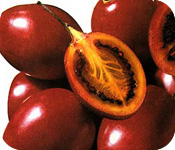
Fruit: The long-stalked, dangling
fruit, borne singly or in clusters of 3 to 12, is smooth egg-shaped
but pointed at both ends. It ranges in size from 2 to 4 inches long
and 1-1/2 to 2 inches in width. Skin color may be solid deep purple,
blood red, orange or yellow, or red and yellow, and may have faint
dark longitudinal stripes. Flesh color varies accordingly from orange-red
or orange to yellow or cream-yellow. While the skin is somewhat
tough and unpleasant in flavor, the outer layer of the flesh is
slightly firm, succulent and bland, and the pulp surrounding the
seed in two lengthwise compartments is soft, juicy, and sweet/tart.
The yellow types are usually a little sweeter. The pulp is black
in dark purple and red fruits and yellow in yellow and orange fruits.
The edible seeds are thin, nearly flat, circular, larger and harder
than those of the true tomato.
CULTURE
Location: The tamarillo is small enough and attractive
enough to fit into many parts of the home landscape as long as the
site is well-drained. They grow best in full sun except in hot,
dry situations, where partial shade is better. They need protection
from strong winds.
Soil: Tamarillos require a fertile, light soil
that is rich in organic matter. Perfect drainage is also necessary.
Water standing for even a few days may kill the plant. Because of
the shallow root system, deep cultivation is not possible, but light
cultivation to eliminate weeds is acceptable.
Irrigation: The plant
cannot tolerate prolonged drought and must have ample water during
dry periods. A mulch is very beneficial in conserving moisture at
such times.
Fertilization: Recommended fertilizer applications is
0.5 to 2 lbs. per tree of 5:6:6 NPK. Half of this should be applied
in early spring and the other half in midsummer. A late winter application
of superposphate every other year at the rate of 0.5 lb. per tree
is also beneficial.
Pruning: Newly planted tamarillos should be
pruned to a height of 3 to 4 ft. to encourage branching. Yearly
pruning thereafter is advisable to eliminate branches that have
already fruited and to induce ample new shoots close to the main
branches, since fruit is produced on new growth. Pruning also aids
in harvesting, and if timed properly can extend the total fruiting
period.
Frost Protection: Although tamarillos can tolerate a few
degrees of frost, they do best (and look their best) under frost-free
conditions. In areas where frost may be a problem, providing them
with some overhead protection or planting them next to a wall or
a building may be sufficient. The smallish plants are also fairly
easy to cover during cold snaps by placing carpeting, plastic sheeting,
etc. over a frame around them. Potted specimens can be moved to
a frost-secure area.
Propagation: Seeds and cuttings
may be used for propagation. Seeds product a high-branched, erect
tree, while cuttings develop into a shorter, bushy plant with low-lying
branches. The tree does not always come true from seed, but is most
likely to if one is careful to take seed from red fruits with black
seed pulp or yellow fruits with yellow seed pulp. Germination is
accelerated by placing washed and dried seed in a freezer for 24
hours before planting out. Cuttings should be of 1 to 2year-old
wood 3/8 to linch thick and 18 to 30 inches long. The leaves are
removed and the base cut square below a node. Cuttings can be planted
directly in the ground, but should not be permitted to fruit the
first year.
Pest and Diseases: The tamarillo
is generally regarded as pest-resistant, although they are occasionally
attacked by green aphids, and fruit flies will attack the fruit
in areas where that is a problem. Nematodes are also a potential
problem. The principal disease is powdery mildew, which may cause
serious defoliation if not controlled. The plant is noted for its
resistance to tobacco mosaic virus, though it is susceptible to
cucumber mosaic virus and potato virus. Die-back, of unknown origin,
at times is lethal to the flowers, fruit cluster, twigs and new
shoots. Potted plants grown inside should be watched for the common
house plant pests, such as mealybugs, cottony scale and white flies.
Harvest: Tamarillos are ready to harvest when they
develop the yellow or red color characteristic of the particular
variety. To harvest, simply pull the fruit from the tree with a
snapping motion, leaving the stem attached. The fruit can be stored
in the refrigerator for up to 10 weeks, but temperatures below 38°F
can cause the skin to discolor. Ripe tamarillos may be merely cut
in half lengthwise, sprinkled with sugar (and chilled if you like)
and served for eating by scooping out the flesh and pulp. The fruit
should not be cut on a wooden or other permeable surface, as the
juice will make an indelible stain. For other purposes, the skin
must be removed, which is easily done by pouring boiling water over
the fruit and letting it stand for 4minutes before peeling.
CULTIVARS
Ecuadorian Orange Fruit is medium
orange in color, the size of a large hen's egg. Pulp light orange,
creamy in texture, less acid than the Ruby Red. Excellent for eating
out of hand and also suited for culinary purposes.
Goldmine A superior cultivar originating
in New Zealand and recently introduced. Very large golden-yellow
fruit with golden, highly flavored flesh, less bland than Solid
Gold, but not acidic. Has superb earing qualities.
Inca Gold A yellow-fruited cultivar
said to be less acid than the red types. When cooked the fruit is
said to resemble the apricot in flavor.
Oratia Red A large fruited red
cultivar, oval to rounded in shape, with a sharp acid flavor. Good
quality for eating out of hand and excellent for jams and preserves.
Rothamer Unusual large fruit, over
3 ounces. Skin bright red. Flesh golden-yellow, flavor sweet and
exotic. Seeds dark red. Ripen from December to April. Delicious
eaten out of hand. Vigorous and heavy bearing plant. Originated
in San Rafael, Calif.
Ruby Red Large, brilliant red fruit.
Pulp dark red, tart and flavorful. Fair for eating out of hand,
but very good for culinary use. If allowed to ripen for one to three
weeks after picking, they will become less acid. The standard cultivar
grown for export in New Zealand.
Solid Gold Large, oval shaped fruit.
Skin golden-orange in color. Pulp soft, less acidic in flavor than
Oratia Red. Very good for eating out of hand, with acceptable culinary
qualities.
Yellow Fruits the size and shape
of a large plum. Skin yellowish orange. Flesh yellow, with a milder
flavor than the red types. The yellow form is the oldest in cultivation
in New Zealand. |
|
|
AVAILABLE FROM:
Exotica Nursery Inc.
Vista, CA
Fowler Nurseries
Newcastle, CA
Green Mart
Orange, CA
Jene’s Tropicals
St Petersburg, FL
Laguna Hills Nursery
El Toro, CA
Roger & Shirley Meyer
Fountain Valley, CA
Oregon Exotics
Grants Pass, OR
Pacific Tree Farms
Chula Vista, CA
Tropical Oasis Farms
Cucamonga, CA
|
|