|
Related
Species:
Brazilian guava, Guisaro (Psidium guinense
Sw.), Cattley Guava, Strawberry Guava (P. cattleianum Sabine), Costa
Rican Guava (P. friedrichsthalianum Ndz.), Para Guava (P. acutangulum
DC.), Rumberry, Guavaberry (Myrciaria floribunda Berg.).
Adaptation:
The tropical guava is best adapted to the
warm climate of Florida and Hawaii, although it can be grown in
coastal Southern California, and with some protection, selected
areas north to Mendocino County. Guavas actually thrive in both
humid and dry climates, but can survive only a few degrees of frost.
The tree will recover from a brief exposure to 29°F but may be
completely defoliated. Young trees are particularly sensitive to
cold spells. Older trees, killed to the ground, have sent up new
shoots which fruited 2 years later. Guavas can take considerable
neglect, withstanding temporary waterlogging and very high temperatures.
They tend to bear fruit better in areas with a definite winter or
cooler season. The adaptability of the guava makes it a serious
weed tree in some tropical areas. The smaller guava cultivars can
make an excellent container specimen.
DESCRIPTION
Growth Habit: Guavas are evergreen,
shallow-rooted shrubs or small trees to 33 ft, with spreading branches.
Growth in California is rarely over 10 - 12 feet. The bark is smooth,
mottled green or reddish brown and peels off in thin flakes to reveal
the attractive "bony" aspect of its trunk. The plant branches close
to the ground and often produces suckers from roots near the base
of the trunk. Young twigs are quadrangular and downy.
Foliage: Guava leaves leaves are
opposite, short-petioled, oval or oblong-elliptic, somewhat irregular
in outline, 2 - 6 inches long and 1 - 2 inches wide. The dull-green,
stiff but leathery leaves have pronounced veins, and are slightly
downy on the underside. Crushed leaves are aromatic.
Flowers: Faintly fragrant, the
white flowers, borne singly or in clusters in the leaf axils, are
1 inch wide, with 4 or 5 white petals. These petals are quickly
shed, leaving a prominent tuft of perhaps 250white stamens tipped
with pale-yellow anthers. Guavas are primarily self-fruitful, although
some strains seem to produce more fruit when cross-pollinated with
another variety. Guavas can bloom throughout the year in mild-winter
areas, but the heaviest bloom occurs with the onset of warm weather
in the spring. The exact time can vary from year to year depending
on weather. The chief pollinator of guavas is the honeybee.
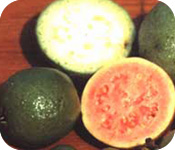
Fruits: Guava fruits may be round,
ovoid or pear-shaped, 2 - 4 inches long, and have 4 or 5 protruding
floral remnants (sepals) at the apex. Varieties differ widely in
flavor and seediness. The better varieties are soft when ripe, creamy
in texture with a rind that softens to be fully edible. The flesh
may be white, pink, yellow, or red. The sweet, musky odor is pungent
and penetrating. The seeds are numerous but small and, in good varieties,
fully edible. Actual seed counts have ranged from 112 to 535. The
quality of the fruit of guavas grown in cooler areas is often disappointing.
CULTURE
Location: Like other tender subtropicals, guavas need a
frost-free location, but are not too fussy otherwise. They prefer
full sun.
Soil: The guava will tolerate many soil conditions, but
will produce better in rich soils high in organic matter. They also
prefer a well-drained soil in the pH range of 5 to 7. The tree will
take temporary waterlogging but will not tolerate salty soils.
Irrigation:
Guavas have survived dry summers with no water in California, although
they do best with regular deep watering. The ground should be allowed
to dry to a depth of several inches before watering again. Lack
of moisture will delay bloom and cause the fruit to drop.
Pruning:
Shaping the tree and removing water shoots and suckers are usually
all that is necessary. Guavas can take heavy pruning, however, and
can be used as informal hedges or screens. Since the fruit is borne
on new growth, pruning does not interfere with next years crop.
Fertilization: Guavas are fast growers and heavy feeders, and benefit
from regular applications of fertilizer. Mature trees may require
as much as 1/2 pound actual nitrogen per year. Apply fertilizer
monthly, just prior to heavy pruning.
Frost Protection:Overhead
protection and planting on the warm side of a building or structure
will often provide suitable frost protection for guavas in cooler
areas. A frame over the plant covered with fabric will provide additional
protection during freezes, and electric lights can be included for
added warmth. Potted plants can be moved to a more protected site
if necessary.
Propagation: Guava seed remain
viable for many months. They often germinate in 2 - 3 weeks but
may take as long as 8 weeks. Since guavas cannot be depended upon
to come true from seed, vegetative propagation is widely practiced.
They are not easy to graft, but satisfactory techniques have been
worked out for patch-budding by the Forkert Method (probably the
most reliable method), side-veneer grafting, approach grafting and
marcotting The tree can also be grown from root cuttings. Pieces
of any roots except the smallest and the very large, cut into 5
- 10 inch lengths, are placed flat in a prepared bed and covered
with 2 - 4 inches of soil, which must be kept moist. They may also
be grown by air-layering or from cuttings of half-ripened wood.
Pieces 1/4 - 1/2 inch will root with bottom heat and rooting-hormone
treatment. Trees grown from cuttings or air-layering have no taproot,
however, and are apt to be blown down in the first 2 or 3 years.
One of the difficulties with budded and grafted guavas is the production
of water sprouts and suckers from the rootstocks.
Pests and diseases: Foliage diseases,
such as anthracnose, can be a problem in humid climates. They can
be controlled with regular fungicide applications. Where present,
root-rot nematodes will reduce plant vigor. Guava whitefly, guava
moth and Caribbean fruit fly can be major problems in southern Florida,
but have not been reported in California. Mealy-bugs, scale, common
white flies and thrips can be problems in California. In some tropical
countries the where fruit flies are a problem, the fruit is covered
when small with paper sacks to protect it and assure prime quality
fruits for the markets.
Harvest: In warmer regions guavas will ripen all year.
There is a distinctive change in the color and aroma of the guava
that has ripened. For the best flavor, allow fruit to ripen on the
tree. The can also be picked green-mature and allowed to ripen off
the tree at room temperature. Placing the fruit in a brown paper
bag with a banana or apple will hasten ripening. Mature green fruit
can be stored for two to five weeks at temperature between 46° and
50°F and relative humidity of 85 to 95 percent. Fruit that has
changed color cannot be stored for any extended periods. It bruises
easily and will quickly deteriorate or rot. Commercial juice varieties
have rock hard inedible seeds, deep pink flesh and hard yellow rinds.
They are not good for eating out of hand but have extremely high
vitamin C content.
Commercial Potential: Guavas are the only commercially
significant myrtaceous fruit. It is an important fruit in many parts
of the world suitable for its production. Guava is one of the leading
fruits of Mexico. Commercial producation of guava in Hawaii and
Florida is hampered by the presence of fruit flies. California is
too cool except for a few selected sites.
CULTIVARS
Beaumont Selected from a seedling
population derived from fruits found in Halemanu, Oahu, Hawaii.
Medium to large, roundish fruits weighing up to 8ounces. Flesh
pink, mildly acid, seedy. Excellent for processing. Somewhat susceptible
to fruit rots. Tree vigorous, wide spreading, very productive.
Detwiler Originated in Riverside,
Calif. in the early 1900's. Selected by H. J. Webber. Medium to
large, roundish fruit, about 3inches in diameter. Skin greenish-yellow,
moderately thick. Flesh yellowish to salmon, medium firm, relatively
sweet, of pleasant flavor. Quality very good. Tree is a very heavy
bearer.
Hong Kong Pink Selected at Poamoho
Experimental Farm, Oahu, Hawaii from seed obtained from a clone
grown in Hong Kong. Medium to large, roundish fruit fruit weighing
6 - 8ounces. Flesh is pinkish-red, very thick, smooth-textured.
Flavor subacid to sweet, very pleasant, few seeds. Tree spreading,
high yielding.
Mexican Cream Originated in Mexico.
Small to medium-small, roundish fruits. Skin light yellow, slightly
blushed with red. Flesh creamy white, thick, very sweet, fine-textured,
excellent for dessert. Seed cavity small with relatively soft seeds.
Tree upright.
Red Indian Originated in Dade County,
Fla. by Fred Lenz. Introduced in 1946. Medium-large, roundish fruit,
of strong odor. Skin yellow, often with pink blush. Flesh medium
thick, red, sweet, quality good. Ascorbic acid content averages
195mg per 100g fresh fruit, total sugars 7 - 10%. Seeds numerous
but small. Good for eating out of hand.
Ruby X Hybrid of the Florida cultivars
Ruby and Supreme. Small, roundish fruit. Skin greenish-yellow. Flesh
dark pinkish-orange. Flavor delicious, sweet, seed cavity 33% of
pulp. Tree bushy, low growing, with vigorous branches drooping outward.
Sweet White Indonesian Large, round
fruit, 4inches or more in diameter. Thin, pale yellow skin. Thick
white, melting flesh of a sweet, delicious flavor. Edible seeds
in cavity surrounded by juicy pulp. Vigorous, fast growing tree,
bears several times a year.
White Indian Originated in Florida.
Small to medium-sized, roundish fruit, 2-1/2 to 3inches in diameter.
Flesh thick, white, moderately seedy. Excellent, sprightly flavor.
Tree somewhat of a shy bearer.
White Seedless An improved selection
from Florida with seedless, white flesh of good quality. |
|
|
AVAILABLE FROM:
Alan’s Tropical Fruit Trees
Largo, FL
J.D. Andersen Nursery
Fallbrook, CA
Atkins Nursery, Inc.
Fallbrook, CA
California Tropical Fruit Tree Nursery
Vista, CA
Exotica Nursery Inc.
Vista, CA
Green Mart
Orange, CA
Jene’s Tropicals
St Petersburg, FL
Laguna Hills Nursery
El Toro, CA
Louisiana Nursery
Opelousas, LA
Roger & Shirley Meyer
Fountain Valley, CA
Ong Nursery
San Diego, CA
Oregon Exotics
Grants Pass, OR
Pacific Tree Farms
Chula Vista, CA
Papaya Tree Nursery
Granada Hills, CA
Ben Poirier
Fallbrook, CA
Sri Siam
Vista, CA
Tropical Oasis Farms
Cucamonga, CA
Pacific Tropical Gardens
Keau’au, Hawaii
Montoso Gardens
Maricao, Puerto Rico
|
|