|
Distant
affinity:
Carob (Ceratonia siliqua).
Adaptation:
The tamarind is well adapted to semiarid tropical
conditions, although it does well in many humid tropical areas of
the world with seasonally high rainfall. Young trees are very susceptible
to frost, but mature trees will withstand brief periods of 28° F
without serious injury. A tamarind tree in the Quail Botanical Gardens
in San Diego County flowers, but rarely sets fruit, possibly because
of the cool coastal climate. Dry weather is important during the
period of fruit development. The tree is too large to be grown in
a container for any length of time.
DESCRIPTION
Growth Habit: Tamarinds are slow-growing,
long-lived, evergreen trees that under optimum conditions can grow
80 feet high with a spread of 20 to 35 ft., in its native eastern
Africa and Asia. However, in Southern California it seldom reaches
more than 15 to 25 ft. in height.
Foliage: The bright green, pinnate
foliage is dense and feathery in appearance, making an attractive
shade tree with an open branch structure. The leaves are normally
evergreen but may be shed briefly in very dry areas during the hot
season. There are usually as many as 10 to 20 nearly sessile 1/2
- 1 inch, pale green leaflets per leaf. The leaflets close up at
night.
Flowers: The inconspicuous, inch-wide,
five-petalled flowers are borne in small racemes and are yellow
with orange or red streaks. The flower buds are pink due to the
outer color of the 4 sepals which are shed when the flower opens.
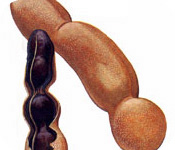
Fruit: The 3 - 8 inch long, brown,
irregularly curved pods are borne in abundance along the new branches.
As the pods mature, they fill out somewhat and the juicy, acidulous
pulp turns brown or reddish-brown. When fully ripe, the shells are
brittle and easily broken. The pulp dehydrates to a sticky paste
enclosed by a few coarse stands of fiber. The pods may contain from
1 to 12 large, flat, glossy brown, obovate seeds embedded in the
brown, edible pulp. The pulp has a pleasing sweet/sour flavor and
is high in both acid and sugar. It is also rich in vitamin B and
high in calcium. There are wide differences in fruit size and flavor
in seedling trees. Indian types have longer pods with 6 - 12 seeds,
while the West Indian types have shorter pods containing only 3
- 6 seeds. Most tamarinds in the Americas are of the shorter type.
CULTURE
Location: The tamarind ultimately becomes a fairly large
tree, so this should be kept in mind when planting out the tree.
It should be planted in full sun and is highly wind-resistant with
strong, supple branches. The tree generally forms a beautiful spreading
crown that casts a light shade. Soils Tamarinds tolerate a great
diversity of soil types but do best in deep, well drained soils
which are slightly acid. Trees will not tolerate cold, wet soils
but are tolerant of salt spray and can be planted fairly near the
seashore.
Irrigation: The tamarind is adapted to semiarid regions
of the tropics and can withstand drought conditions quite well.
Young trees require adequate soil moisture until they become established,
but mature trees do quite well without supplemental irrigation.
Avoid over-watering which results in soggy soils.
Fertilization:
The tamarind is not very demanding in its nutritional requirements.
Young trees should be fertilized every 2 - 3 months with a 6-6-3
NPK or similar analysis fertilizer. Apply 1/4 lb. and gradually
increase to about 1/2 lb. Thereafter, young trees should receive
1/2 lb. per application, per year of tree age, 3 - 4 times a year.
Bearing trees can be fertilized with 8-3-9 NPK or similar analysis,
at rates of about 1/2 lb. per application per year of tree age.
Microelements, particularly iron may be required for trees in alkaline
soils.
Pruning: Young trees are pruned to allow three to five well
spaced branches to develop into the main scaffold structure of the
tree. Maintenance pruning only is required after that to remove
dead or damaged wood.
Propagation: Rootstocks are propagated
from seed, which germinate within a week. Seeds retain their viability
for several months if kept dry. Plant seeds 1/2 inch deep in containers
filled with a UC soilless type potting media. They should be selected
from trees of good production and quality. Even so, seedlings will
be variable in quality and slow to bear. Veneer grafting, shield
(T or inverted T) budding and air layering may be used to propagate
desirable selections. Such trees will usually fruit within 3 - 4
years if provided optimum growing conditions. Seedlings should begin
to produce fruit in 6 - 8 years, while vegetatively propagated trees
will normally bear in half that time. Young trees should be planted
in holes larger than necessary to accommodate the root system. They
should be planted slightly higher than existing ground level to
allow for subsequent settling of the soil and a water basin should
be built around each tree to assure adequate moisture for young
trees. Spacing of trees is normally 20 to 25 ft. in commercial orchards.
However, solitary trees planted in Southern California rarely exceed
15 feet in diameter.
Pests and Diseases: In California
tamarinds are generally free of pests and diseases, although ants
will sometimes spread black and olive scales. In India there are
are a host of pests that attack the tree, including mealybugs, caterpillars,
aphids, white flies, thrips and a variety of scales. Various weevils
and borers can also infest the ripening pods or stored fruits.
Harvest:
Tamarind fruits mature in late spring to early summer. They may
be left on the tree for as long as 6 months after maturity so that
the moisture content will be reduced to 20% or lower. Fruits for
immediate processing are often harvested by pulling the pod away
from the stalk. Mature trees are capable of producing 350 lb. of
fruit a year. Ripe fruit in humid climates is readily attacked by
beetles and fungi, so mature fruit should be harvested and stored
under refrigeration. Tamarinds may be eaten fresh, but they area
most commonly used with sugar and water in the American tropics
to prepare a cooling drink. The pulp is used to flavor preserves
and chutney, to make meat sauces ant to pickle fish. Candy can be
made by mixing the pulp with dry sugar and molding it into desired
shapes.
CULTIVARS
There are selected cultivars
which have sweeter pulp. One in Thailand is Makham Waan and the
USDA's subtropical horticulture research unit in Miami, Florida
has one called Manila Sweet. None are presently available in Southern
California. |
|
|
AVAILABLE FROM:
Alan’s Tropical Fruit Trees
Largo, FL
J.D. Andersen Nursery
Fallbrook, CA
California Tropical Fruit Tree Nursery
Vista, CA
Exotica Nursery Inc.
Vista, CA
Green Mart
Orange, CA
Jene’s Tropicals
St Petersburg, FL
Oregon Exotics
Grants Pass, OR
Pacific Tree Farms
Chula Vista, CA
Tropical Oasis Farms
Cucamonga, CA
Montoso Gardens
Maricao, Puerto Rico
|
|