|
Related
Species:
Woolly-leaf Sapote, Yellow Sapote (C. tetrameria
Millsp.). Matasano, (C. Sapote Oerst.), C. pringlei.
Distant affinity:
Citrus, Bael Fruit (Aegle marmelos Correa),
Wampi (Clausena lansium Skeels), Wood-apple (Feronia limonia Swingle)
Adaptation:
The white sapote is successful wherever oranges
can be grown. In California mature trees are found from Chico, southward.
It does poorly in areas with high summer heat such as the deserts
of the Southwest, and in the high humidity of the tropical lowlands
of Hawaii and Florida. Otherwise, it can take a lot of abuse, but
is brittle in wind. Established trees withstand occasional frost
to 22°F., although young trees can be damaged at 30°F. The tree
does best where the mean temperature from April to October is about
68°F. White sapotes are also tolerant of cold wet roots and north
sides of buildings. Wooly-leaf sapotes are somewhat less hardy than
the common white sapote. Only grafted trees are suitable for containers;
seedlings get large fast.
DESCRIPTION
Growth Habit: The white sapote
forms a medium to very large evergreen tree, 15 to 50 feet, according
to cultivar and soil. It is deciduous under drought and other stress.
The tree casts a dense shade. Growth is rapid, in flushes. It is
densely branching, drooping at maturity. Young trees tend toward
a single, limber stem for first 2 years often requiring staking.
White sapotes have a taproot and other fibrous roots that are wandering
and greedy like citrus.
Foliage: The white sapote has glossy,
bright green, palmately compound, hand-shaped leaves with 5 - 6
inch leaflets on a long petiole. New growth is usually reddish,
becoming dark green with age, pale green beneath. Stress such as
either prolonged cold or abnormal heat, will cause defoliation and
a subsequent new growth flush. Leaves will burn in hot winds, which
may also scar the fruit or cause it to drop.
Flowers: The odorless flowers,
small and greenish-yellow, are 4- or 5-parted, and born in terminal
and axillary panicles. They are hermaphrodite and occasionally unisexual
because of aborted stigmas. They follow growth flush and often rebloom
again several months later. The flowers are attractive to bees,
hoverflies and ants. The pollination tendencies or requirements
of various cultivars have not yet been fully determined.
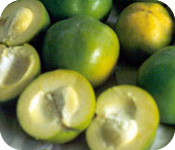
Fruit: White sapote fruit ripens
six to nine months from bloom. Some cultivars are alternate bearing.
Fruit size varies from 1 inch to 6 inches for some of the newer
cultivars. Fruit color ranges from apple-green to orange-yellow
at maturity, according to cultivar. The fruit shape is round, oval
or ovoid, symmetrical or irregular. The skin is very thin and smooth,
with a waxy bloom, and is sometimes bitter. Green-skinned varieties
have white flesh; yellow skinned varieties have yellow flesh. The
flesh has a custard-like texture and a sweet delicious flavor reminiscent
of peach or banana, although sometimes with a hint of bitterness.
The fruit becomes pungent and unpleasant if overripe. In California
the flesh of the wooly-leaf sapote is often bitter and unpleasant.
The fruit contains 5 - 7 short-lived seeds thaat resemble a greatly
enlarged orange seed. They range in size from 1 - 2 inches in length.
The fruits also usually contain several aborted, thin, papery seeds.
White sapotes bear within 10 years from seed, or 2 - 8 years from
graft.
CULTURE
Location: Before planting, consider
the mess made by unpicked fruit. Planting over a patio can be a
big mistake. The ultimate size of the the tree should also be kept
in mind. They prefer full sun. Soils: White sapotes prefer a well-drained
soil with a pH between 5.5 and 7.5, but the tree will grow in almost
any soil as long as it is well-drained.
Irrigation: White sapote trees
are drought tolerant but produce better fruit with regular, deep
watering. Deep watering is also necessary to keep greedy roots deep
in the ground. Shallow watering can encourage surface roots that
will break pavement or ruin lawns. Drip irrigation is suitable for
young trees. They will tolerate some salts, but gradually decline.
White sapotes are often most productive following wet winters.
Fertilization: Fertilizer formulas
should vary with the nature of the soil, but, in general, the grower
is advised to follow procedures suitable for citrus trees. Many
white sapote trees have received little or no care and yet have
been long-lived.
Pruning: Young trees tend to grow
vertically without much branching. After planting, remove the flowers
and pinch out the terminal bud to encourage branching. Since branches
are brittle in wind, and will often break at crotches that are either
too narrow or horizontal, it is important to prune to eliminate
such weak joints. Too much pruning or heading-back, however, may
encourage weak growth.
Propagation: Seedlings generally
produce inferior fruit, but there is always a chance of producing
a worthwhile new cultivar. Use fresh seed, washed and cleaned of
flesh. Budding is done in the spring, if possible, on year-old seedlings.
Trees are usually grafted., using stocks grown in place for three
years. Scions should be girdled 1 to 2 months, then stored until
the first sign of new stock growth in spring. Cleft, splice, or
approach grafts are all successful. Seedling trees usually begin
to bear in 7 - 8 years; grafted trees will start bearing in 3 or
4 years.
Pests and diseases: The white sapote
has few natural enemies but the fruits of some cultivars are attacked
by fruit flies where that is a problem. Black scale often occurs
on nursery stock and occasionally on mature trees in California.
Mealybugs are sometimes found around fruit stems, and aphids can
infest new growth. The trees also attract fruit-eating animals,
including parrots. White sapotes are resistant to both Phytophthora
and Armillaria. Snails can defoliate young trees and damage fruit.
Control by keeping weeds away and applying bait.
Harvest: White sapote fruit ripens
in October (south) to February (north). A few cultivars will have
fruit year-round, but the fruit from later blooms generally ripens
poorly and is of poorer quality. Large trees commonly produce a
ton of fruit per year. The fruits taste best when tree ripened,
but tend to fall first. The fruits must be handled with care even
when unripe as they bruise so easily and any bruised skin will blacken
and the flesh beneath turns bitter. Mature fruits should be clipped
from the branches leaving a short piece of the stem attached. This
stub will fall off when the fruits become eating-ripe. Some cultivars
will ripen to good flavor when picked hard and kept in a controlled
atmosphere, while others become bitter and inedible. Fruits that
have ripened on hand will keep in good conditions in the home refrigerator
for at least 2 weeks. The fruit is said to be soporific and have
an effect upon the central nervous system, hence the name Matasano,
but it is pleasing and wholesome. It is very high in carbohydrates
and low in acids. A 1922 analysis of flesh by the University of
California found: 72.64% water, 0.44% ash, 0.64% protein, 20.64%
total sugars (8.44% invert, 12.20% sucrose), 0.46% fat, 1.26% fiber,and
3.92% starches, etc. At 30 mg per 100 g of fresh pulp, the fruit
is a moderately good source of vitamin C.
Commercial Potential: The white
sapote is an old California fruit and is liked by most people who
taste it. Its best markets are local stands and luxury or health
food stores. Chain stores require a steady source of round, non-bitter
fruit, packed in a single layer. Seasonal production can be avoided
by selecting cultivars that give year-round harvest. The fruit must
be picked hard mature with minimal handling.
CULTIVARS
Chestnut Origin Vista, Calif. Wesley
C. Chestnut, 1935. Seedling of Suebelle. Tree large, heavy production,
fruit has withstood shipping to eastern states. Spherical, yellow-green
when ripe, taste good, skin bitter. Alternate bearing.
Cuccio Origin Fallbrook, Calif.
Cuccio, 1973. Probable syn. Florida. Very quick to come into bearing.
Green when ripe, taste excellent, keeps long and well on tree. Fruit
sunburns if tree defoliates.
Ecke Origin Encinitas, Calif.,
Paul Ecke, Sr., 1963. Single fruits,uniform in size and shape, Skin
becomes bright yellow several months before maturity.
Fiesta Origin Yorba Linda, Calif.,
Ray Vincent, 1973. Reliable,productive but very late cropper of
rather small (1-2 inch) fruit. Pale yellow, thick skin, endures
handling.
Lemon Gold Origin Escondido, Calif.,
Martin Reinecke, 1958. A less vigorous tree, moderate crops, usually
in November. Keeps well when ripe, can be picked immature and ripens
well off the tree. Uniform, pleasing appearance; flesh quite yellow.
Flavor excellent, occasional hints of lemon.
Louise Origin Chula Vista, Calif.,
Bill Nelson, 1973. Nearly everbearing, Jan. - Sept., productive.
Fruit yellow, medium size. Suggested for home gardens, not commercial.
Malibu No. 3 Origin Malibu, Calif.,
Washington MacIntyre, 1981. Fruit spherical, yellow, ripens Oct
- Nov. Pick when soft. Tree is long coming into bearing. Most promising
new cv.
Maltby Origin Carlsbad, Calif.,
Guy Maltby, 1928. syn. Nancy Maltby. Frequently found in Florida,
obsolete in California. Tree large. Fruit to one pound, irregular
in shape, pointed, flesh yellow, flavor varies by season, can be
good. Productive.
McDill Origin Orange, Calif., McDill,
1968. Precocious, excellent taste, among the largest. Shape oblate,
large, greenish-yellow. Bears early autumn. Tree large, grafts easy.
Michele Origin Pasadena, Calif.,
Michele Montllor, 1940. Tree small, nearly everbearing. Fruit smallish,
yellow, with distinct taste of caramel. For home culture.
Pike Origin Santa Barbara, Calif.,
intro. USDA, 1928. Tree med. size, heavy cropper, mid-season, Large
green fruits. One of three most popular cultivars of the mid-century,
is still found commercially. Taste fairly good, skin bitter.
Reinecke Commercial Origin San
Diego, Calif., John M. Reinecke. Fruit irregular in shape, weighing
about 5 ounces. Skin attractive golden-orange when ripe. Flavor
good, seeds moderate in number. Has excellent keeping qualities,
and even if picked prematurely will soften and become fairly good
eating. Tree is a relatively poor yielder.
Stickley Origin La Mesa, Calif.,
Stickley 1967. Seedling of Vernon,less alternate in bearing. Broad
vigorous tree. Fruit yellow-green, quite sweet, uniformly large.
Ripens very early, sweet even if harvested immature. Keeps well
when soft.
Suebelle Origin Encinitas, Calif.,
Susan Hubbell, 1931. Syn. Hubbell. The best known cv of sapote,
still not surpassed in performance by others; common in nurseries.
A distinct cv., Neysa was commonly sold as Suebelle from 1955-65.
True Suebelle fruit is variable in size, usually small, yellow,
asymmetrical, sweet. Pick when soft. Bears nearly year-round. Tree
medium, for home culture.
Vernon Origin Vista, Calif., Wells
Miller, 1953. A mature tree found by him and may prove to be another,
older cv. Tree large, rounded, vigorous but medium height. Fruit
green, round oblate; flesh white, not becoming bitter when over-ripe.
Alternate bearing, over the winter months. Performs well in northern
California. Difficult to graft.
Wilson Origin Monrovia, Calif.,
W. C. Wilson, 1927. Introduced then by Armstrong Nurseries and still
found in collections. Tree productive, fruit flattened, flavor good,
poor keeper.
Mac's Golden Origin Carlsbad, Calif.,
Charles Ramsey, 1932 A wooly-leaf sapote (C. tetrameria). Fruit
large, yellow with deeper-colored flesh. The best, and least yellow,
of the matasanos, preferred by some, with characteristic aroma.
Elongated oval, few seeds. |
|
|
AVAILABLE FROM:
Alan’s Tropical Fruit Trees
Largo, FL
J.D. Andersen Nursery
Fallbrook, CA
Atkins Nursery, Inc.
Fallbrook, CA
Exotica Nursery Inc.
Vista, CA
Green Mart
Orange, CA
Jene’s Tropicals
St Petersburg, FL
Laguna Hills Nursery
El Toro, CA
Roger & Shirley Meyer
Fountain Valley, CA
Oregon Exotics
Grants Pass, OR
Pacific Tree Farms
Chula Vista, CA
Papaya Tree Nursery
Granada Hills, CA
Ben Poirier
Fallbrook, CA
Tropical Oasis Farms
Cucamonga, CA
Montoso Gardens
Maricao, Puerto Rico
|
|