|
Related
Species:
Hardy Kiwi (Actinidia arguta, A. kolomikta),
Chinese Egg Gooseberry (A. coriacea), Red Kiwi (A. melanandra),
Silver Vine (A. polygama), Purple Kiwi (A. purpurea).
Adaptation:
The plants need a long growing season (at
least 240 frost-free days) which will not be hampered by late winter
or early autumn freezes. When fully dormant they can withstand temperatures
to about 10°F (and perhaps a bit lower.) However they must acclimate
to cold slowly and any sudden plunge in temperature may cause trunk
splitting and subsequent damage to the vine. Late winter freezing
temperatures will kill any exposed buds which limits the adaptable
growing areas of kiwifruit. In California the kiwifruit is an appropriate
crop wherever citrus fruits, peaches and almonds are successful.
All cultivarsneed a certain period of winter chilling and their
needs vary dramatically, dependent upon cultivar. The most popular
cultivar, Hayward, does best with a winter rest of 800hours of
chilling (defined as total hours between 32° and 45°F.) For warm
winter areas with low chill hours (such as southern California,
southern Texas, and Florida), cultivars such as Elmwood, Dexter,
Abbott, or Vincent would be more suitable. In very mild winter areas
the vines may retain their leaves and fail to flower the following
season. Kiwi vines can be successfully grown in large containers.
DESCRIPTION
Growth Habit: In the forests where
it is native, the plant is a vigorous, woody, twining vine (liana)
or climbing shrub. It is not unusual for a healthy vine to cover
an area 10 to 15 feet wide, 18 to 24 feet long and 9 to 12 feet
high. In cultivation it is supported on a trellising system.
Foliage:The large, deep green,
leathery leaves are oval to nearly circular and 7 to 10 inches in
diameter. Young leaves and shoots are coated with red hairs, while
mature leaves are dark green and hairless on the upper surface,
downy-white with prominent, light colored veins beneath.
Flowers: The large (1 to 2 inch
diameter), white to cream colored flowers are somewhat fragrant
and produced as singlets to triplets in the leaf axiles. The flowering
period extends over several weeks from early May to June, depending
on climatic conditions. The plants are dioecious, bearing either
male or female flowers, thus needing plants of both sexes to produce
fruit. Self-fruiting males are known to exist but produce less desirable
fruit.
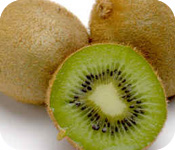
Fruit: The oval, ovoid or oblong
fruit is up to 2-1/2 inches long, with russet-brown skin densely
covered with short, stiff brown hairs. The flesh, firm until fully
ripe, is glistening, bright green or sometimes yellow, brownish
or off-white, except for the white, succulent center from which
radiate many fine, pale lines. Between these lines are scattered
minute dark-purple or nearly black seeds, unnoticeable in eating.
The flavor is sweet/tart to acid, somewhat like that of the gooseberry
with a suggestion of strawberry.
CULTURE
Location: Kiwifruit will tolerate
part shade but prefer a sunny location where they can ramble across
some type of trellising system. The vines should be protected from
strong winds. Spring gusts can snap off new growth where it emerges
from the canes. Kiwifruit is not recommended for the hot dessert
climates of the Southwest.
Site Preparation: Kiwifruit plants
need a substantial trellis, patio cover, or other permanent place
to grow upon. For the trellis system, either a single wire or T-bar
system can be installed. Both have a 4 inch by 4 inch redwood post
of 8 feet. For the T-bar, a 2 inch by 6 inch crossarm about 4feet
long is bolted in place. Bury the post 2 feet into the ground and
cement in if at all possible. At each end of the system, a cemented
deadman should be in place. Run wires across the posts and anchor
tautly to the deadman. When using a patio cover, no extra trellising
needs to be in place. Simply run the plant up a corner post to the
top and allow the plant to then form a spoke work of shoots which
would resemble an umbrella.
Soils: Kiwifruit prefer somewhat
acid (pH 5-6.5), well-drained soils that are rich in organic matter.
The leaves may show nitrogen deficiency if the soil is too basic.
The plants do not tolerate salty soils.
Irrigation: Kiwifruit plants need large volumes of
water during the entire growing season but must also be in well-drained
soils. Watering regularly in the heat of the summer is a must. Never
allow a plant to undergo drought stress. Symptoms of drought stress
are drooping leaves, browning of the leaves around the edges, and
complete defoliation with regrowth of new shoots when the stress
is continuous. More plants probably die from water related problems
than any other reason.
Fertilization: Plants are heavy nitrogen
feeders which should be applied in abundance during the first half
of the growing season. Late season applications of nitrogen will
enhance fruit size but are discouraged as the fruit then tends to
store poorly. In basic soils, a citrus and avocado tree fertilizer
should be broadcast about the vine and watered in well in early
March. Follow up the initial fertilizing by supplemental additions
to early summer. In other areas, use a high nitrogen fertilizer
which contains trace elements unless it is known that the particular
soil is deficient in another nutrient. Mulching with manures and/or
straws is very beneficial. However, do not put the mulch directly
in contact with the vine as crown rot will occur.
Pruning: For best
fruit production, pruning in the winter is a must. All pruning techniques
are usually based on a "cane replacement" and differ only based
on the trellising method used. Kiwi vines need to be supported and
this is usually done in one of three ways: single wire, 3-5 wire
on a T-bar system, or onto a patio cover. In all cases, one stem
is trained up to a wire at six feet and then allowed to grow along
the wire. When growth ends in a "pig-tailing" of the shoot, it is
cut behind the entanglement and new a shoot allowed to grow from
a leaf base. After two years multiple shoots will now emerge from
the lateral mainline. During the growing season, each lateral cane
will send out a new shoot about 1/3 of the way from its own starting
point. The next winter, prune off the older cane at the point that
it connects with last summers new shoot. Repeat this every year.
Propagation: Seeds from store bought
fruit may be planted in the spring. This should be done in a fine,
somewhat sandy planter mix which is kept moist but not soaking wet.
Seed germinates in 4 to 5 weeks. Plants raised this way will need
to be grafted the following season to produce better, known sex,
plants. Nursery bought plants are usually either grafted or cutting
grown. Both types have their own attributes. One slight advantage
of the cutting grown plants would be advantageous to growers in
areas that experience winter freeze problems. If a plant is killed
to the ground, a cutting grown plant that survives will regrow from
the roots and thus maintain its known characteristics. Otherwise,
either type is acceptable to backyard growers.
Pests and diseases: Kiwifruit plants
are relatively free from problems, possibly due to their lack of
heavy planting into areas so that pests begin to take a liking to
the leaves, trunk, or roots. One odd problem is the fact that the
trunks have a catnip-like aroma which cats love to rub against.
When plants are small, this can be a problem as they can rub off
any new shoots which emerge in the spring. Garden snails can also
be a problem on younger plantings. Other pests include deer browsing
on the leaves and gophers attacking the roots. Scale insects can
also be a problem if populations build up too extensively. Where
present, root-rot nematodes will reduce plant vigor.
Harvest: Ripening depends both on cultivar grown and
local climatic conditions. Commercially, the fruit is harvested
mature-ripe when its soluble sugars reach 6.5 brix on a refractometer.
For the home grower it is best to wait for harvest until at least
November1, but November 15 would be preferable. Seed inside should
be fully black by this time. If available, a specifically designed
fruit ripening bowl can be used to quickly ripen a few fruit to
see if the rest of the crop is ready to be picked. Once harvested,
place the hard fruit into plastic bags and put into the refrigerator
for keeping. When needed, the fruit can be taken out of the refrigerator
and ripened on the counter for a few days in a plastic bag. Well
stored fruit can last for several months. The long keeping qualities
of the fruit made world wide shipment possible and heavy planting
of the Hayward variety brought the fruit into recognition.
CULTIVARS
Females By far, the best cultivar
is the New Zealand Hayward. It is the standard grown by the world.
However, it does require extensive winter chilling which may not
be available to the plant in your area. For areas which test the
cold limits of the plant, the Saanicheon (developed in British Columbia,
Canada) is said to survive where Hayward has failed. For low winter
chilling areas, the opposite problem is encountered. Tested cultivars
that have proven to fruit well include Elmwood, Dexter, Abbott,
Tewi, and Vincent, among others. For areas with the potential for
early autumn freezes, perhaps the Blake, which can ripen up to 6 weeks
ahead of the Hayward, would prove to be valuable. Other named New
Zealand cultivars include Allison, Bruno, Gracie, and Monty. A closely
related species to the deliciosa, called Actinidia chinensis, has
recently become available from China. They are virtually fuzz-free
and some cultivars are pure yellow inside instead of the normal
emerald green. Work to date show these to be quite fruitful in the
low winter chill areas and are becoming a promising alternative.
Maintenance and care would be the same for both species.
Males Two basic New Zealand males
are used. The Matua (father in the Maori language of New Zealand)
is the most common in commercial orchards. It is a mid-season cultivar
which begins a bit before the Hayward flowers and extends for several
weeks. The other cultivar, Tomuri (late blooming in Maori), extends
the male pollen season. In California, one might encounter the Chico
male which is quite acceptable. Other males which may be encountered
are the M-Series from New Zealand and the CC Early Male. Specific
growing sites might encourage one to plant a specific male due to
the blossom timing of the females. Specific males are available
for the chinensis species but males from either species will pollinize
each other as long as their bloom periods coincide. |
|
|
AVAILABLE FROM:
Alan’s Tropical Fruit Trees
Largo, FL
Bay Laurel Nursery
Atascadero, CA
Burnt Ridge Nursery
Onalaska, WA
California Tropical Fruit Tree Nursery
Vista, CA
Exotica Nursery Inc.
Vista, CA
Green Mart
Orange, CA
Hidden Springs Nursery
Cookeville, Tenn.
Jene’s Tropicals
St Petersburg, FL
Laguna Hills Nursery
El Toro, CA
Louisiana Nursery
Opelousas, LA
Roger & Shirley Meyer
Fountain Valley, CA
Northwoods Wholesale Nursery
Mollala, OR
One Green World
Molalla OR
Oregon Exotics
Grants Pass, OR
Pacific Tree Farms
Chula Vista, CA
Raintree Nursery
Morton, WA
Tropical Oasis Farms
Cucamonga, CA
Just Fruits and Exotics
Crawfordville, FL
|
|